

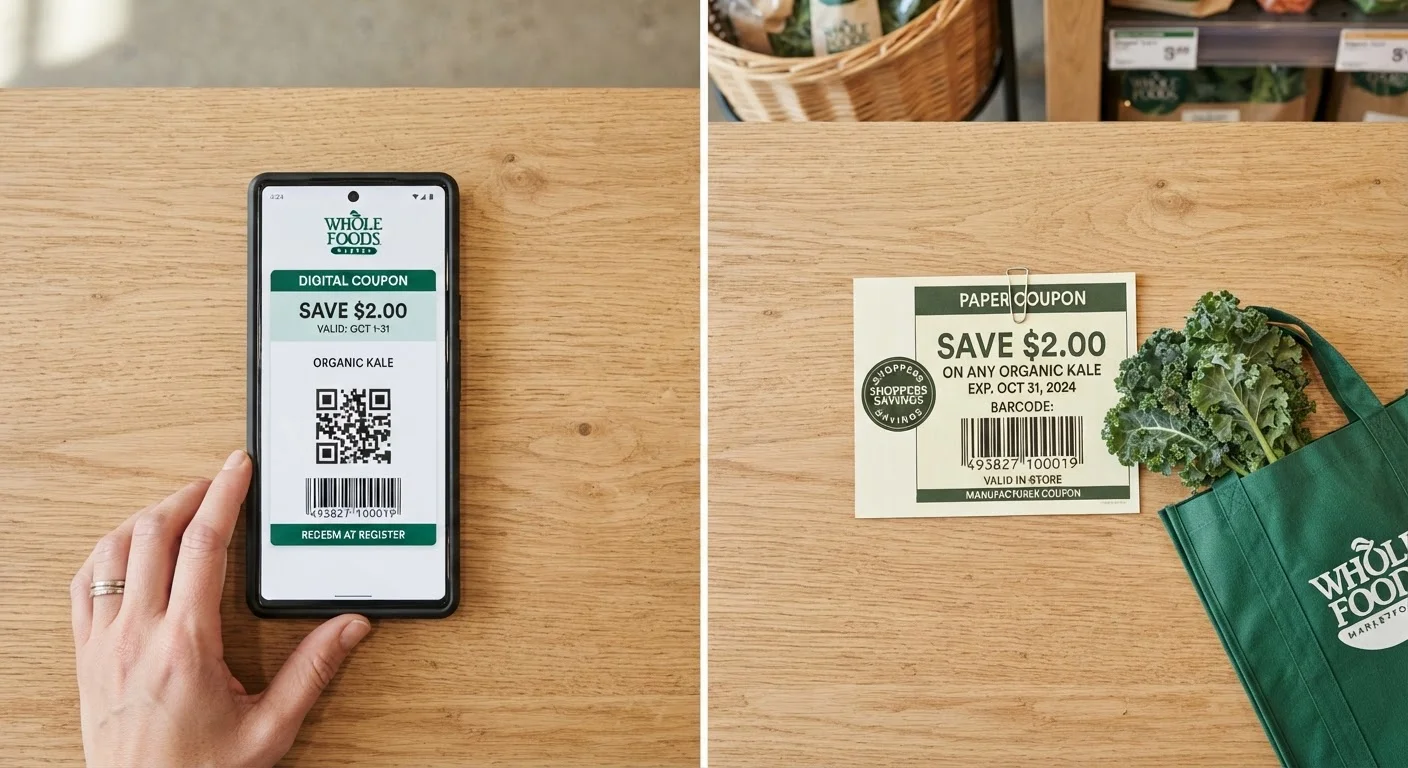
Key Takeaways
- Digital coupons are faster to access and redeem but may offer lower face values than paper equivalents.
- Paper coupons can sometimes be stacked with store sales for larger savings, depending on retailer policy.
- Neither format is universally superior - the best choice depends on your shopping habits and store policies.
- Many retailers now offer both formats simultaneously, so using them together is often the strongest strategy.
- Always check expiration dates and per-item limits regardless of which coupon format you use.
Option A
Digital Coupons
The convenient, clip-free modern approach.
Best for: Shoppers who prefer managing savings through apps and store loyalty accounts without handling physical materials.
Option B
Paper Coupons
The traditional, tangible savings method.
Best for: Shoppers who want to stack high-value manufacturer offers and don't mind doing a bit of prep work before shopping.
If you want the fastest, lowest-effort savings at checkout
Digital Coupons
Clipping to a loyalty account takes seconds, and redemption is automatic at the register - no paper to track or forget at home.
If you're hunting for the deepest possible discount on a specific item
Paper Coupons
Manufacturer paper coupons frequently carry higher face values and can sometimes be layered with store promotions where policies permit.
If you shop primarily online or via delivery apps
Digital Coupons
Paper coupons are rarely accepted in online checkout flows; digital codes or app-clipped offers are the standard format for e-commerce savings.
If you're new to couponing and building your first routine
Digital Coupons
Store apps and loyalty portals centralise available offers in one place, making it easier to start saving without an elaborate clipping and sorting system.
If you shop the same stores regularly and plan purchases in advance
Paper Coupons
Advance planning lets you match paper offers against weekly sale cycles, a strategy that can meaningfully increase total savings over time.
How Each Format Works
Understanding the mechanics of each format is the foundation for using them well. If you're just starting out, our first-timer's guide to coupons and deals covers the broader landscape before you dive into format comparisons.
Digital coupons live inside retailer apps, store loyalty accounts, or third-party coupon platforms. You activate - commonly called "clipping" - an offer online, and the discount applies automatically when you scan your loyalty card or enter your phone number at checkout. No physical item changes hands.
Paper coupons arrive via Sunday newspaper inserts, direct mail, product packaging, and in-store dispensers. You present the physical coupon to a cashier or insert it into a self-checkout reader. Manufacturer coupons are accepted at most major grocery and drug chains regardless of which store issued them, which gives them notable flexibility.
| Criterion | Digital Coupons | Paper Coupons |
|---|---|---|
| Access method | App, website, or loyalty account | Print inserts, mail, packaging |
| Redemption | Automatic via loyalty card or code | Physical presentation at register |
| Typical face value | Often lower; percentage or BOGO | Often higher fixed dollar amounts |
| Stacking potential | Store-level stacking common | Cross-source stacking possible |
| Works online | Yes - native to e-commerce | Rarely accepted online |
| Effort required | Low - digital clip in seconds | Moderate - cut, store, present |
| Expiry visibility | Usually displayed in app | Printed on coupon; easy to miss |
| Store exclusivity | Tied to issuing retailer's app | Manufacturer coupons widely accepted |
Savings Potential: What the Numbers Actually Reflect
Face value alone doesn't tell the full savings story. Paper manufacturer coupons have historically offered higher individual discount amounts - often $1.00 to $3.00 off a single item - because they're funded by the brand, not the retailer. Digital coupons loaded through a store's own app tend to be retailer-funded and are frequently structured as percentage-off or buy-one-get-one deals rather than fixed dollar amounts.
93%
US shoppers using digital coupons
According to Statista consumer survey data, the vast majority of US shoppers have used a digital coupon at least once.
$1.85B+
Paper coupons redeemed annually
The Association of Coupon Professionals has reported that billions of paper coupons continue to be redeemed each year in the US, despite digital growth.
2-3x
Potential multiplier when stacking formats
Consumer finance educators note that combining a manufacturer paper coupon with a digital store offer on sale items can multiply per-item savings significantly, though results vary by retailer and promotion.
Where paper coupons can genuinely outperform their digital equivalents is stacking: combining a manufacturer paper coupon with a store sale or a digital store coupon on the same item. Many grocery chains permit this because the discounts come from different funding sources. Policies vary widely, however, so it's worth confirming the rules at your specific store before planning a stacking strategy. For a deeper look at habits that quietly erode savings, see our piece on couponing pitfalls to avoid.
Convenience, Access, and Availability
Digital coupons have a clear edge in convenience. Browsing available offers, clipping them in a few taps, and having discounts apply automatically removes the friction of physical prep. They also don't get lost, wet, or accidentally left on the kitchen counter.
Paper coupons require more effort: finding the source, cutting or tearing the coupon, storing it, and remembering to present it. But that friction comes with a structural advantage - manufacturer paper coupons are often accepted store-wide, meaning you're not locked into a single retailer's app ecosystem to use them.
Availability also differs by product category. Paper inserts have historically concentrated in grocery, household, and personal care categories. Digital offers are growing fastest in those same categories, but also extend readily to online retail, subscription services, and food delivery - contexts where paper has no practical role at all. For comparisons involving other digital savings methods, cashback portals vs. coupon codes is worth reading alongside this article.
A Note on Finding Verified Digital Coupons
Not every digital coupon code circulating online is legitimate. Expired codes, misleading offers, and outright fakes are common on general coupon aggregator sites. If you want to verify an offer before checkout, our guide to finding legitimate coupons online explains where verified offers typically live and what red flags to watch for.
Which Format Should You Actually Use?
The honest answer is: both, where practical. Digital coupons are the right default for routine weekly shopping - low effort, consistent value, no prep required. Paper coupons are worth the extra work when you spot a high-value manufacturer offer that lines up with a planned purchase or a current store sale.
The worst outcome is treating the two as competing choices and ignoring one entirely. Shoppers who combine formats - digital clips for everyday items plus paper manufacturer coupons for big-ticket grocery staples - tend to capture more savings than those who rely on a single method.
If you want to build a more complete picture of how coupons, stacking strategies, and deal-finding fit together, the complete guide to coupons, deals, and discount strategies covers the full framework. And if you're weighing coupons against other reward mechanisms, loyalty programmes vs. cashback cards provides useful context on where each tool fits in a broader savings approach.