

Key Takeaways
- Oats offer the most fiber and staying power per dollar among the four staples.
- Brown rice and whole-grain pasta provide more nutrients than their refined counterparts at comparable prices.
- Bread is the most convenient but typically the least cost-efficient per calorie.
- All four are nutritious when paired with proteins, vegetables, and healthy fats.
- Choosing whole-grain versions of any staple meaningfully improves fiber and micronutrient intake.
Our Verdict
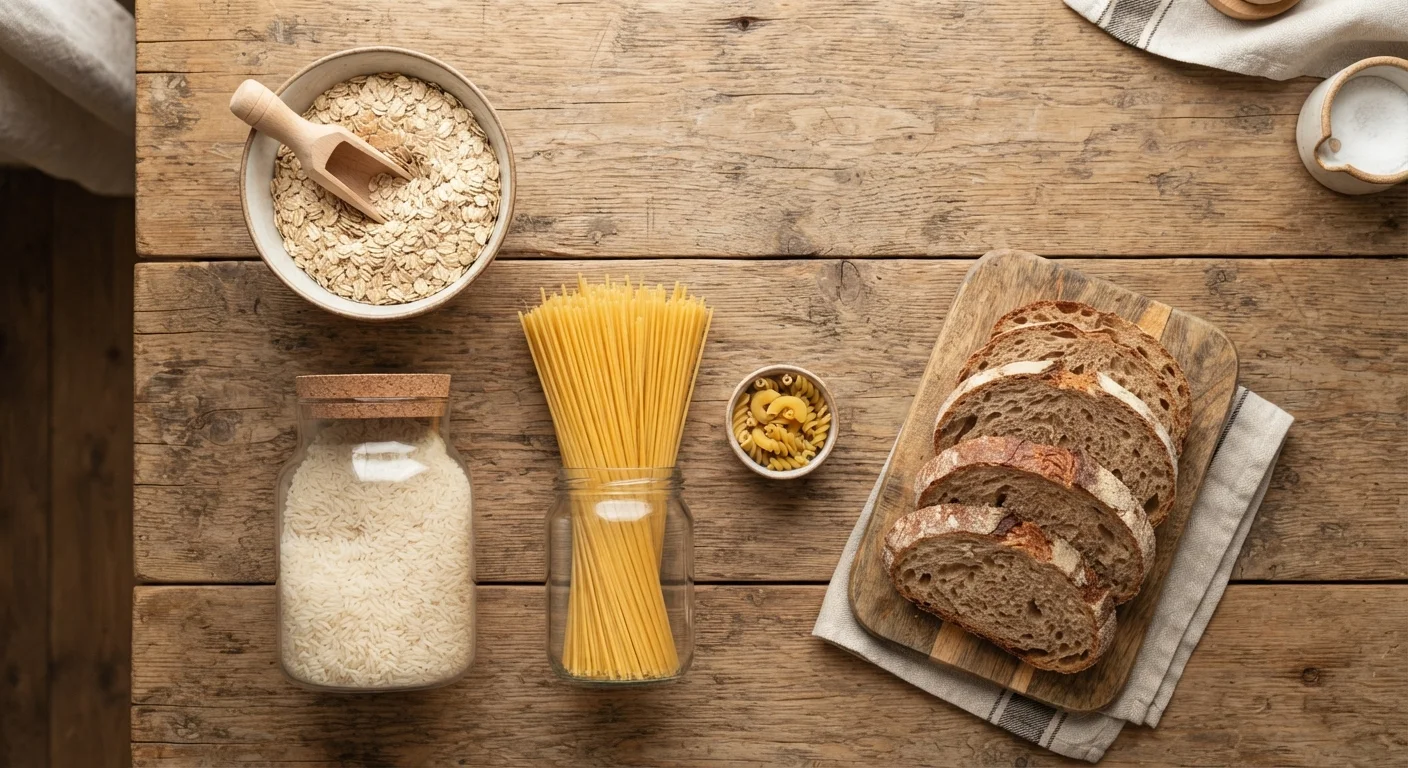
Each of these four carbohydrate staples earns a place in a budget pantry, but they differ meaningfully in fiber content, cost per serving, shelf life, and kitchen versatility. Oats stand out for satiety and nutritional density at low cost, while rice excels in long shelf life and meal adaptability. Pasta and bread fill important convenience roles but are best chosen in whole-grain forms when possible.
| Best for | Recommended |
|---|---|
| Maximizing fiber and satiety on a very tight budget | Oats |
| Long-term pantry storage and neutral meal pairing | Rice |
| Quick weeknight meals with familiar flavor profiles | Pasta |
| Speed and convenience for minimal-prep eating | Bread |
Why Carbohydrates Belong in a Budget Diet
Carbohydrates are the body's primary fuel source, and the four staples compared here - oats, rice, pasta, and bread - have anchored affordable diets across cultures for centuries. For a fuller explanation of what carbohydrates do in the body, see Macronutrients at a Glance.
On a per-serving basis, these four options are among the most calorie-dense foods available at grocery stores, meaning a small outlay of money provides substantial energy. The key distinctions lie in their fiber content, micronutrient profiles, glycemic impact, shelf stability, and how easily they integrate into a variety of meals. None of them is inherently unhealthy - context, preparation, and what you pair them with matter just as much as the staple itself.
| Oats | White Rice | Brown Rice | Pasta (Whole-Wheat) | Bread (Whole-Grain) | |
|---|---|---|---|---|---|
| Approx. fiber per serving | 4g (½ cup dry) | 0.5g (¼ cup dry) | 1.5g (¼ cup dry) | 3g (2 oz dry) | 2g (1 slice) |
| Relative cost per serving | Very low | Very low | Low | Low | Moderate |
| Shelf life (sealed/dry) | 12-24 months | 2-5 years | 6-12 months | 2 years | 5-7 days (room temp) |
| Prep time | 5-30 minutes | 15-20 minutes | 40-50 minutes | 8-12 minutes | None |
| Meal versatility | Moderate | High | High | High | Moderate |
| Key micronutrients | Iron, Mg, B vitamins | B vitamins (enriched) | B vitamins, Mg | B vitamins, iron | B vitamins, iron |
Oats: Fiber-Rich and Filling
Rolled oats (also called old-fashioned oats) are one of the most nutritionally dense carbohydrates available at low cost. A half-cup dry serving provides roughly 4 grams of fiber, including beta-glucan, a soluble fiber that research published in peer-reviewed nutrition journals associates with more stable blood glucose levels and modest cholesterol reduction. Oats also supply iron, magnesium, and more protein per serving than most other grain staples.
Dry oats store for many months in a sealed container, reducing waste. They are most commonly prepared as a warm breakfast but also work in baked goods, overnight preparations, and savory dishes. Instant oat varieties sacrifice some fiber and often contain added sugar - plain rolled or steel-cut oats are more nutritionally complete choices.
Simple Ways to Boost Oat Nutrition
Adding a source of protein - such as a spoonful of nut butter, a poached egg, or a serving of plain yogurt - to a bowl of oats creates a more balanced, longer-lasting meal. A handful of fruit adds natural sweetness and additional micronutrients without the added sugars found in flavored instant varieties. For plant-based eaters, oats pair well with options covered in Plant-Based Eating on a Budget.
Rice: Long Shelf Life and Neutral Versatility
White rice is inexpensive, cooks quickly, and pairs with virtually any cuisine. However, milling strips away the bran and germ, leaving a starch that is lower in fiber and B vitamins than brown rice. Brown rice retains these layers and delivers roughly twice the fiber per serving; the trade-off is a longer cook time and slightly higher price - though the difference is typically modest.
From a budget perspective, rice purchased in larger bags (five pounds or more) offers a notably lower cost per serving than smaller packages. Properly stored in a sealed container, white rice can last years, making it one of the most practical long-term pantry items available. For meal planning ideas that build on staples like rice, the Weekly Grocery Checklist for a Balanced, Budget-Conscious Pantry offers a useful starting framework.
~4g
Beta-glucan fiber in a serving of oats
According to the USDA FoodData Central database, a half-cup of dry rolled oats contains approximately 4 grams of total dietary fiber.
2x
More fiber in brown rice vs. white rice
USDA nutrient data shows brown rice contains roughly twice the dietary fiber of equivalently sized servings of white rice.
Pasta: Familiar, Filling, and Fast
Dried pasta - typically made from semolina (durum wheat) - is energy-dense, cooks in under 15 minutes, and is extremely versatile. Whole-wheat pasta provides noticeably more fiber than standard refined pasta and is widely available at similar price points. The glycemic index of pasta is moderate compared to white bread or white rice, partly because of how its starch is structured during processing.
One practical consideration: pasta pairs easily with legumes such as lentils or canned beans, creating low-cost meals that also deliver meaningful protein. For complementary affordable protein options, see The Cheapest Protein Sources That Nutritionists Actually Recommend. Pasta's main limitation is a shorter shelf life than rice or oats once a package is opened, though it still stores well for several months in a dry pantry.
Bread: Convenient but Variable in Quality
Bread is the most convenient of the four staples - no cooking required - but it is also the most variable in nutritional quality. Many standard sandwich loaves are made from refined flour with added sugars and preservatives. Whole-grain or 100% whole-wheat breads contain more fiber, B vitamins, and minerals, and the ingredient list should list a whole grain as the first item to confirm this.
On a cost-per-calorie basis, bread tends to be the least efficient of the four options, and its shelf life is the shortest (typically five to seven days at room temperature, though freezing extends this significantly). For shoppers working within a defined grocery budget, bread is best thought of as a convenience complement rather than the primary carbohydrate staple. For broader strategies on stretching food dollars, Eating Well on a Tight Budget: What Actually Works covers practical approaches in depth.
This article is for general informational purposes only and is not a substitute for advice from a qualified healthcare professional or registered dietitian. Individual nutritional needs vary; consult a professional before making significant changes to your diet.