

| Most common coupon restriction | Exclusions on trial, travel, or clearance sizes |
| Typical doubling cap | Up to $0.99 face value (where doubling is offered) |
| Stackable coupon types (common rule) | One manufacturer + one store coupon per item |
| Coupon barcode prefix (manufacturer) | Starts with '5' in standard GS1 format |
| Where store policies are published | Retailer website, customer service desk |
| Digital coupon clip window | Must usually be clipped before checkout, not applied retroactively |
Why Fine Print Matters More Than the Discount Amount
A coupon's headline discount - $2 off, 20% back, buy one get one - is the easy part. The real work happens in the smaller text underneath. Misreading a single restriction can mean the coupon declines at the register, or worse, that you buy a product you wouldn't have purchased otherwise to chase a deal that doesn't apply to you.
This reference guide decodes the terms retailers and manufacturers use most often. Bookmark it before your next shopping trip, and pair it with the complete overview of coupon and discount strategies for the full picture.
| Most common coupon restriction | Exclusions on trial, travel, or clearance sizes |
| Typical doubling cap | Up to $0.99 face value (where doubling is offered) |
| Stackable coupon types (common rule) | One manufacturer + one store coupon per item |
| Coupon barcode prefix (manufacturer) | Starts with '5' in standard GS1 format |
| Where store policies are published | Retailer website, customer service desk |
| Digital coupon clip window | Must usually be clipped before checkout, not applied retroactively |
Core Coupon Terms, Decoded
The glossary below covers the terminology you're most likely to encounter on paper inserts, digital app coupons, and printable offers. Each definition reflects how these terms are standardly applied in the U.S. retail environment - though individual store policies may layer on additional rules.
Stacking
Using more than one coupon or discount on a single item or transaction. Some retailers allow one manufacturer coupon plus one store coupon on the same product; others prohibit it entirely.
Doubling
A store policy that multiplies the face value of a coupon - typically up to a stated maximum - at the register. Doubling is retailer-specific and has become less common over time.
Manufacturer Coupon
A coupon issued by the product's manufacturer rather than the retailer. It is typically redeemable at any participating store that carries the product.
Exclusions
Specific products, categories, sizes, or flavors that a coupon explicitly cannot be applied to, regardless of how similar they appear to eligible items.
Minimum Purchase Requirement
A threshold - either a dollar amount or a quantity of items - that must be met before a coupon's discount activates.
Raincheck
A written guarantee from a retailer allowing a shopper to purchase an out-of-stock sale item at the advertised price when it becomes available again. Not all coupons are compatible with rainchecks.
Single-Use
A coupon that can only be redeemed once, tied either to a unique code or a loyalty account. Attempting to reuse it typically results in an automatic rejection at the point of sale.
Catalina Coupon
A coupon printed at the register after a qualifying purchase, named for the system that generates them. These function like cash-off vouchers for a future transaction.
Store Coupon
A coupon issued by a specific retailer, redeemable only at that retailer's locations or website. It cannot typically be used at a competitor.
BOGO
Short for 'buy one, get one.' Terms vary: the second item may be free, half-price, or discounted by a set amount. Always check whether a coupon can be applied on top of a BOGO offer.
Expiry Date
The date after which a coupon is no longer valid. Some retailers accept coupons briefly past their expiry as a courtesy, but this is discretionary and not guaranteed.
Rolling
Completing multiple qualifying transactions back-to-back to trigger Catalina coupons or loyalty rewards repeatedly within a single shopping trip.
For a plain-English walkthrough of related savings vocabulary outside the coupon context - such as APR, net worth, and liquidity - see personal finance terms decoded.
Reading Restrictions Without Getting Caught Out
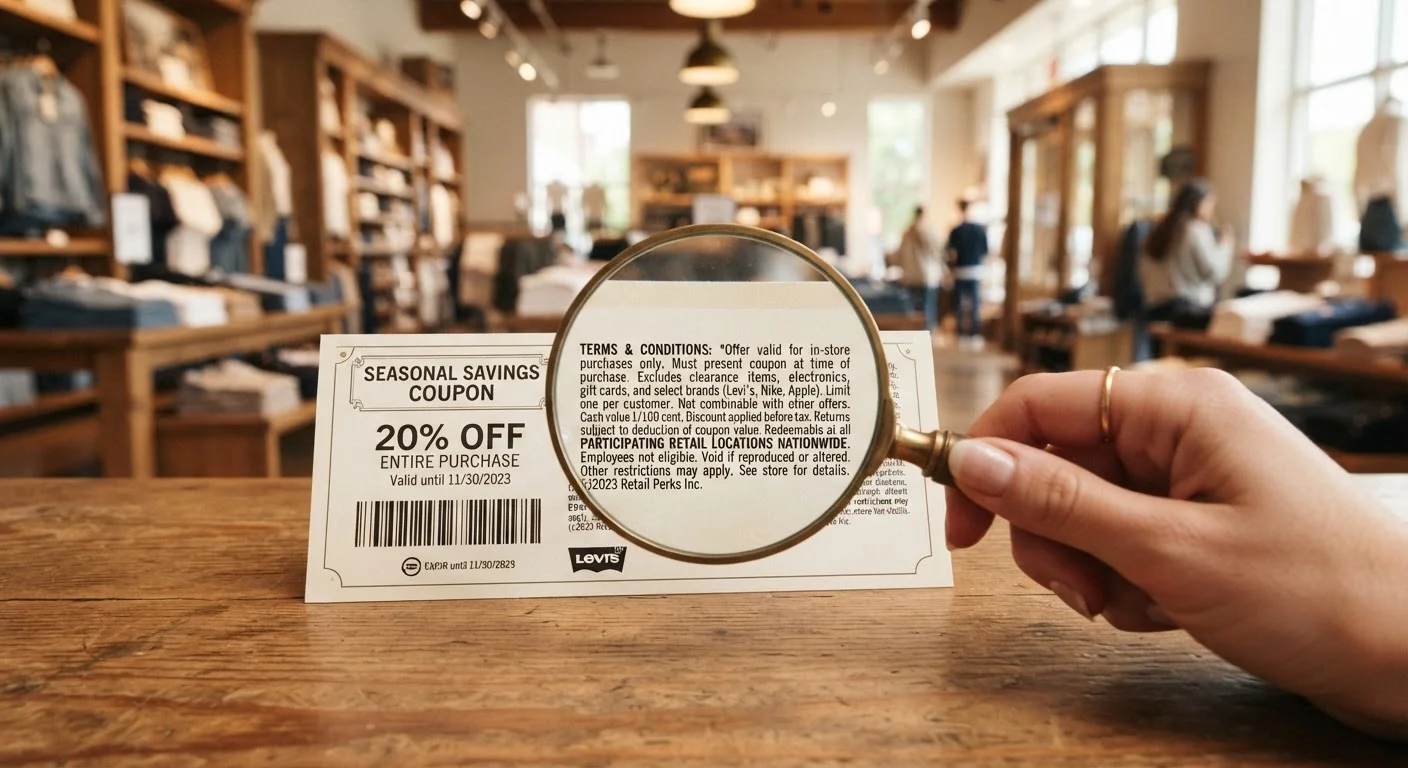
Exclusion language is where most shoppers lose value without realising it. Phrases like "excludes trial and travel sizes," "not valid on clearance merchandise," or "participating items only" are not just legal boilerplate - they actively define what you can and cannot buy.
Store Policies Vary - Always Check
Coupon terms printed on the coupon itself set minimum conditions, but each retailer may impose additional restrictions. A store's coupon policy - usually available at the service desk or on its website - is the authoritative guide for how coupons will be handled at that location. When in doubt, ask before you reach the register.
Minimum purchase thresholds deserve particular attention. A coupon that reads "$5 off a $30 purchase" activates only after pre-tax totals - in most cases - clear that threshold. Some coupons specify pre-discount subtotals; others calculate after other promotions have already been applied. These two approaches can produce meaningfully different totals.
Stacking and doubling require you to distinguish between manufacturer and store coupons before you shop. If a coupon's barcode begins with the digit 5, it's generally a manufacturer coupon under GS1 standards. Store coupons carry separate identifiers. Knowing which you hold tells you whether stacking is even theoretically possible at your retailer.
Knowing these terms is only half the equation - common couponing mistakes outlines the habits that erode savings even when the terms are understood. And if you're sourcing digital coupons, verifying codes before checkout prevents wasted time on fakes and expired offers.