
Fixed vs. Variable Expenses: Understanding the Difference Changes How You Budget

Key Takeaways
- Fixed expenses are predictable and repeat at the same amount each period; variable expenses fluctuate.
- Variable costs are where most day-to-day spending control actually happens.
- Misclassifying costs leads to budgets that look balanced on paper but fail in practice.
- Semi-variable expenses - like utilities - need their own realistic average rather than a fixed figure.
- Knowing your fixed costs sets a spending floor; managing variable costs creates financial flexibility.
Fixed vs. Variable Expenses
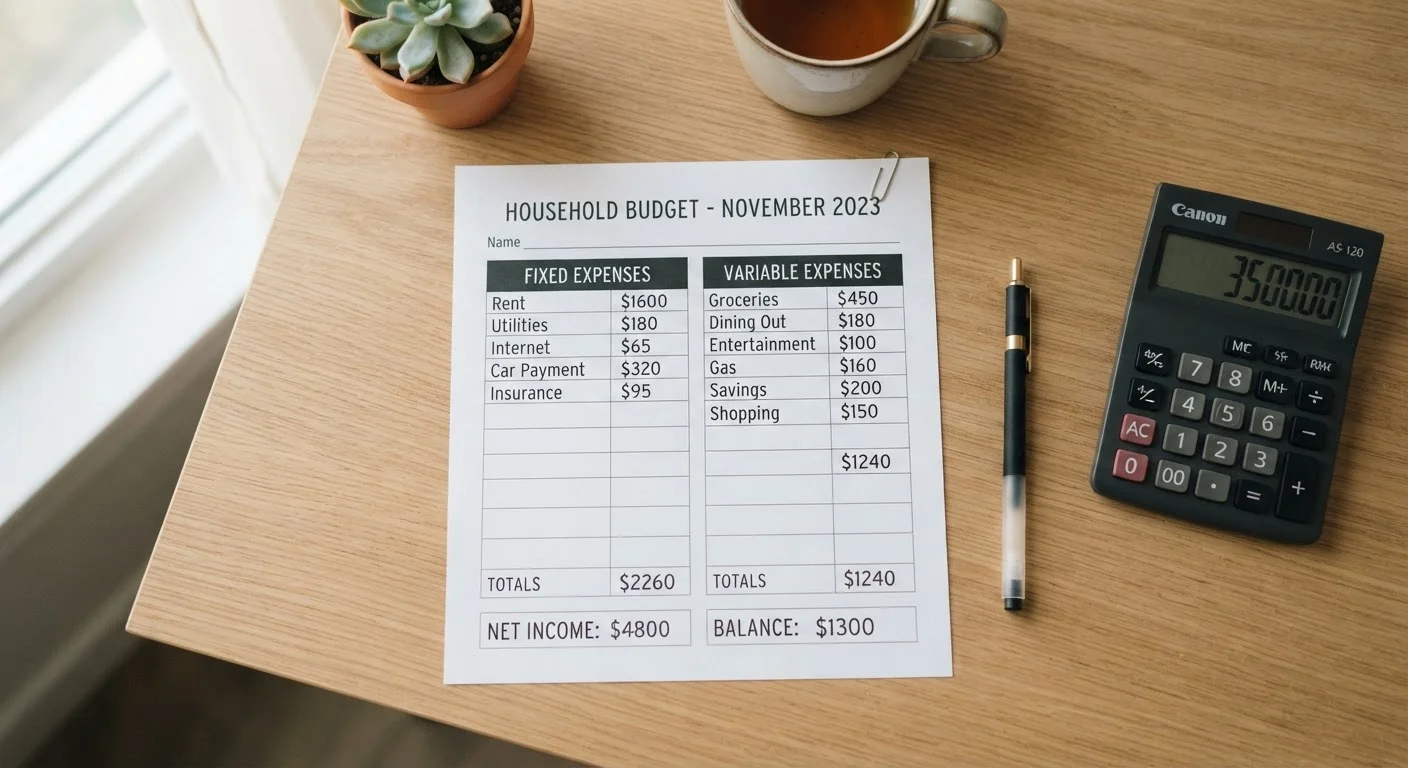
Fixed expenses are costs that stay the same amount every billing period - think rent, a car loan payment, or a monthly insurance premium. Variable expenses change from month to month based on usage, choices, or circumstances - groceries, gas, and dining out are common examples. Understanding which category each of your costs falls into is the foundation of realistic budgeting.
Some expenses are described as 'semi-variable' or 'mixed' - they have a fixed base component plus a usage-dependent portion, such as a cell phone plan with a set monthly fee and per-GB overage charges.
Why the Category You Assign Each Cost Actually Matters
Most budget failures aren't math problems - they're categorisation problems. When people lump all their spending into one pile and compare it to income, they lose the signal buried in the noise: which costs are truly locked in, and which ones they actually control.
Sorting expenses into fixed and variable buckets solves this. Fixed costs set your spending floor - the minimum your household must spend regardless of circumstances. Variable costs represent your daily decision-making margin. Treating both categories the same way virtually guarantees a budget that feels off every month.
If you're newer to the vocabulary of household budgeting, the plain-language budgeting reference covers the broader terminology worth knowing before you build your first category list.
~33%
Average share of income spent on housing
The U.S. Bureau of Labor Statistics Consumer Expenditure Survey consistently shows housing - typically a fixed cost - consumes the largest single share of household budgets.
~$800
Typical monthly food spending per household
BLS Consumer Expenditure data shows food costs (a variable expense) averaging roughly this figure, though individual household spending varies considerably by size and location.
Fixed Expenses: Predictable, Recurring, Non-Negotiable in the Short Term
A fixed expense has two defining characteristics: it recurs on a regular schedule, and its amount doesn't change based on how much you use the underlying product or service. You pay the same whether you use it heavily or barely at all.
Common fixed expenses include:
- Rent or mortgage principal and interest
- Auto loan or lease payments
- Fixed-rate insurance premiums (health, auto, renters, life)
- Flat-rate subscription services
- Minimum debt payments (student loans, personal loans)
The practical implication: fixed costs are largely immovable within any given month. That means your budget must accommodate them first, every time. They're also easier to track - once recorded, they rarely surprise you.
Variable Expenses: Where Your Spending Decisions Live
Variable expenses shift based on usage, lifestyle choices, and circumstances. They're not inherently bad or frivolous - groceries are variable, and so is gas. The key characteristic is that the amount is not predetermined.
Common variable expenses include:
- Groceries and household supplies
- Gas and fuel
- Utilities (electricity, water, heating)
- Dining out and entertainment
- Clothing and personal care
- Medical co-pays and out-of-pocket costs
Variable expenses are where most budget control actually lives. Reducing a fixed expense usually requires a contract change, refinance, or major lifestyle shift. Trimming variable spending can happen in a single week.
One important caveat: some variable costs are more controllable than others. Electricity use can be managed; a sudden medical bill cannot. Budgeters who track overlooked spending categories tend to spot variable cost drift before it compounds.
Use Averages, Not Minimums, for Variable Costs
When setting a variable expense budget line, base it on your average actual spending over the past three to six months - not your best month or your goal amount. Using an unrealistically low figure creates a budget that fails by design. Once you know your true average, you have an honest baseline to work from and reduce intentionally.
Semi-Variable Expenses Deserve Their Own Line
A third category trips up many household budgets: semi-variable expenses. These have a predictable base component combined with a usage-dependent portion. Utility bills are the textbook case - your bill includes a fixed service charge plus a variable amount based on kilowatt-hours or therms consumed.
Rather than treating these as either purely fixed or purely variable, assign them a realistic monthly average derived from at least three to six months of actual bills. This average becomes your budget line. A figure that's too low will produce a recurring shortfall; too high and you're over-reserving funds you could use elsewhere.
People with irregular income often find semi-variable costs especially tricky to manage. The guide to budgeting on irregular income addresses how to smooth out these fluctuations when your paycheck itself varies month to month.
“A budget is telling your money where to go instead of wondering where it went. Knowing whether each cost is fixed or flexible is what makes that direction possible.”
— Dave Ramsey, Personal finance author and radio host
Putting the Framework to Work in Your Own Budget
The practical exercise is straightforward. Pull three months of bank and credit card statements. Label every line item as fixed, variable, or semi-variable. Total each column separately.
Your fixed total is your floor - income must clear this before anything else is allocated. Your semi-variable total needs a realistic average, not a wish. Your variable total is your working margin, the number you have genuine influence over each month.
This structure becomes especially useful when your financial priorities shift - say, when you're balancing short-term savings against longer-term goals. The short-term vs. long-term budgeting framework builds directly on knowing which costs are fixed versus adjustable.
This article is for general informational and educational purposes only and does not constitute personalised financial advice. For guidance specific to your circumstances, consult a qualified financial professional.