

Key Takeaways
- Depreciation is often the largest annual cost of car ownership, frequently exceeding fuel and insurance.
- New vehicles lose a significant portion of their value within the first few years of ownership.
- Factors like mileage, condition, brand reputation, and vehicle category all influence how fast a car depreciates.
- Understanding depreciation helps drivers make more cost-aware decisions when buying or selling.
- Used vehicles generally depreciate more slowly, offering a potential advantage for budget-conscious buyers.
Vehicle Depreciation
Vehicle depreciation is the reduction in a car's market value over time. It's the difference between what you paid for a vehicle and what it's worth when you sell or trade it in. Unlike fuel or insurance, depreciation doesn't appear on any bill - but it's typically the single largest cost of owning a car.
Depreciation is calculated as the difference between a vehicle's original purchase price and its residual value at a given point in time. It is a non-cash expense, meaning no money leaves your account directly - but it represents real lost wealth.
Why Depreciation Is the Cost No One Talks About
Ask most drivers what their biggest car expense is and they'll say gas or insurance. Rarely does anyone mention depreciation - yet industry data consistently shows it accounts for the largest share of the total cost of vehicle ownership for many drivers. The reason it gets overlooked is simple: it never shows up on a statement.
Depreciation is the loss in value your vehicle experiences from the moment you acquire it to the moment you sell or trade it. It's not a fee or a bill. It's just reality. And for budget-conscious drivers trying to get a clear picture of what a car actually costs, ignoring it means working with an incomplete ledger.
For a fuller view of what drivers actually spend annually, see our breakdown of the true annual cost of owning a car.
~20%
Average new car value lost in year one
Industry estimates commonly place first-year depreciation for new vehicles in the 15%-25% range, depending on the make, model, and market conditions.
~50%
Value lost by year five for many new vehicles
Many new cars retain only around half their original purchase price after five years of typical ownership, according to general automotive valuation data.
#1
Depreciation's rank among annual ownership costs
Automotive cost-of-ownership analyses regularly identify depreciation as the single largest component of annual vehicle ownership expenses for new car buyers.
How Depreciation Works in Practice
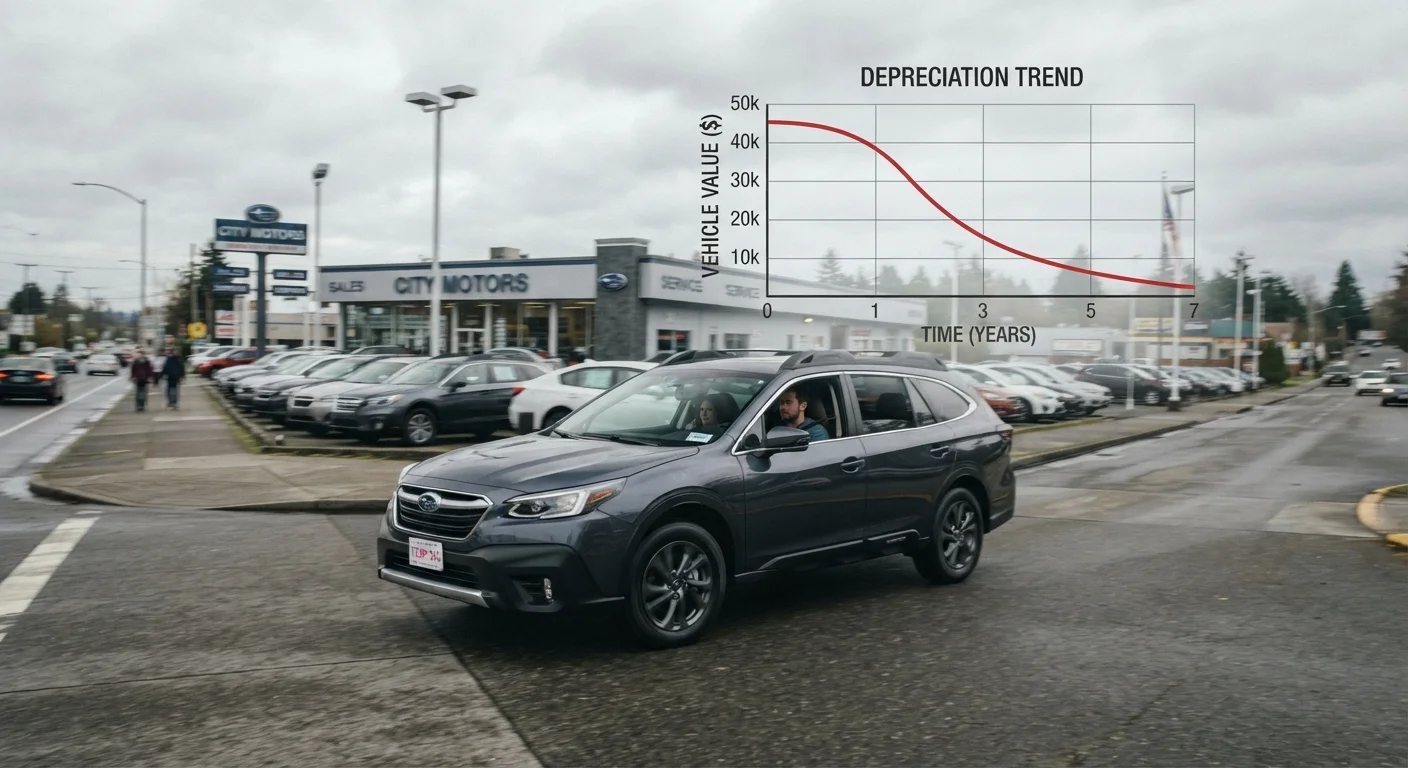
Depreciation doesn't move at a steady pace. It front-loads: the sharpest drops in value occur earliest in a vehicle's life. A new car driven off a dealership lot can lose a meaningful chunk of its value within the first year alone, before most buyers have even made a dent in their loan balance.
After that steep initial drop, depreciation tends to slow - though it never stops entirely. By years three through five, many vehicles have lost nearly half their original value. The exact rate depends on several interacting factors:
- Mileage: Higher annual mileage accelerates value loss.
- Condition: Wear, damage, and maintenance history all affect resale value.
- Vehicle category: Trucks and SUVs with strong demand often depreciate more slowly than sedans or entry-level cars.
- Brand reputation: Vehicles associated with long-term reliability tend to hold value better.
- Market demand: Economic shifts and fuel prices can influence which vehicle types retain or lose value fastest.
“Depreciation is the largest cost of vehicle ownership, yet it is the least visible. Drivers who ignore it are working without the most important number in their budget.”
— Consumer Financial Protection Bureau, U.S. government agency providing financial education resources for consumers
Understanding this pattern matters whether you're buying, financing, or planning to sell. It's a core part of what makes hidden costs catch new car owners off guard.
What This Means for Your Ownership Budget
Treating depreciation as an invisible expense - one that simply doesn't count - leads to real miscalculations. Drivers who compare only monthly payments, fuel costs, and insurance premiums are missing the largest line item in many ownership scenarios.
A practical way to account for it: estimate the expected resale value of a vehicle after a given number of years, subtract that from the purchase price, and spread the difference across your ownership period. That figure - often expressed as a cost per year or per mile - represents what depreciation is actually costing you.
Factor Depreciation Into Every Vehicle Decision
Before purchasing any vehicle, look up estimated resale values for that make and model after three to five years. Resources like vehicle valuation guides can give you a realistic projection. Subtract the expected resale value from the purchase price to understand the true depreciation cost you're agreeing to absorb - not just the monthly payment.
This kind of thinking also helps explain why common car cost myths lead drivers to miscalculate their budgets. Assumptions like "newer is always more expensive to own" or "older cars save money" collapse when depreciation is properly factored in.
Depreciation also connects to broader smart spending habits. A car is often a household's second-largest asset - treating it like one means accounting for how that asset's value changes over time. It's part of the same logic behind understanding hidden costs buried in everyday purchases.