

Key Takeaways
- The sticker price of a product rarely reflects its true lifetime cost to you.
- Consumables, maintenance, and disposal costs can significantly exceed the original purchase price.
- Asking a few targeted questions before buying can prevent expensive surprises down the line.
- Financing charges and subscription lock-ins quietly inflate the total you pay over time.
- Comparing true cost - not just unit price - is one of the most effective budgeting habits you can build.
Why the Price Tag Tells Only Part of the Story
Most shoppers are trained to evaluate purchases by a single number: the price on the shelf or the total at checkout. That number is real, but it's often incomplete. A product's sticker price captures only what you pay to acquire it - not what it costs to own, operate, maintain, and eventually replace or dispose of it.
This gap between acquisition cost and total cost of ownership is where household budgets quietly get strained. Understanding it doesn't require complex math - it requires asking a different set of questions before you buy. The list below covers the most common hidden cost categories, along with what to watch for in everyday situations. For a deeper look at how this plays out with one of the biggest household purchases most people make, see our breakdown of what car ownership actually costs annually.
Consumables That Outlast the Original Purchase Price
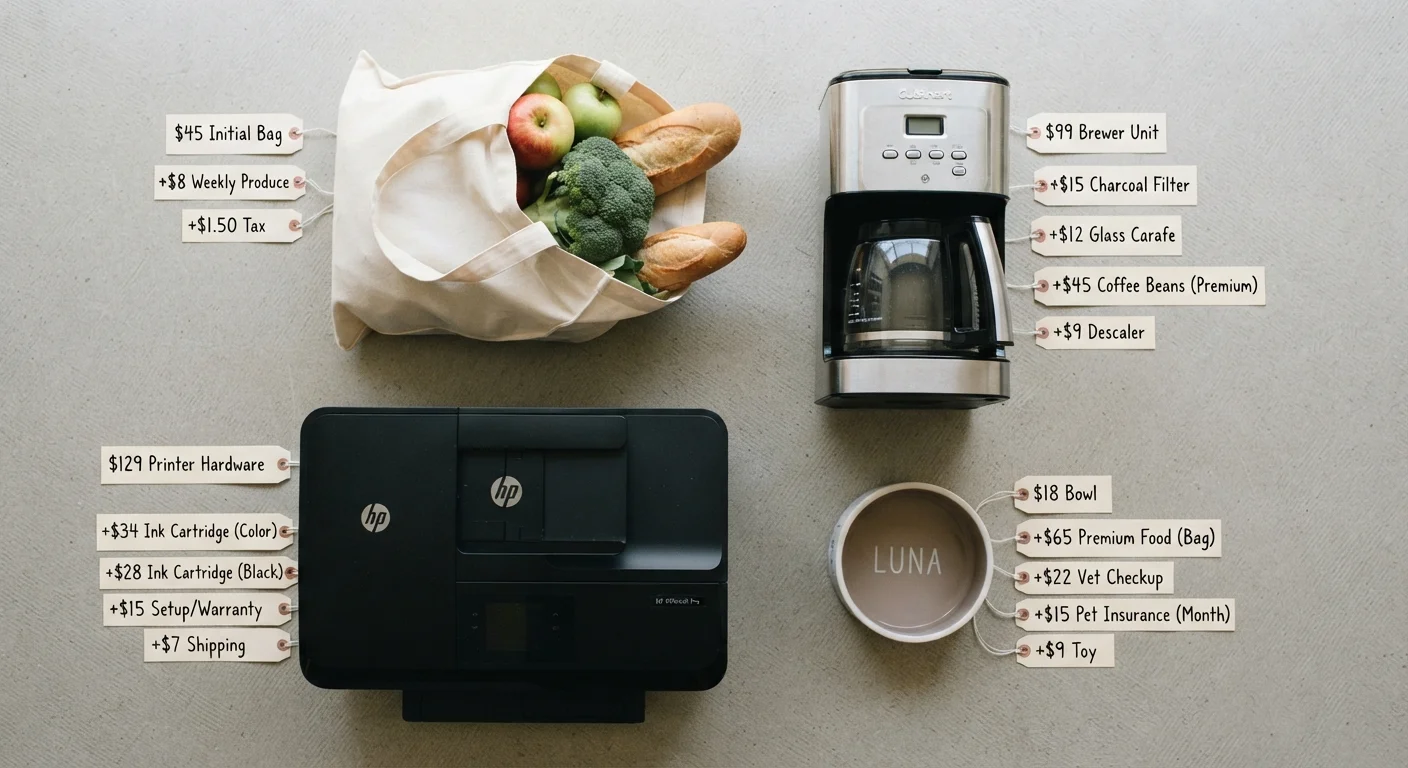
Printers are a textbook example: the hardware may be inexpensive, but replacement ink cartridges can cost more per year than the printer itself. The same logic applies to razors, coffee pod machines, water filters, and many small kitchen appliances. Manufacturers often price the device low specifically because they earn recurring revenue on the supplies.
Before buying anything that requires proprietary refills, cartridges, or replacement parts, look up the annual cost of those consumables. If that information isn't readily available, that's a signal worth pausing on.
The device can be cheap - the consumables it requires are where the real cost lives.
Energy Costs That Compound Over Years
Appliances, electronics, and HVAC equipment all carry an energy cost that runs every time they're in use. Two refrigerators with identical price tags might have annual energy costs that differ by $50 or more - a gap that adds up to hundreds of dollars over the appliance's lifespan.
Most major appliances in the U.S. carry an EPA EnergyGuide label showing estimated annual energy cost. Checking this number before purchase, rather than after, is one of the simplest ways to avoid a long-running hidden expense.
Two identical price tags can hide meaningfully different energy bills over years of use.
Maintenance Requirements That Aren't Disclosed at Point of Sale
Certain purchases come with ongoing maintenance obligations that significantly affect their true cost. Vehicles are the clearest case - oil changes, tires, brakes, and inspections are expected, but costs like timing belt replacements or dealer-only software updates are often overlooked at purchase. The same principle applies to outdoor power equipment, hot tubs, pools, and even some types of flooring that require periodic professional treatment.
Ask specifically what maintenance a product requires and at what intervals. If you're evaluating a vehicle purchase, our hub on car ownership costs covers these expenses in structured detail.
Maintenance costs rarely appear on the price tag, but they show up reliably over time.
Subscription and Service Contract Lock-Ins
Software, smart home devices, streaming-enabled appliances, and security systems frequently require ongoing subscriptions to unlock core functionality. A security camera that costs $80 upfront might require a $100 annual subscription to store footage - meaning the "hardware" purchase is really the entry point to a recurring fee.
Similarly, extended warranties and service contracts are often sold with vague terms. Read the actual coverage before adding them, and factor that cost into your total price calculation. For a broader look at how convenience-oriented spending accumulates, the real cost of convenience is worth reviewing.
[note_callout]A low hardware price is sometimes an entry fee to a subscription you didn't fully anticipate.
Disposal and Replacement Costs
Some products cost money to get rid of. Mattresses, large appliances, electronics, and certain batteries carry disposal fees in many municipalities, or require paid haul-away services. Tires, paint, and motor oil also have regulated disposal requirements. If you're replacing an old item, disposal of the old one is a real line item to account for.
For anything with a defined lifespan - tires, water heaters, HVAC filters, car batteries - knowing the expected replacement cycle upfront lets you budget for it rather than absorb the cost unexpectedly.
Getting rid of a product can cost money too - and that's rarely mentioned at the point of sale.
Financing Costs That Inflate the Final Price
When a purchase is financed - whether through a store credit card, a "buy now, pay later" arrangement, or a personal loan - the total amount paid depends heavily on the interest rate and repayment timeline. A $500 purchase financed over 18 months at a high interest rate can cost meaningfully more in total than the original price suggests.
Understanding how revolving debt compounds is especially relevant here. Our article on the hidden costs of carrying a credit card balance explains how interest accumulation works over time and what it means for real purchasing decisions.
Financing turns a fixed sticker price into a variable - and often larger - final total.
Building a Habit of Full-Cost Thinking
None of this means you should avoid spending or agonize over every purchase. It means building a brief mental checklist: What does this require from me after I buy it? Consumables, energy use, professional servicing, and end-of-life disposal are the four questions worth asking consistently.
Try a Simple Pre-Purchase Checklist
Before committing to any significant purchase, run through four quick questions: What consumables does this require? What's the estimated energy cost per year? What maintenance will this need, and how often? Is there a subscription or service contract involved? Answering these takes minutes and can prevent months of unplanned expense.
Tracking these secondary costs alongside your regular spending is a foundation of any realistic budget. Our guide on spending categories most people overlook shows exactly where these expenses tend to hide. And if you're evaluating whether a price is genuinely favorable before committing, understanding unit price, total price, and value gives you a practical framework to do that clearly.
This article is for general informational purposes only and does not constitute personalized financial advice. For guidance specific to your situation, consider consulting a qualified financial professional.