

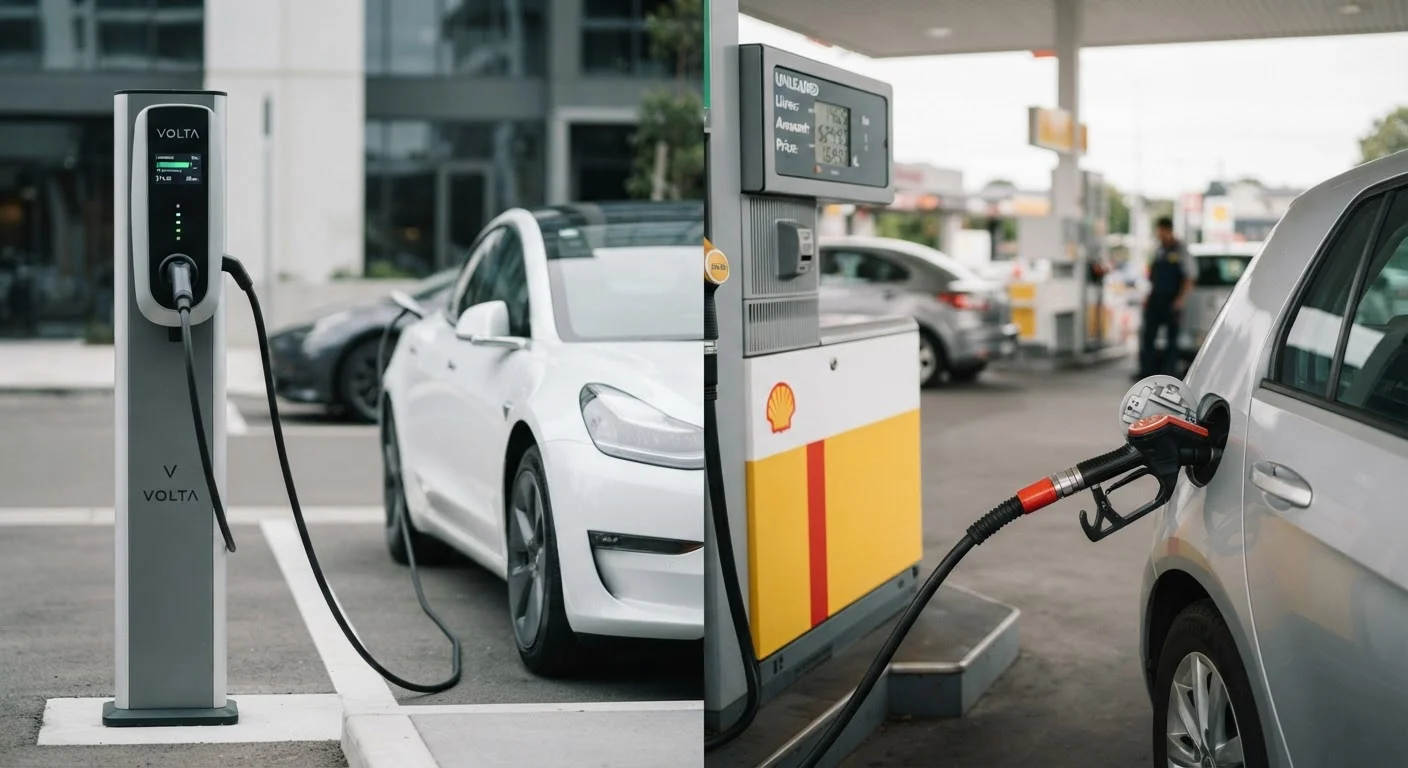
Key Takeaways
- EVs typically cost more to purchase but significantly less to fuel and service over time.
- Petrol vehicles carry lower sticker prices but accumulate higher fuel and maintenance bills across years.
- EV depreciation is improving but remains less predictable than petrol equivalents, especially for older battery tech.
- Home charging access is a major factor - without it, EV running cost advantages shrink considerably.
- Insurance costs are generally higher for EVs, partly due to repair complexity and parts availability.
- The financial break-even point depends heavily on annual mileage, local energy prices, and how long you keep the car.
Option A
Electric Vehicle (EV)
Higher upfront investment, lower day-to-day running costs.
Best for: Drivers with predictable commutes, home charging access, and a longer ownership horizon who want to minimize fuel and servicing expenses.
Option B
Petrol Vehicle
Lower purchase price, familiar costs, wider used-market availability.
Best for: Drivers who need flexibility, travel long distances unpredictably, or want to keep initial outlay low.
If you drive a consistent daily commute and can charge at home
Electric Vehicle (EV)
Home overnight charging is cheap, and lower servicing costs add up quickly over years of regular use, often justifying the higher purchase price.
If you drive long, unpredictable distances frequently
Petrol Vehicle
Petrol's refuelling speed and widespread station availability make it more practical where range anxiety and charging infrastructure gaps remain real concerns.
If minimizing upfront cost is the priority
Petrol Vehicle
The used petrol market is deep and well-understood, making it easier to find a reliable vehicle at a lower entry price point.
If you plan to own the vehicle for five or more years
Electric Vehicle (EV)
The longer the ownership period, the more fuel and maintenance savings accumulate, improving the likelihood of reaching financial break-even on the higher purchase cost.
If you rely on public charging only, without home access
Petrol Vehicle
Public rapid charging costs are considerably higher than home rates and can erode much of the EV's fuel-cost advantage, depending on your location and usage patterns.
Purchase Price and Depreciation
The most immediate cost difference between EVs and petrol vehicles sits at the point of purchase. New EVs carry a notable price premium compared to equivalent petrol models, driven largely by battery manufacturing costs. That gap has been narrowing over time, but it remains significant in most segments as of recent model years.
Depreciation complicates the picture. Petrol vehicles follow well-established depreciation curves that dealers and private buyers understand. EV depreciation is less predictable - earlier models with smaller battery packs have lost value sharply as range-improved successors arrived. Newer EVs from established manufacturers are holding value better, but the used EV market is still maturing. For buyers considering resale, this uncertainty is worth factoring into the total ownership calculation.
For those weighing new versus pre-owned, our comparison of new and used car ownership costs explores how purchase price affects long-term outlay across both categories.
| Criterion | Electric Vehicle | Petrol Vehicle |
|---|---|---|
| Typical purchase price (new) | Higher premium vs. petrol equivalent | Lower upfront cost |
| Fuel/energy cost per mile | Lower (home charging); variable (public) | Higher; subject to market fluctuation |
| Routine servicing | Simpler, fewer components | Oil, filters, more wear points |
| Insurance premiums | Generally higher | Generally lower |
| Depreciation predictability | Less predictable; market still maturing | Well-established curves |
| Refuelling convenience | Charging infrastructure varies by region | Wide petrol station availability |
| Tyre wear | Higher (weight and torque) | Standard wear rates |
Fuel and Energy Costs
This is where EVs typically recoup their price premium. Charging an EV at home overnight - particularly on an off-peak tariff - costs substantially less per mile than filling a petrol tank. The precise gap varies with local electricity and petrol prices, but home-charging EV drivers consistently report lower per-mile energy costs.
Public rapid charging narrows that advantage significantly. Prices at public charge points vary widely and can approach or occasionally exceed petrol costs on a per-mile basis, depending on the network and tariff. Drivers without home charging access should factor this into their projections carefully.
Petrol prices fluctuate with global markets and are inherently less controllable. Over a full vehicle lifetime, fuel spend is substantial for petrol drivers. Our breakdown of lifetime fuel costs shows how those expenses compound across years of ownership.
3-4×
Cheaper per mile: home EV charging vs. petrol
U.S. Department of Energy data has consistently shown home electricity costs per mile run well below petrol for equivalent driving, though the ratio shifts with energy price changes.
40%
Lower average maintenance costs reported for EVs
A study by Consumer Reports found EV owners spend roughly 40% less on repairs and maintenance compared to petrol vehicle owners over comparable ownership periods.
~$1,000
Annual petrol servicing cost differential vs. EV
Industry estimates suggest petrol vehicle owners typically spend several hundred to over a thousand dollars more per year on routine maintenance than EV counterparts, varying by model and mileage.
Servicing, Maintenance, and Insurance
EVs have fewer moving parts than petrol engines - no oil changes, no timing belts, no exhaust system - and this translates directly into lower routine servicing bills. Brake wear is also reduced on most EVs due to regenerative braking systems, which recover energy during deceleration. The main consumables remain tyres (often worn faster due to EV torque and weight) and windscreen wiper fluid.
Petrol vehicles require regular oil and filter changes, spark plug replacements, and a more complex drivetrain that generates more wear points over time. Cumulative servicing costs are reliably higher.
Insurance, however, tilts the other way. EVs generally attract higher premiums than equivalent petrol models, reflecting costlier repairs, specialized technician requirements, and battery-related risk assessments. This gap is narrowing as the repair industry adapts, but it remains a real line item in the EV cost column.
For a full picture of where ownership money goes each year, see our annual car ownership cost breakdown.
Federal and State EV Incentives Can Shift the Equation
In the US, federal tax credits and various state-level incentives have historically reduced the effective purchase price of qualifying new EVs. These programs change frequently - eligibility rules, income limits, and vehicle qualifications have all shifted in recent years. Always verify current incentive availability through official government sources before factoring them into your budget. Incentives can meaningfully close the purchase price gap, but they should not be assumed as guaranteed.
Which Option Makes Financial Sense?
There is no single answer - the math depends on your annual mileage, access to home charging, how long you intend to keep the vehicle, and where you live. High-mileage drivers with home charging tend to reach the EV break-even point faster. Low-mileage drivers or those relying on public charging may find petrol remains cheaper over their ownership window.
What the numbers consistently show is that total cost of ownership - not sticker price - is the right metric to apply. A petrol vehicle that appears affordable at purchase can carry significantly higher cumulative costs across fuel and servicing. Conversely, an EV's financial case depends on actually realizing lower running costs, which requires the right charging setup and driving pattern.
For a comprehensive framework covering all ownership cost categories - from tyres and tax to depreciation - our guide to car running costs before you buy provides a structured starting point before you commit.
This article provides general financial information for educational purposes. Costs, incentives, and market conditions vary by location and change over time. Consult current sources and, where relevant, a qualified financial adviser before making purchasing decisions.