

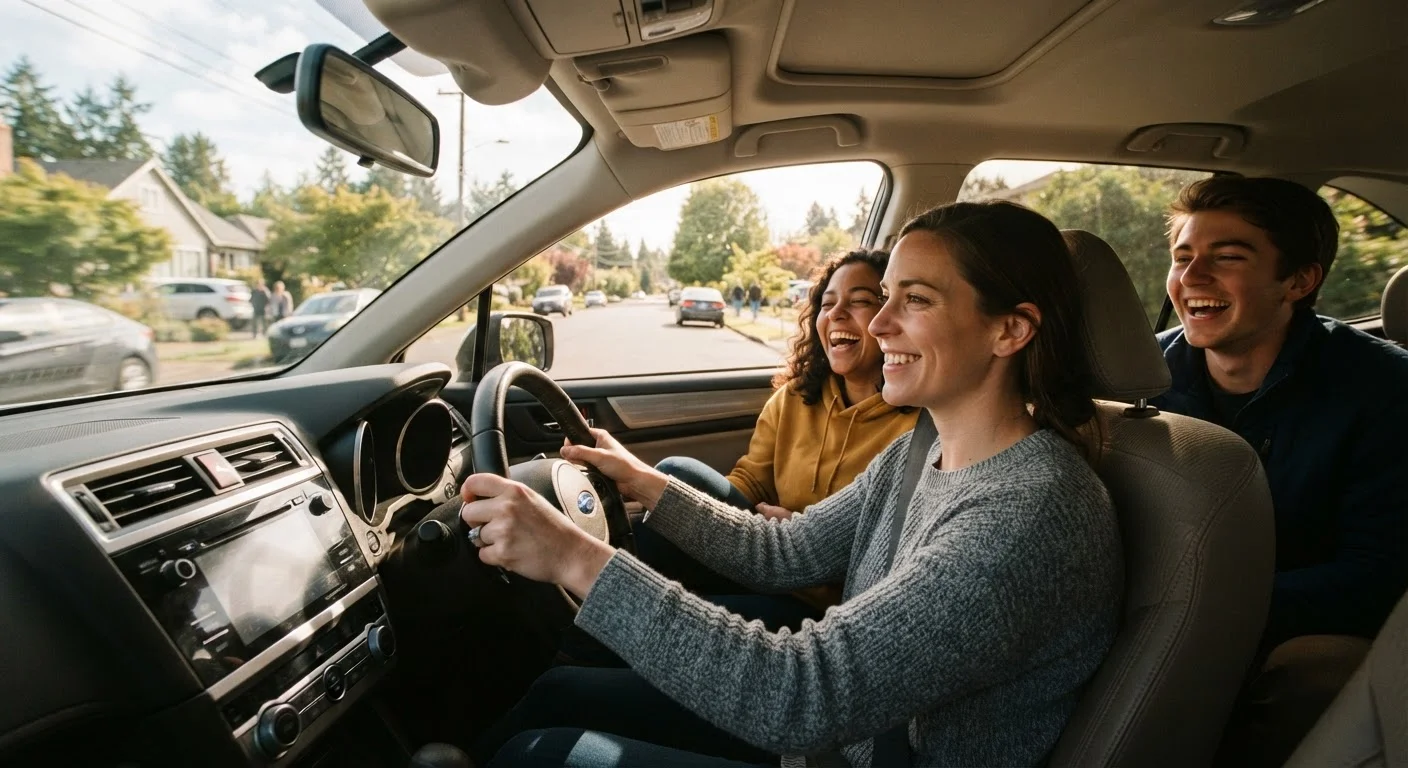
Key Takeaways
- Passengers can increase crash risk by encouraging speeding, distraction, or risk-taking behavior.
- Teen drivers are especially vulnerable - crash risk rises significantly with each additional young passenger.
- Adult passengers, particularly those who are calm and engaged, can sometimes improve driver alertness.
- Social pressure in a car is often subtle and doesn't require anyone to say a word.
- Drivers retain full responsibility for vehicle safety regardless of passenger behavior.
- Setting expectations before a trip is one of the most effective ways to manage passenger influence.
Passenger-Induced Social Pressure
Passenger-induced social pressure refers to the influence that other people in a vehicle have on a driver's behavior, risk tolerance, and decision-making. This influence can be direct - through requests or comments - or indirect, stemming from the driver's desire to appear confident, relaxed, or accommodating. The effect can increase or decrease driving risk depending on who is in the car.
Researchers categorize this as a form of social facilitation or social inhibition, where the presence of an audience alters an individual's performance on a task - in this case, operating a vehicle.
Why the People in Your Car Change How You Drive
Most drivers think of distraction as something screen-related - a notification, a call, a GPS prompt. But one of the most persistent sources of distraction and altered behavior sits right in the passenger seat. The people traveling with you shape the decisions you make on the road, often without anyone realizing it's happening.
This isn't just about noise or conversation. Social pressure is a quieter force. A driver may push through a yellow light to avoid appearing hesitant, edge above the speed limit to match the casual confidence of friends in the back seat, or take a risky merge to avoid inconveniencing passengers on a schedule. None of these decisions involve a direct instruction - they emerge from the driver's desire to manage how they appear to others.
Understanding this dynamic is a practical safety step. The first move is simply recognizing that the behavior exists.
Social Pressure Doesn't Require Words
Drivers often respond to what they perceive passengers are thinking, not just what passengers say aloud. A carload of expectant friends, a passenger checking the time repeatedly, or even laughter from the back seat can subtly alter a driver's pace and risk tolerance. Awareness of this silent influence is the first line of defense.
The Teen Driver Problem Is Well Documented
Passenger influence on driving risk is not uniform across all age groups - it is most pronounced among young drivers. Research from traffic safety organizations has consistently found that the presence of young passengers in a vehicle driven by a teen significantly raises crash probability. The risk compounds with each additional peer passenger.
The underlying mechanism isn't mysterious. Peer environments encourage performance. A teenager who might drive cautiously alone may feel an implicit expectation to drive confidently - or even boldly - in front of friends. Speeding, hard braking, late-night driving through unfamiliar areas, and failure to yield all become more likely when peer approval is in play.
This is one reason graduated driver licensing (GDL) laws in most U.S. states restrict the number and age of passengers new drivers can carry, particularly during nighttime hours. Those restrictions aren't arbitrary - they reflect meaningful crash data.
3x
Teen crash risk increase with multiple young passengers
Research from the AAA Foundation for Traffic Safety has found that teen driver crash risk roughly triples with two or more teen passengers compared to driving alone.
~56%
Of teen crash deaths involve peer passengers or distraction
The Insurance Institute for Highway Safety (IIHS) has reported that a significant share of fatal teen crashes involve passengers, underscoring the peer-presence effect.
40+
U.S. states with GDL passenger restrictions for new drivers
The majority of states include passenger restrictions in their Graduated Driver Licensing programs, reflecting the documented safety risk of peer passengers for new drivers.
When Passengers Can Actually Help
The relationship between passengers and driver safety isn't one-directional. Adult companions - particularly those who are calm, attentive, and familiar with the driver - can serve as an informal co-pilot. They can flag road hazards, manage navigation, and help a tired driver stay alert on a long stretch of highway.
This stands in contrast to solo driving on fatiguing routes. A thoughtful passenger can interrupt the mental drift that builds during monotonous trips, which is where driver fatigue quietly becomes dangerous. In this sense, the right passenger, in the right situation, is a safety asset rather than a liability.
The difference lies in the nature of the relationship and the nature of the conversation. A front-seat passenger who naturally pauses when traffic gets complex is far less cognitively demanding than a conversation partner on the phone - one of the reasons hands-free phone use still carries meaningful distraction risk.
Practical Ways to Manage the Dynamic
Awareness is the starting point, but there are concrete steps drivers can take to reduce passenger-related risk without creating friction in the car.
- Set expectations before you pull out of the driveway. A brief, low-key comment - "I'm going to need you to keep things calm back there" - is far more effective than trying to manage a distracting situation at highway speed.
- Don't treat passenger comfort as a reason to take risks. Being late is recoverable. A collision is not. Keeping that perspective grounded helps resist the subtle pressure to rush.
- Use the passenger as a resource. Assign a front-seat passenger the navigation task so your attention stays on the road rather than the screen.
- Recognize emotionally charged conversations as a hazard. Arguments, upsetting news, or tense discussions pull cognitive attention. It's reasonable - and safe - to pause a difficult conversation until the vehicle is parked.
Building these habits consistently is part of what separates reactive drivers from resilient ones. For a broader look at how sustained habits shape road safety, see our guide to building safer driving habits over time.
Talk to Passengers Before Long or Complex Trips
If you're driving in unfamiliar territory, bad weather, or heavy traffic, let passengers know you'll need to stay focused. Most people are happy to dial back conversation when they understand the driving conditions require it. A simple heads-up removes the awkwardness of asking mid-trip.