

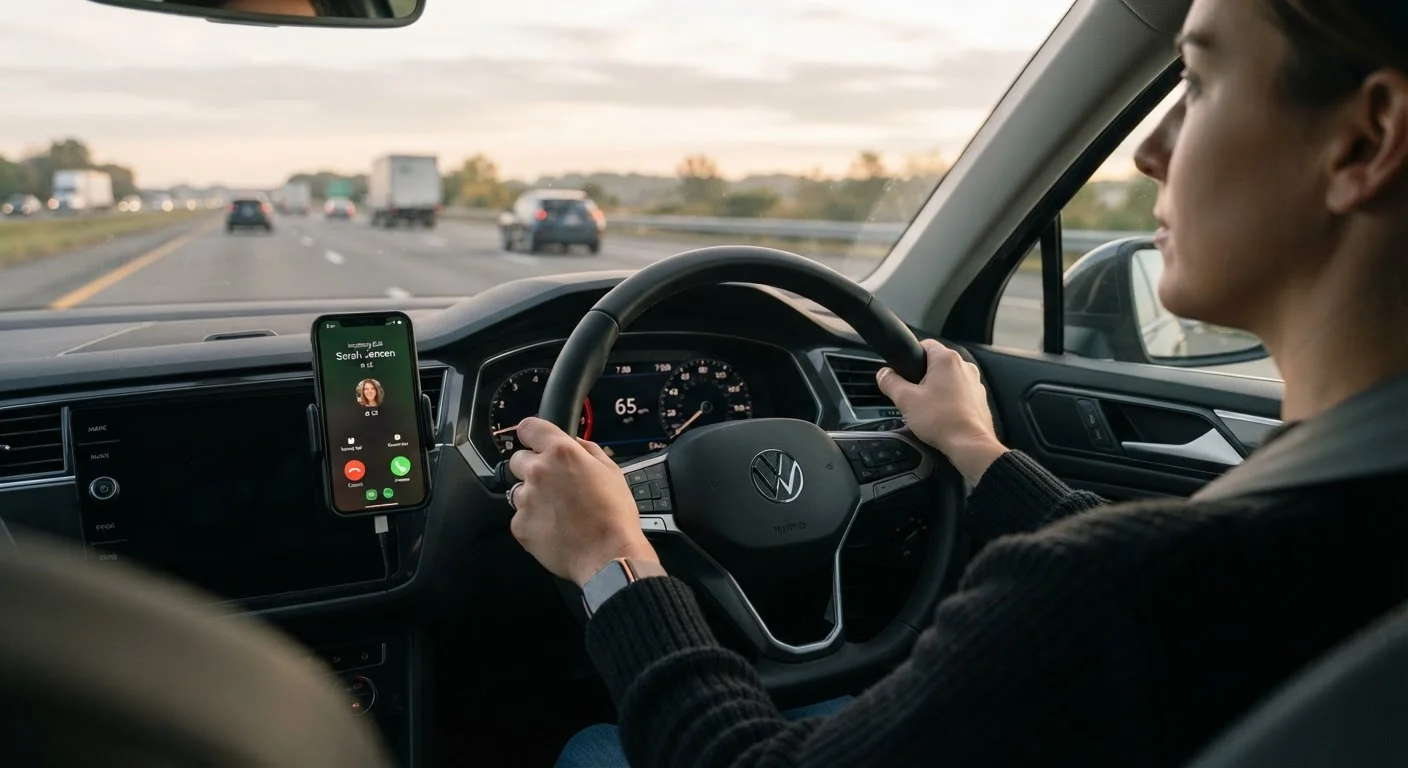
Key Takeaways
- Hands-free calling is legal in most U.S. states but does not eliminate cognitive distraction.
- Research consistently shows that phone conversations reduce a driver's situational awareness, regardless of device type.
- Manual tasks like dialing or texting carry a separate, additional layer of physical distraction.
- Driving with no active phone use offers the clearest cognitive baseline for road attention.
- Brief, urgent calls may be lower-risk than sustained multi-topic conversations while driving.
Option A
Hands-Free Phone Use
The legally permitted, tech-enabled compromise.
Best for: Drivers who need to stay reachable for urgent calls and want to stay within the law.
Option B
No Phone at All
The fully disconnected, cognitively clear approach.
Best for: Drivers who prioritize maximum attention and want to eliminate distraction entirely.
If you must stay reachable for critical, time-sensitive calls
Hands-Free Phone Use
It removes the physical distraction of holding a device and keeps you within the law, though you should keep calls short and pull over for complex conversations.
If you want the safest possible driving environment
No Phone at All
Silencing and stowing your phone eliminates both physical and cognitive distraction - the most reliable way to keep your full attention on the road.
If you're driving in heavy traffic or unfamiliar conditions
No Phone at All
High-demand driving situations require your complete mental bandwidth; even a hands-free conversation competes with the same cognitive resources.
If you're on a long, low-complexity highway stretch
Hands-Free Phone Use
Lower cognitive load on familiar, open roads somewhat reduces - though doesn't remove - the risk of a brief hands-free call.
Why 'Hands-Free' Doesn't Mean 'Distraction-Free'
Most U.S. states allow hands-free phone use while driving and ban handheld calls. That legal distinction is meaningful - but it can give drivers a false sense of safety. The core problem isn't just where your hands are. It's where your mind is.
Research from institutions including the National Safety Council has repeatedly found that phone conversations impair a driver's ability to process the visual environment around them - a phenomenon sometimes called inattention blindness. Even with both hands on the wheel and eyes on the road, drivers engaged in phone conversations can miss traffic signals, pedestrians, and sudden stops. This is distinct from simply listening to audio, because conversation demands active, dynamic cognitive participation.
Compare this to driving with no phone engagement at all. With no call to track, no response to formulate, and no social obligation to manage, a driver's working memory stays oriented toward the road environment - where it belongs. As you'd find in our overview of driver fatigue, degraded attention - whether from exhaustion or distraction - affects reaction time in ways that are easy to underestimate.
| Criterion | Hands-Free Phone Use | No Phone at All |
|---|---|---|
| Legal status (most U.S. states) | Permitted | Permitted |
| Manual distraction | Eliminated (no holding device) | None |
| Visual distraction | Minimal (eyes stay on road) | None |
| Cognitive distraction | Present - conversation demands attention | None from phone |
| Situational awareness | Reduced during active calls | Unimpaired |
| Risk vs. handheld use | Lower (no physical handling) | Lowest |
| Practical accessibility | High - Bluetooth widely available | Requires deliberate habit change |
What the Research Actually Shows
Studies on driver distraction broadly distinguish three types: visual (eyes off the road), manual (hands off the wheel), and cognitive (mind off the task). Handheld phone use triggers all three. Hands-free use eliminates the first two - but cognitive distraction remains.
~50%
Visual information potentially missed during hands-free calls
Estimated by the National Safety Council based on cognitive distraction research.
4×
Increased crash risk with handheld phone use
The National Highway Traffic Safety Administration cites consistent findings across multiple distraction studies.
27×
Increased crash risk when texting while driving
NHTSA research highlights texting as among the most dangerous manual-visual-cognitive distractions.
One frequently cited finding from the National Safety Council estimates that drivers using hands-free devices can miss seeing up to 50% of the information in their driving environment. That doesn't mean every hands-free call ends in a near-miss - context matters enormously. A brief, low-stakes check-in on a straight, empty road is a different scenario than a tense, emotionally loaded call in stop-and-go traffic.
Passenger conversations, by contrast, tend to be less cognitively demanding: a passenger naturally pauses when traffic gets complex. A phone caller has no such awareness and may continue talking through exactly the moments when you need to focus. For a deeper look at how in-car social dynamics work, see our piece on how passengers affect road safety.
Practical Decisions Behind the Wheel
Knowing that hands-free calling carries cognitive risk doesn't mean every driver needs to treat their phone as contraband. It does mean making more deliberate choices about when a call is appropriate.
A few considerations worth applying:
- Pull over for complex conversations. If a call involves decisions, conflict, or concentrated information exchange, park before engaging.
- Use Do Not Disturb modes proactively. Most smartphones offer driving-detection modes that hold messages and auto-reply to callers - use them.
- Short, simple calls carry less risk. "I'm running five minutes late" is categorically different from a negotiation or an emotional conversation.
- High-demand roads warrant full focus. Dense urban driving, adverse weather, and unfamiliar routes should prompt you to defer all calls.
Building consistent habits around phone use is part of broader safe driving practice. The habits that underpin long-term road safety are rarely dramatic - they're about steady defaults that hold up under pressure.
State Laws Vary Significantly
Hands-free requirements differ across U.S. states - some ban all handheld use, others only restrict texting, and a few have stricter rules for novice drivers. Research indicates that even where hands-free calling is legal, cognitive impairment from the call itself remains. Always verify your state's current distracted driving statutes directly through official sources.
This article is for general informational and educational purposes. Always check your state's current distracted driving laws, as regulations vary and can change.