

| Roundabout right-of-way rule | Yield to traffic already inside the circle |
| Four-way stop tiebreaker | Driver on the left yields to driver on the right |
| Merging on-ramp rule | Merging driver yields to through-lane traffic |
| Roundabout traffic direction (US) | Counterclockwise |
| Zipper merge endorsement | Recommended by most state DOTs for lane-end merges |
| Uncontrolled intersection rule | Yield to vehicle already in intersection; then yield to driver on right |
Why Right-of-Way Confusion Is a Real Safety Problem
Failure to yield is consistently cited by traffic safety researchers as one of the leading causes of intersection collisions in the United States. Right-of-way rules aren't optional courtesies - they are codified traffic laws that vary slightly by state but share a common framework. Misreading a junction or hesitating at a merge can produce rear-end impacts, sideswipes, and T-bone crashes that are largely preventable.
This reference covers the three scenarios where drivers most often get it wrong: roundabouts, traditional junctions (including stop and yield signs), and highway or arterial merges. Use it as a quick lookup whenever a rule feels unclear.
For a broader look at what road markings and signs legally require, see our road signs reference guide.
| Roundabout right-of-way rule | Yield to traffic already inside the circle |
| Four-way stop tiebreaker | Driver on the left yields to driver on the right |
| Merging on-ramp rule | Merging driver yields to through-lane traffic |
| Roundabout traffic direction (US) | Counterclockwise |
| Zipper merge endorsement | Recommended by most state DOTs for lane-end merges |
| Uncontrolled intersection rule | Yield to vehicle already in intersection; then yield to driver on right |
Roundabouts: Yield to the Left, Move Counterclockwise
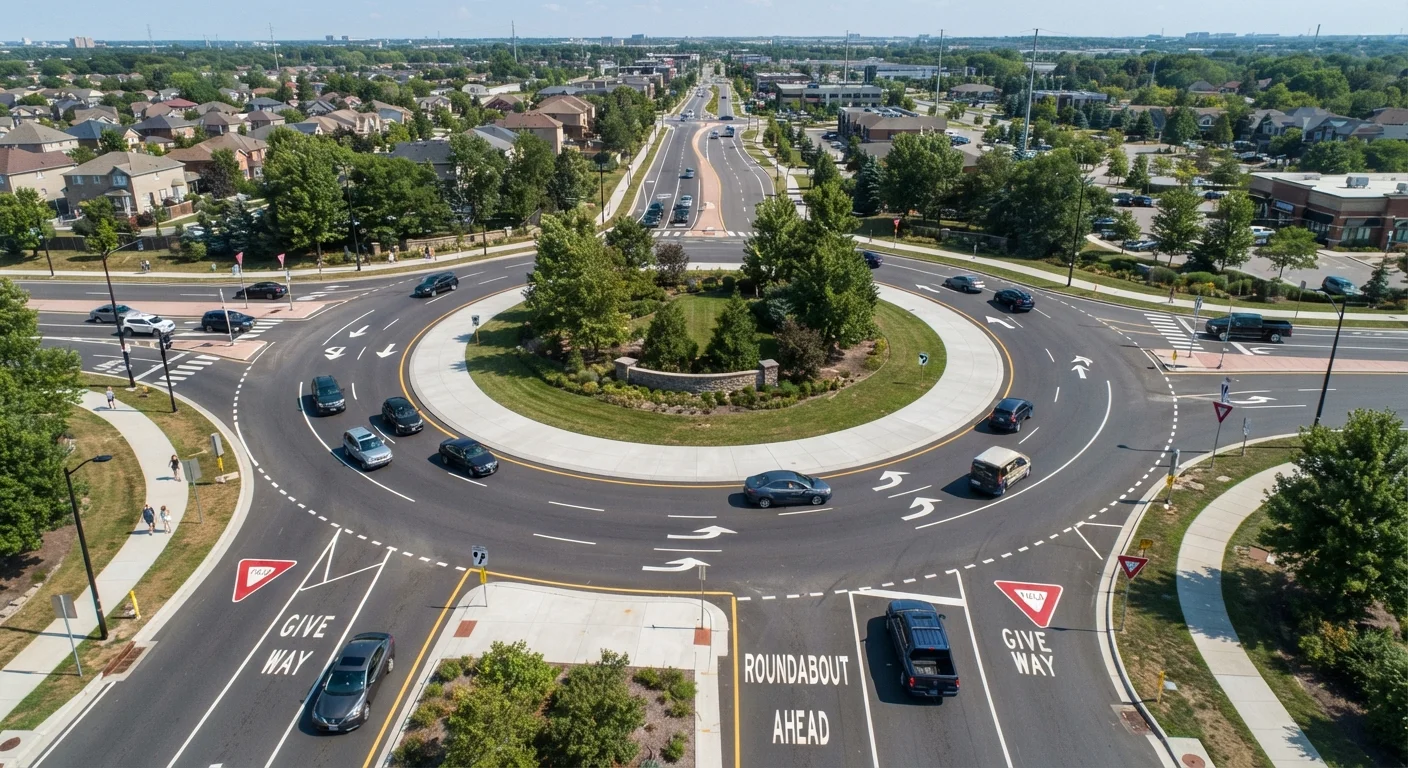
Roundabouts replace traditional signalized intersections with a one-way circular roadway. In the US, traffic flows counterclockwise. The core rule is straightforward: vehicles already inside the roundabout have right-of-way. Entering drivers must yield at the dashed white yield line before entering the circle.
Common roundabout mistakes
- Stopping inside the circle: Once you have entered legally, you have priority - do not stop to let additional cars in.
- Wrong lane choice: In multi-lane roundabouts, choose your lane before you enter based on your exit. Right lane for the first or second exit; left lane for exits further around the circle. Lane markings and signs guide this.
- Misjudging speed: Roundabout entry speeds are typically 15-25 mph. Entering too fast reduces reaction time for pedestrians in crosswalks, who have right-of-way at marked crossings outside the circle.
Right-of-way
The legal entitlement of a driver, pedestrian, or cyclist to proceed through a given point before others. Right-of-way can be granted by traffic controls (signs, signals) or by law when no controls are present.
Yield
To slow or stop and allow conflicting traffic to pass before proceeding. A yield does not always require a full stop - only when traffic is present and a safe gap does not exist.
Zipper merge
A merging technique where drivers use the full length of an ending lane and then alternate one-for-one with through traffic at the merge point. Endorsed by traffic engineers as efficient and safe.
Uncontrolled intersection
An intersection with no stop sign, yield sign, or traffic signal. Drivers must use the standard right-of-way rules - yield to vehicles already present, then to the vehicle on the right.
All-way stop
An intersection where every approach has a stop sign. Vehicles proceed in the order they arrived; ties are broken by yielding to the driver on the right.
Junctions: Stop Signs, Yield Signs, and Uncontrolled Intersections
Four-way stops
At an all-way stop, the driver who arrives and stops first proceeds first. When two vehicles arrive simultaneously, the driver on the left yields to the driver on the right. When three or more vehicles arrive together, the same right-of-way-to-the-right principle cascades - though eye contact and cautious communication often resolve ambiguity in practice.
Two-way stops
Only cross-traffic has a stop sign. Drivers on the through road have right-of-way at all times. Drivers at the stop sign must wait for a safe gap before proceeding, turning left, or turning right - regardless of how long they have been waiting.
Yield signs
A yield sign requires you to slow and give way to conflicting traffic but does not require a full stop unless traffic is present. Treat it as a rolling evaluation: if a gap exists, proceed; if not, stop and wait.
Uncontrolled intersections
Where no sign or signal exists, yield to any vehicle already in the intersection. If arriving simultaneously, yield to the driver on your right. These intersections demand extra caution because neither driver has an obvious legal advantage until one vehicle is clearly already committed.
Right-of-Way Laws Vary by State
While the principles described here reflect the broad US framework, specific wording, penalties, and edge-case rules differ by state. Always consult your state's driver handbook for the exact statutory language that applies where you drive. This article is general educational information, not legal advice.
Merging: Who Yields on Ramps and Lane Changes
Highway on-ramps require merging drivers to match the speed of through traffic and find a gap - through-lane traffic is not legally required to move over, though doing so when safe is common courtesy and reduces collision risk. Treat the acceleration lane as your opportunity to reach highway speed, not a place to stop and wait.
Zipper merge
When a lane ends due to construction or a lane drop, traffic engineers and most state DOTs endorse the zipper merge: use the full length of the ending lane, then alternate one-for-one with through-lane traffic at the merge point. Studies indicate zipper merging reduces backup length and is statistically safer than early merging, yet many drivers treat late merging as aggressive. It is not - it is the intended technique.
Lane changes on multi-lane roads
A driver changing lanes always yields to vehicles already occupying the target lane. There is no right-of-way based on lane position alone. Signal early, check mirrors and blind spots, and ensure a clear gap before moving. For a deeper look at managing speed and space on high-speed roads, see motorway driving fundamentals.
Maintaining safe following distance during all merging scenarios is essential - tailgating significantly increases crash risk in exactly these high-transition situations.
~40%
Of US traffic fatalities occur at or near intersections
According to the Federal Highway Administration, intersection-related crashes account for roughly 40% of all traffic fatalities annually.
Up to 75%
Reduction in serious injury crashes at roundabouts vs. traditional intersections
The Insurance Institute for Highway Safety reports that converting signalized intersections to roundabouts can reduce serious injury crashes by up to 75%.