

Key Takeaways
- At 60 mph, a car travels roughly 88 feet per second - leaving little margin for error when following too closely.
- Most tailgating is habitual or stress-driven, not a deliberate choice to drive aggressively.
- The two-second following distance rule is a minimum - wet roads, fatigue, and heavy loads all demand more space.
- Rear-end collisions are among the most common crash types in the US, and following distance is a leading factor.
- Increasing your following distance costs almost no travel time but significantly reduces crash risk.
The Physics Most Drivers Ignore
When a driver ahead brakes suddenly, you don't just need time to apply your own brakes - you need time to perceive the hazard, decide to react, and then physically move your foot. That cognitive-physical sequence typically takes between 1.5 and 2.5 seconds for an alert, rested driver. At 60 mph, your vehicle covers around 88 feet every second. Do the math: before your brakes even engage, you may have already closed 130-220 feet of gap.
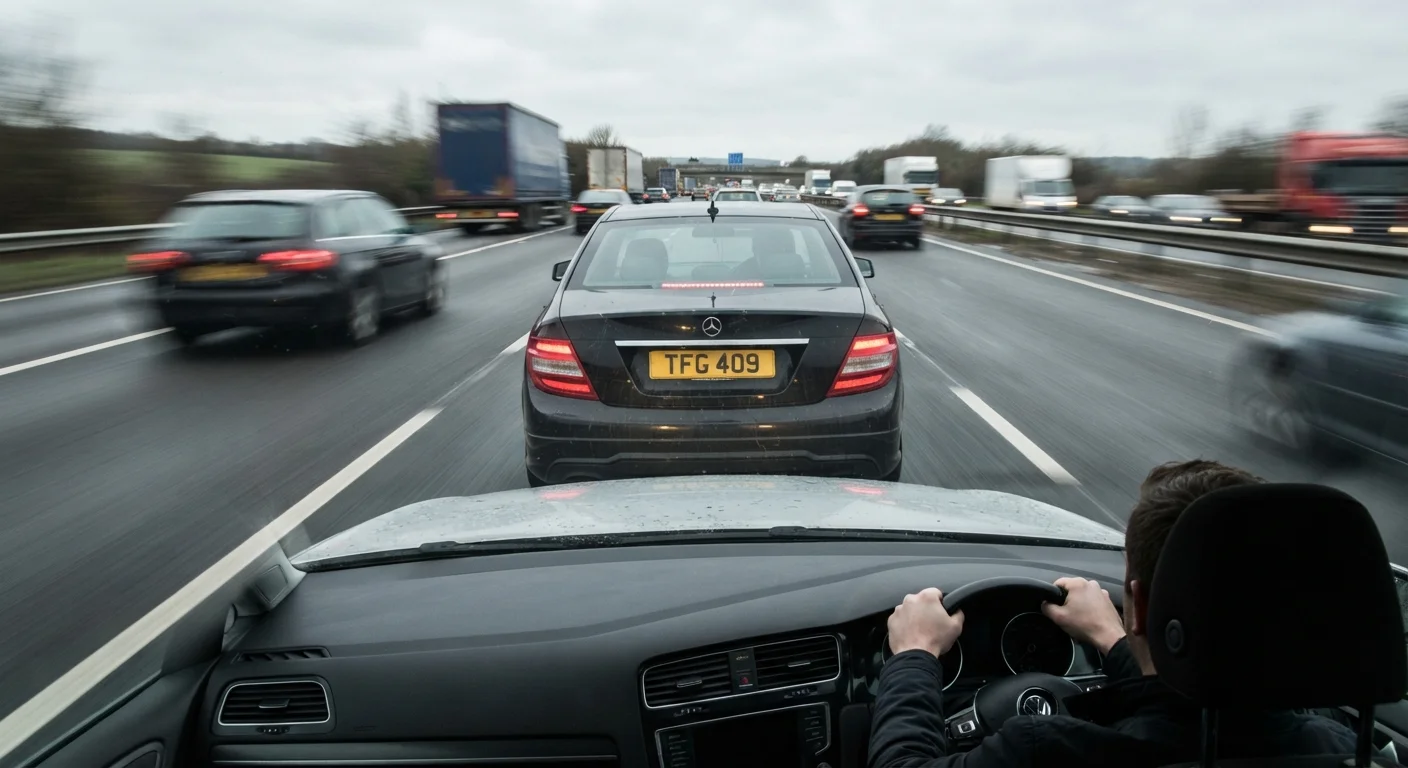
Tailgating erases that buffer entirely. A car riding two car lengths behind another at highway speed has, effectively, zero safe stopping margin if the lead vehicle encounters an obstacle, braking animal, or sudden congestion. The physics are unforgiving - kinetic energy increases with the square of velocity, meaning stopping distances climb sharply as speed rises.
See our following distance guidelines explained for a practical breakdown of how to calculate safe gaps in different conditions.
~29%
Of all US crashes involve rear-end collisions
According to the National Highway Traffic Safety Administration (NHTSA), rear-end crashes consistently account for roughly a third of all reported traffic collisions in the United States.
1.5-2.5 sec
Typical perception-reaction time for an alert driver
Research in traffic safety consistently places average driver perception-reaction time in this range under normal conditions - longer when fatigued or distracted.
Common Tailgating Mistakes and How to Avoid Them
Tailgating isn't usually one single behaviour - it's a cluster of related habits and misjudgements. Understanding where these patterns come from is the first step to correcting them.
Underestimating personal reaction time and assuming brakes will compensate.
Why it happens: Drivers tend to overestimate their own alertness and reflexes, especially on familiar routes or after years of incident-free driving.
Tailgating out of frustration when a slower driver is ahead.
Why it happens: Stress, time pressure, and the sense that the driver ahead is being inconsiderate trigger an emotional override of rational risk assessment.
Maintaining city-road following distances on highways.
Why it happens: Drivers calibrate distance by visual spacing, which looks deceptively large at speed. The same number of car lengths that is adequate at 30 mph is dangerously insufficient at 65 mph.
Failing to increase following distance in poor weather or low-visibility conditions.
Why it happens: Many drivers apply the same habitual gap regardless of conditions, not consciously adjusting for rain, fog, or road surface changes.
Closing the gap after being cut off by a merging vehicle.
Why it happens: Being cut off feels like a loss of position, and the instinct is to re-establish the original gap by accelerating toward the vehicle that merged in.
Tailgating Can Also Carry Legal Consequences
In most US states, following too closely is a ticketable traffic violation. If a rear-end collision occurs and you were determined to be tailgating, you are typically presumed at fault - which can affect your insurance rates and driving record. Some jurisdictions also treat aggressive tailgating as a form of reckless driving.
Conditions That Make Tailgating Even More Hazardous
Following distance requirements don't stay constant. Several conditions dramatically increase the stopping distance your vehicle needs, making an already insufficient gap dangerous:
- Wet or icy roads: Stopping distances can double or triple on wet pavement and increase by up to ten times on ice compared to dry conditions.
- Fatigue: A tired driver's perception-reaction time can stretch well beyond 2.5 seconds. Driver fatigue impairs judgement in ways that rival alcohol impairment - and most drivers underestimate how degraded their responses have become.
- Night driving: Reduced visibility compresses the distance at which hazards become visible. Night driving carries risks most drivers underestimate, and tailgating at night leaves virtually no corrective window.
- Heavy or tall vehicles: Trucks and SUVs have longer stopping distances than smaller cars. If you're driving one - or following one - adjust your gap accordingly.
- High-speed roads: The gap that feels adequate at 35 mph is dangerously inadequate at 70 mph. Legal speed limits set a ceiling, not a target - safe speed depends on more than the posted number.
Wet Roads Change Everything
On wet pavement, stopping distances for a typical passenger car can double compared to dry conditions. At 60 mph in rain with a standard following gap, you may have already entered the vehicle ahead's space before your brakes take full effect. When it rains, increasing your gap to a minimum of four seconds is not overcaution - it's physics.
Building the Habit of Safer Following Distance
Changing a deeply ingrained driving behaviour takes deliberate effort over time. The good news: the adjustment is small but the payoff is substantial. Increasing your following distance from one second to three seconds costs you almost no additional travel time on a typical commute - but it dramatically expands your reaction window.
Practical strategies include picking a fixed reference point when the car ahead passes it, then counting off seconds until you pass the same point. If you reach it in under two seconds, back off. In adverse conditions, extend that minimum to four seconds or more. Cruise control on highways can help maintain a steadier speed and reduce the unconscious drift toward the vehicle ahead.
The broader goal is building consistent habits - not just applying rules once. Building safer driving habits over time covers the mindsets and practices that underpin long-term road safety beyond any single technique.