

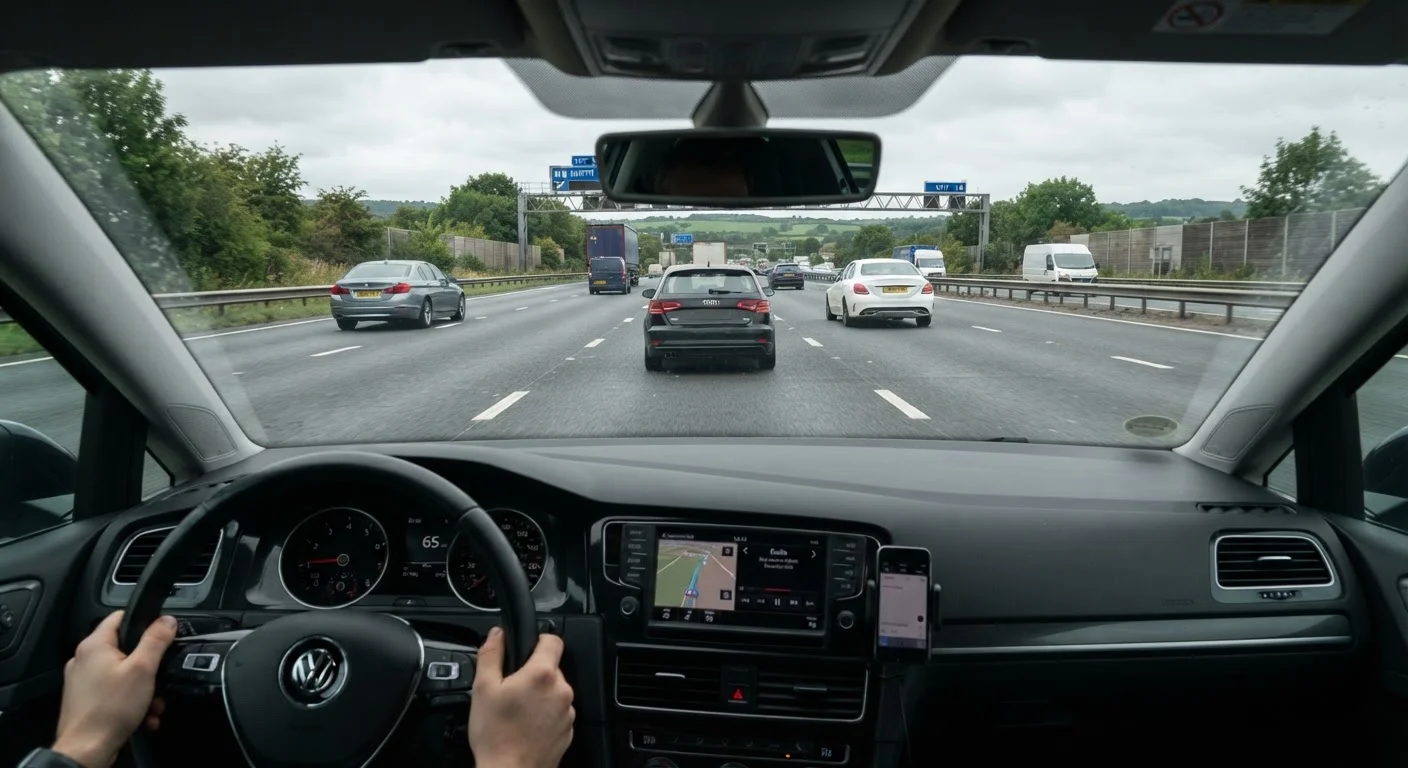
Key Takeaways
- The two-second rule gives you a speed-adaptive baseline for following distance in normal conditions.
- Adverse weather, heavy loads, and reduced visibility all call for extending that gap significantly.
- Following too closely is a leading cause of rear-end collisions, which are largely preventable.
- Large vehicles like trucks and motorcycles require adjusted spacing rules from other drivers.
- No fixed formula replaces real-time judgment - conditions on the road change constantly.
The Two-Second Rule
The two-second rule is a simple method for maintaining a safe following distance behind another vehicle. After the car ahead passes a fixed landmark, count two seconds - if you reach that same landmark before you finish counting, you're following too closely. The rule works at any speed because it automatically adjusts the gap based on how fast you're traveling.
At 60 mph, two seconds translates to approximately 176 feet of following distance. Many driver safety curricula and state DMV guidelines reference this rule as a baseline for dry, clear conditions.
Why Following Distance Matters More Than Most Drivers Think
Reaction time is the hidden variable in nearly every rear-end collision. Even an alert driver typically takes 1.5 seconds to perceive a hazard and press the brake - and that's before the vehicle's braking system even begins slowing the car. At 60 mph, you travel about 132 feet in that 1.5 seconds alone. Add actual braking distance, and the total stopping requirement becomes substantial.
That's the core problem with following too closely: it eliminates your margin for error. A distraction lasting less than two seconds, a sudden stop from the car ahead, or a patch of wet pavement can close a short gap before you've had any real chance to respond. Tailgating is far more dangerous than most drivers acknowledge - and it's one of the most common collision causes on US roads.
~40%
Of all US crashes that are rear-end collisions
According to NHTSA research, rear-end crashes consistently represent the most common crash type on American roads.
1.5 sec
Average driver perception-reaction time
Traffic engineering references commonly cite 1.5 seconds as a standard assumption for alert drivers in stopping-distance calculations.
176 ft
Two-second gap at 60 mph
At 60 mph, two seconds of following distance equals approximately 176 feet - longer than half a football field.
How the Two-Second Rule Works
The method is deliberately simple. Pick a stationary object - a road sign, an overpass, a painted marking. The moment the rear of the vehicle ahead passes it, start counting: one-one-thousand, two-one-thousand. If the front of your car reaches that same point before you finish, close your gap.
The rule's elegance is that it's speed-independent. At 30 mph, two seconds gives you roughly 88 feet. At 65 mph, that same count yields around 190 feet. The gap expands automatically because you're measuring time, not a fixed distance.
Practice the Count Before It Counts
Run through the two-second count during low-stakes moments - light traffic on a familiar route - until it feels natural. Drivers who practice the technique consciously tend to apply it more reliably when conditions suddenly change.
Some driving instructors recommend starting with a three-count until the habit is ingrained - it builds a buffer for the inevitable moment your eyes drift to your mirrors or an in-car display.
When Two Seconds Isn't Enough
The two-second rule is explicitly a baseline for ideal conditions: dry pavement, good visibility, a well-maintained vehicle. In practice, many situations demand considerably more space.
- Rain or wet roads: Stopping distances can increase by 50% or more on wet surfaces. Three to four seconds is a reasonable minimum.
- Fog, snow, or ice: Drop your speed and extend following distance to five seconds or beyond. Visibility limitations compound stopping-distance problems.
- Towing a trailer: The added weight dramatically increases stopping distance. Four seconds minimum; more if the load is heavy.
- Following a large truck or bus: Heavy vehicles stop more slowly. Give them at least four seconds, and stay out of their rear blind spot.
- Night driving: Your ability to perceive hazards early is reduced. Add at least one additional second to your gap.
Just as posted speed limits don't define a safe speed in every condition, the two-second rule isn't a ceiling - it's a floor.
Special Cases: Motorcycles, Trucks, and City Traffic
Following distance rules aren't one-size-fits-all. Different vehicle types and road environments shift the calculus.
- Motorcycles ahead of you
- Motorcycles can stop faster than cars on dry pavement, but riders are far more vulnerable in any collision. Maintain at least two seconds and treat it more conservatively - three is better.
- You on a motorcycle
- Motorcyclists generally follow the same two-second guideline, but braking performance and road hazard sensitivity (gravel, debris, uneven pavement) may warrant more space.
- City and stop-and-go traffic
- At low speeds, the two-second rule may feel excessive and often collapses in dense traffic. In slow-moving city conditions, keeping enough room to see the rear tires of the car ahead touching the pavement is a practical alternative - it provides a small but meaningful buffer without disrupting traffic flow.
City Traffic and the Two-Second Rule
In dense urban stop-and-go traffic, strictly maintaining a two-second gap can be difficult and may draw impatient lane changes from other drivers. In these scenarios, focusing on visibility - keeping enough distance to see the road surface under the tires of the car ahead - remains a practical safety baseline even when the full two-second gap isn't realistic.
Building the Habit
Knowing the rule and consistently applying it are different things. Aggressive traffic, time pressure, and the tendency of other drivers to fill any gap you leave all work against the habit.
One practical approach: treat your following gap as non-negotiable, not as an invitation for other drivers to merge. If someone cuts in, simply ease back to re-establish your distance. Over time, maintaining space becomes automatic - a low-effort behavior with a meaningful payoff in crash avoidance.
It also helps to regularly scan further ahead than just the car immediately in front of you. Watching two or three cars ahead gives you earlier warning of slowdowns, which means less abrupt braking and a safer experience for everyone in your lane.