

Key Takeaways
- Posted speed limits represent legal maximums, not recommended driving speeds for all conditions.
- Weather, visibility, road surface, and traffic all affect what speed is actually safe.
- Driving at the limit during hazardous conditions can still result in citations or liability.
- Safe speed requires active judgment - not just compliance with a sign.
- Stopping distance increases dramatically with speed, especially on wet or icy roads.
Option A
The Posted Speed Limit
The legal maximum - set for ideal conditions.
Best for: Establishing a lawful upper boundary on roads under normal, clear conditions.
Option B
Safe Speed
The situational speed - adjusted for real-world conditions.
Best for: Drivers who want to match their pace to actual road, weather, and visibility factors.
If you want to stay within the law on a clear, dry highway
The Posted Speed Limit
Under ideal conditions, the posted limit is designed to be both legal and generally safe for that road type.
If you're driving in rain, fog, snow, or heavy traffic
Safe Speed
Conditions dramatically reduce stopping distance and visibility - your speed should reflect those realities, even if it means going well below the posted limit.
If you're navigating an unfamiliar road at night
Safe Speed
Reduced visibility and unknown hazards demand lower speeds regardless of what the sign says.
What Speed Limits Actually Mean
Speed limits in the US are set by state and local authorities based on road engineering, typical traffic patterns, and conditions under normal, favorable circumstances. They represent the legal maximum - not a suggestion that every driver should travel at that speed at all times.
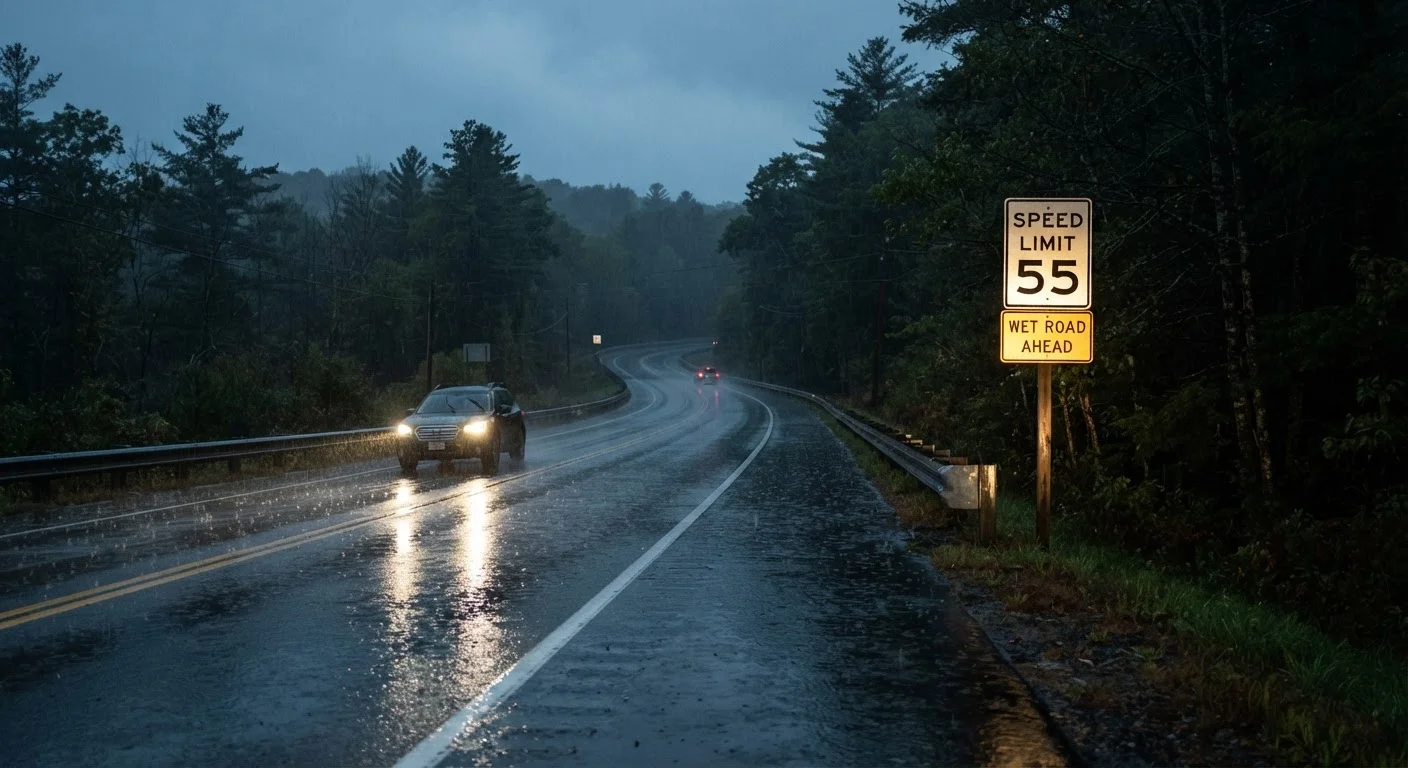
In most states, traffic law includes a concept sometimes called the Basic Speed Law: no driver may operate a vehicle at a speed that is greater than is reasonable and prudent given the actual conditions, regardless of the posted limit. This means that driving at 55 mph on an icy freeway with a 55 mph sign is not automatically a legal defense if you lose control.
Understanding this distinction is foundational. The number on the sign answers the question "What is the legal ceiling?" - not "How fast should I be going right now?"
| Criterion | Posted Speed Limit | Safe Speed |
|---|---|---|
| Set by | Government/traffic engineers | Driver judgment in real time |
| Based on | Ideal road conditions | Actual current conditions |
| Changes with weather? | No - static sign | Yes - should decrease in poor conditions |
| Legal relevance | Defines lawful maximum | Defines reasonable/prudent standard |
| Driver action required | Read and stay at or below | Actively evaluate and adjust |
| Liability if accident occurs | May still be liable if conditions warranted less | Reduced if speed was appropriate to conditions |
The Gap Between Legal and Safe
Several factors can make the posted speed genuinely unsafe, even when you're technically within the law:
- Wet or icy surfaces: Stopping distances can double or triple on wet pavement compared to dry conditions. Black ice offers almost no tire grip, making any speed dangerous if not approached carefully.
- Reduced visibility: Fog, heavy rain, or darkness shrinks the distance at which you can identify hazards. If you can't see far enough to stop safely, you're effectively driving blind into whatever's ahead. See our guide to night driving risks for more on how visibility shapes safety.
- Heavy traffic: Even at moderate speeds, dense traffic compresses reaction time. Maintaining safe following distance - covered in our two-second rule explainer - becomes harder at higher speeds.
- Road type and geometry: A 55 mph limit on a straight rural highway may be reasonable. The same limit on a winding mountain road with tight curves is a different story entirely.
- Vehicle condition: Worn tires, older brakes, or a heavily loaded vehicle all extend stopping distance and reduce control.
2x
Increase in stopping distance on wet pavement
The NHTSA notes that wet roads significantly extend braking distance compared to dry conditions, varying by speed and tire condition.
~40%
Of fatal crashes involve speeding as a factor
The NHTSA's traffic safety data consistently shows speeding - including speed inappropriate for conditions - contributes to a large share of fatal collisions.
Safe speed requires you to weigh these variables continuously - it's an active decision, not a passive glance at a sign.
How to Gauge Your Actual Safe Speed
There's no universal formula, but a few practical principles help:
- Match your speed to your sight line. You should always be able to stop within the distance you can see clearly ahead. If fog or darkness limits visibility to 200 feet, ask whether your current speed allows you to stop in 200 feet or less.
- Treat posted limits as upper bounds. When conditions degrade, treat the speed limit as a ceiling, then work down from there based on what you actually see and feel from the road.
- Slow down smoothly before curves, intersections, and merges. Speed management is most effective before a hazard - not during it.
- Watch for behavioral cues from other drivers. If traffic is moving noticeably slower than the limit, there's often a reason - don't override that signal to keep pace with the sign.
Building this kind of adaptive judgment is part of developing safer long-term driving habits. It takes practice and attention, but it's the single most effective way to reduce your risk on any road.
This article is for general educational purposes only. Always follow applicable traffic laws in your jurisdiction and consult official driving guidelines for your state.