

Key Takeaways
- When debt interest exceeds your savings rate, every dollar saved costs you more than it earns.
- High-interest debt - typically above 7-8% APR - almost always warrants priority over building savings.
- Low-interest debt may not need to be rushed if your savings rate is competitive or employer matching is available.
- Both rates change over time, so comparing them regularly helps you reallocate dollars effectively.
- A small emergency fund should generally come before aggressive debt repayment to avoid new borrowing.
Option A
Savings Rate (APY)
The return your money earns sitting in a savings vehicle.
Best for: Building an emergency fund, accumulating capital, and earning passive growth over time.
Option B
Debt Interest Rate (APR)
The cost your lender charges for money you've borrowed.
Best for: Understanding how quickly a balance grows and how urgently it should be paid down.
If you carry high-interest credit card debt (15%+ APR)
Debt Interest Rate (APR)
Paying down high-APR debt delivers a guaranteed, risk-free return equal to the rate - almost certainly higher than any savings vehicle can match.
If your only debt is a low-rate mortgage or student loan under 5% APR
Savings Rate (APY)
When borrowing costs are low, consistent saving and investing may outpace the cost of debt over the long run - especially with employer retirement matching.
If you have no emergency fund at all
Savings Rate (APY)
A small cash cushion prevents you from taking on new debt when an unexpected expense hits, breaking a common debt cycle.
If you're unsure which debts to attack first
Debt Interest Rate (APR)
Ranking debts by APR - highest first - is the mathematically efficient approach and helps you see exactly where money is being lost fastest.
Two Numbers That Determine Where Your Dollar Works Hardest
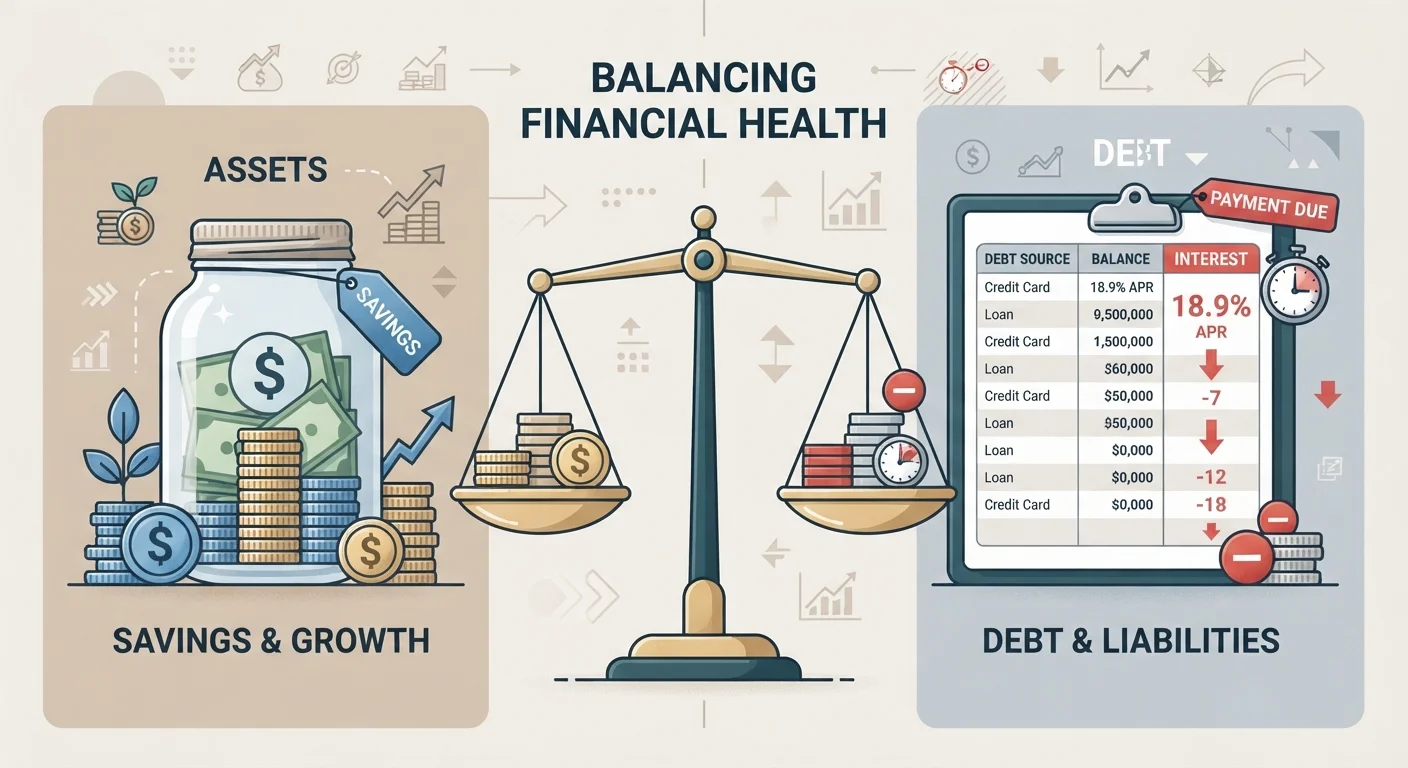
Every dollar in your budget is competing for a job. It can sit in savings and earn a return, or it can go toward debt and eliminate a cost. The question of which job pays better comes down to two rates: your savings APY (Annual Percentage Yield) and your debt APR (Annual Percentage Rate).
APY measures the effective annual return on a deposit account, accounting for compounding. APR measures the annual cost of borrowing, though the actual compounding effect on a revolving debt can make the real cost higher. Understanding how compound interest works for and against you in both contexts is essential before deciding where to direct extra cash.
The math is straightforward in principle: if your debt charges 20% APR and your savings account earns 4.5% APY, every dollar in savings is effectively losing you 15.5 cents a year compared to paying down that debt. That gap is the signal that deserves your attention.
| Criterion | Savings Rate (APY) | Debt Interest Rate (APR) |
|---|---|---|
| What it measures | Annual return on deposited money | Annual cost of borrowed money |
| Typical range (general market) | 2%-5% for deposit accounts | 6%-30%+ depending on debt type |
| Effect of compounding | Works in your favour over time | Works against you on unpaid balances |
| Certainty of return/cost | Variable; rates can change | Fixed or variable per loan terms |
| Priority signal | Prioritise when APY exceeds debt APR | Prioritise when APR exceeds savings APY |
| Risk level | Low (FDIC-insured deposits up to limits) | Obligation is certain; non-payment carries consequences |
When the Debt Rate Wins the Comparison
High-interest consumer debt - credit cards, payday loans, some personal loans - routinely carries APRs in the 20-30% range. No widely available savings account or low-risk investment vehicle reliably matches those returns. Paying down such debt is effectively a guaranteed, risk-free return equal to the rate you eliminate.
This is the core argument for prioritising debt repayment: it's not just about interest math, it's about certainty. Savings yields fluctuate; your obligation to pay 24% APR on a credit card balance does not.
20-30%
Typical credit card APR range in the US
According to the Consumer Financial Protection Bureau, average credit card interest rates have remained well above 20% APR in recent years for accounts carrying a balance.
3-5%
Common high-yield savings APY range
High-yield savings account rates vary with Federal Reserve policy and differ by institution; always verify current rates directly with the provider.
~15-25%
Typical rate gap: credit card vs. savings
The difference between high-interest debt costs and savings yields illustrates how much carrying a credit card balance can erode a household's net financial position.
If you're deciding which debts to tackle first, the debt avalanche and snowball methods offer structured approaches - the avalanche method targets the highest APR first, directly maximising the rate-comparison logic.
When the Savings Rate Deserves Equal Priority
Not all debt is urgent to eliminate ahead of saving. A fixed-rate mortgage at 3.5% or a federal student loan at 4.5% may cost less annually than what a diversified investment account has historically returned over long periods - though past performance is not a guarantee of future results, and investment always carries risk.
Two scenarios push savings to the front even when debt exists. First, if your employer offers a 401(k) match, not contributing enough to capture that match is forfeiting a 50-100% guaranteed return on those dollars - almost certainly better than paying down low-rate debt faster. Second, having no emergency fund while aggressively paying debt leaves you one car repair away from new borrowing at a higher rate, often undoing your progress.
See our framework for paying off debt while still saving for practical guidance on splitting limited income between these two goals without abandoning either.
The Emergency Fund Exception
Most personal finance educators broadly suggest keeping a small liquid emergency reserve - often cited as one to three months of essential expenses to start - even while carrying debt. The rationale is that without any cash buffer, unexpected costs get financed at high interest rates, worsening the debt problem. This is a general framework, not a personalised recommendation; a qualified financial adviser can help you determine the right balance for your situation.
Making the Comparison Work for Your Budget
The practical step is simple: list every debt with its current APR and every savings vehicle with its current APY. Compare them directly. Any debt with an APR materially above your savings rate is costing you money every month you carry it. Any low-APR debt that falls below your savings yield is less urgent mathematically.
Revisit this comparison regularly - rates on savings accounts and variable-rate debts shift with the broader interest rate environment. A monthly financial health audit is a useful habit for catching when the numbers have shifted enough to change your strategy.
Priorities also evolve with your stage of life. Early-career borrowers carrying student loans face a different calculus than mid-career homeowners with equity and retirement accounts to consider. Exploring how savings and debt management shift across life stages can help you map a longer-term strategy beyond the immediate rate comparison.
This article is for general informational and educational purposes only and does not constitute personalised financial, investment, tax, or legal advice. Consult a qualified financial professional before making decisions based on your individual circumstances.