

Key Takeaways
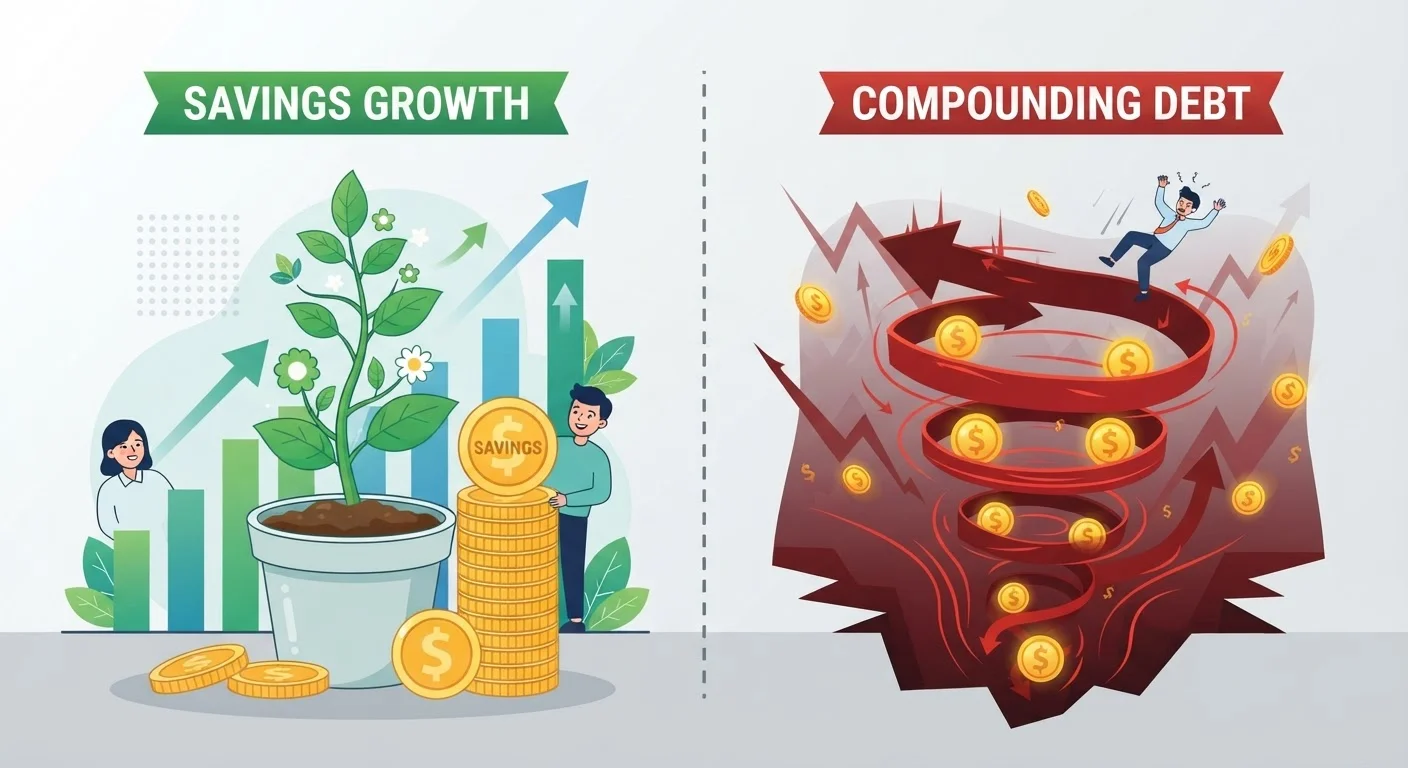
- Compound interest accelerates growth on savings and acceleration of costs on debt over time.
- The earlier you start saving, the more compounding works in your favor.
- High-interest debt like credit cards compounds quickly, making balances hard to escape.
- Compounding frequency (daily vs. monthly) affects how fast a balance grows.
- Paying more than the minimum on debt directly reduces the base that interest compounds on.
Compound Interest
Compound interest is interest calculated on both your original amount (the principal) and the interest already earned or owed. In plain terms, you earn - or owe - interest on top of interest. Over time, this cycle causes balances to grow faster and faster, which can work powerfully in your favor when saving or sharply against you when carrying debt.
Compounding frequency matters: interest compounded daily grows slightly faster than interest compounded monthly or annually at the same stated annual rate, because each cycle's interest feeds into the next sooner.
The Core Mechanic: Interest on Interest
Compound interest has one defining feature: each period's interest gets added to the balance, and the next period's interest is calculated on that new, larger total. This creates a feedback loop - balances grow not in a straight line but along a curve that steepens over time.
Compare two $5,000 deposits earning 6% annually over 20 years. With simple interest, you'd earn $300 each year - a flat $6,000 in total interest. With compound interest (compounded annually), the same deposit grows to roughly $16,036 - more than tripling your original amount.
That curve is the engine behind both long-term wealth building and debt that seems impossible to escape. Understanding which side of the equation you're on is the starting point for smarter financial decisions.
~$16,036
Value of $5,000 compounded at 6% over 20 years
Compared to $11,000 with simple interest - illustrating how compounding accelerates growth beyond flat interest calculations.
20%-30%
Typical credit card APR range in the U.S.
According to Federal Reserve consumer credit data, average credit card rates have remained above 20% APR for most cardholders carrying balances.
10+ years
Time to pay off $3,000 at 24% APR on minimums
Minimum payment schedules stretch repayment dramatically when high interest compounds on an only slowly declining principal.
When Compounding Works For You: Building Savings
In a savings or investment context, compound interest rewards two things above all: time and consistency. The longer money sits and compounds, the less work each individual dollar has to do.
Consider a practical illustration: someone who starts setting aside $100 a month at age 25 into an account earning 6% annually would accumulate substantially more by age 65 than someone who starts the same habit at age 35 - even though the later saver puts in money for a full decade. The earlier saver's first dollars compound for 40 years; the later saver's first dollars only get 30. Time is the variable that cannot be bought back.
Start Small - But Start Now
You don't need a large lump sum to benefit from compounding. Even modest, consistent contributions to a savings or retirement account give your money more time to grow. Waiting until you have a 'real' amount to invest is one of the most common - and costly - delays in personal finance.
Even small, regular contributions matter because they add new principal that also begins compounding. Skipping contributions - or withdrawing early - disrupts the cycle and costs more than the dollar amount taken out, because future compounding on that money is lost too.
When Compounding Works Against You: The Debt Side
The same mechanics that build savings can quietly devastate a household budget when applied to debt. Credit cards are the most common example: most carry annual percentage rates (APRs) between 20% and 30%, and many compound interest daily.
On a $3,000 credit card balance at 24% APR with only minimum payments, it can take over a decade to pay off and cost more in interest than the original purchase amount. The balance doesn't shrink in a straight line - it barely moves early on because interest consumes most of each payment.
The true cost of carrying a credit card balance goes beyond the obvious interest charges: compounding also means opportunity cost, since money spent on interest isn't available to save or invest.
Debt Consolidation and Compounding
Consolidating high-interest debt into a lower-rate loan can reduce how fast interest compounds, but it doesn't eliminate the debt. Understanding the new rate, term, and any fees matters before assuming consolidation saves money. See our look at what debt consolidation actually does for a balanced view.
The most direct way to break the compounding cycle on debt is to pay more than the minimum. Every dollar above the minimum reduces the principal - the base on which interest compounds - which shrinks each future interest charge.
Putting It Into a Budget Strategy
Recognizing which debts compound fastest helps you prioritize. High-rate debt should typically be targeted first, since it costs the most per dollar of balance. The debt avalanche and snowball methods offer structured frameworks for deciding which balance to attack first.
The trickier question is what to do when you have both debt and the opportunity to save. A useful rule of thumb: if a debt's interest rate is higher than what you could reasonably expect to earn from saving, paying down the debt first delivers a guaranteed "return" equal to the interest rate avoided. The comparison between savings rate and debt interest rate is worth understanding before splitting limited income.
For those managing multiple obligations, a framework for paying off debt while still saving can help balance both goals without abandoning either.
This article is for general informational purposes only and does not constitute personalized financial, investment, or tax advice. Consult a qualified financial professional before making decisions based on your individual circumstances.