

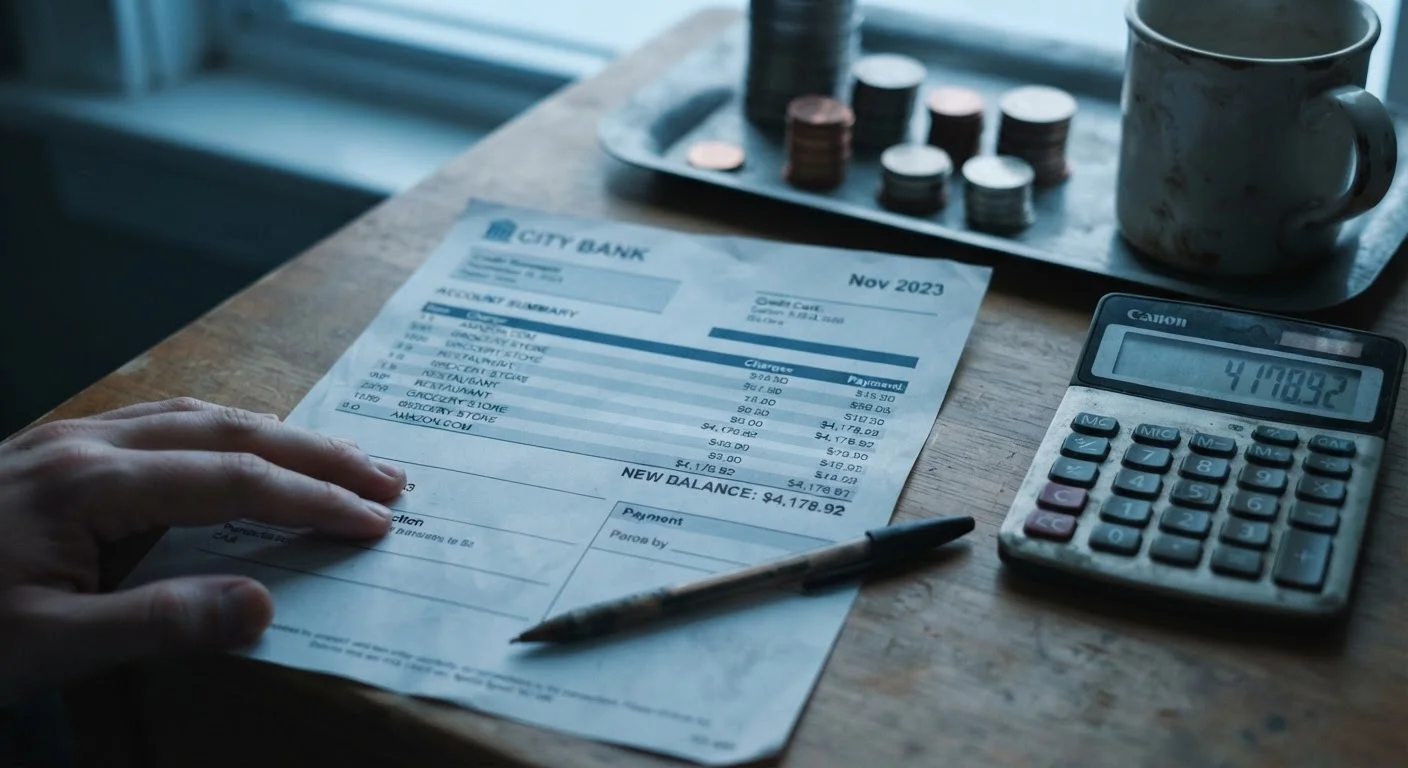
Key Takeaways
- Carrying a credit card balance triggers daily compounding interest that accelerates debt growth.
- Even a modest unpaid balance can generate significant interest costs over months or years.
- Late fees and penalty APRs can silently push balances higher, independent of new spending.
- Every dollar paid in interest is a dollar that can't grow in savings or investments.
- Understanding how balances accumulate is the first step to reducing their long-term cost.
Revolving Credit Card Balance
A revolving balance is the portion of your credit card debt that carries over from one billing cycle to the next instead of being paid in full. When you don't pay off the full statement balance by the due date, you begin accruing interest on the remaining amount. Over time, that interest compounds - meaning you're charged interest on interest - making the original balance grow even when you make regular payments.
Credit card interest is typically calculated using a daily periodic rate (your APR divided by 365), applied to your average daily balance each billing cycle.
How Interest Quietly Compounds Against You
Most people understand that carrying a credit card balance costs something. Fewer appreciate just how fast those costs escalate. The core mechanism is daily compounding interest. When a balance isn't paid in full, the issuer applies a daily periodic rate - your annual percentage rate (APR) divided by 365 - to your average daily balance. This means the interest that accumulated yesterday becomes part of the balance on which interest is calculated today.
At an APR of 22% - roughly in line with national averages in recent years - a $2,500 balance left untouched generates over $550 in interest charges in the first year alone. That's before any new purchases. The higher the APR and the longer the balance persists, the more pronounced the compounding effect becomes. This dynamic is why balances can feel stubbornly resistant to payoff even when you're making consistent payments.
~22%
Average credit card APR in recent years
Federal Reserve data has tracked average credit card interest rates trending above 20% in recent years, the highest in decades.
$550+
Annual interest on a $2,500 balance at 22% APR
This estimate assumes no new purchases and illustrates the compounding effect of carrying a balance through a full year.
Up to $41
Maximum late payment fee (per federal rules)
The Consumer Financial Protection Bureau regulates late fee caps, though the exact limit may change with regulatory updates.
Fees That Add to the Damage
Interest charges are the most visible cost, but they aren't the only one. Several fee categories can silently inflate a credit card balance:
- Late payment fees: Missing a due date typically triggers a fee of up to $41. More significantly, a single late payment can activate a penalty APR - often above 29% - that applies to the existing balance going forward.
- Cash advance fees: Withdrawing cash from a credit card usually incurs an upfront fee (commonly 3-5% of the amount) plus a higher APR that begins accruing immediately, with no grace period.
- Balance transfer fees: Moving debt to another card - even to access a lower rate - typically costs 3-5% of the transferred balance, an expense that needs to be weighed against the interest savings.
These charges don't require any new discretionary spending. They attach to the existing balance and compound right alongside it. For readers who already manage tight budgets, even a single missed payment can reset months of progress. The spending habits that erode savings goals often interact with credit card debt in exactly this way - a shortfall in one area creates a charge in another.
Set Up Autopay for the Full Statement Balance
Automating the full statement balance - not just the minimum - eliminates interest charges entirely on most cards. Even if cash flow is occasionally tight, setting the autopay floor at the statement balance and adjusting manually when needed is more protective than defaulting to minimum-only payments. Check with your card issuer to confirm how autopay settings work for your account.
The Opportunity Cost: What That Money Could Be Doing
There's a second layer of cost that doesn't appear on a credit card statement: opportunity cost. Every dollar directed toward interest payments is a dollar unavailable for savings, an emergency fund, or reducing other debt. At a 22% APR, your debt is growing at a rate that most savings vehicles - including high-yield savings accounts and conservative investment portfolios - are unlikely to outpace.
Consider a household paying $80 per month in credit card interest. Over three years, that's nearly $2,900 in interest - money that could instead have built an emergency cushion or offset everyday expenses like car upkeep. Just as annual car ownership costs tend to exceed what drivers initially anticipate, the cumulative cost of revolving credit card debt consistently surprises people when they calculate it in full.
“Compound interest is the eighth wonder of the world. He who understands it, earns it; he who doesn't, pays it.”
— Widely attributed to Albert Einstein, Aphorism commonly cited in personal finance education (attribution unverified historically, but the principle is mathematically sound)
This is also why the myth that carrying a small balance is financially neutral - or even good for your credit score - is worth correcting directly. It isn't. You don't need to pay interest to demonstrate creditworthiness. Paying the full statement balance monthly, while continuing to use the card, achieves the same credit-building effect at zero interest cost.
For a broader framework on managing and reducing debt responsibly, see our principles for keeping debt manageable. And if you want to examine how everyday purchasing decisions interact with debt accumulation, hidden costs buried in everyday purchases offers a useful parallel perspective.
This article provides general financial education and is not personalized financial or legal advice. Consult a qualified financial professional for guidance tailored to your situation.