

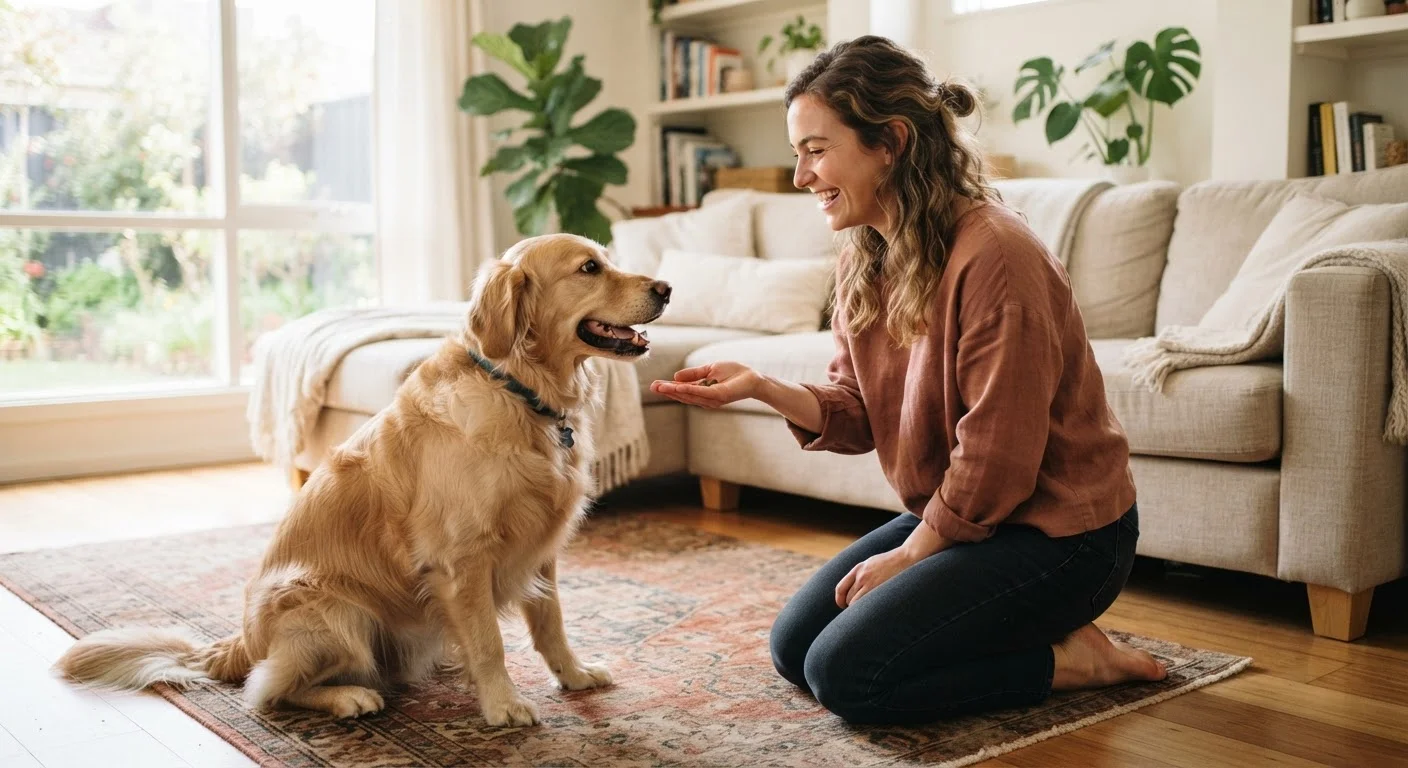
Key Takeaways
- Positive reinforcement relies on adding a reward immediately after a desired behaviour occurs.
- Decades of peer-reviewed research support reward-based training as effective and low-risk for pet welfare.
- Timing and consistency matter more than the size or cost of the reward.
- Most common pet behaviours - sit, stay, recall, leash walking - can be taught at home without professional classes.
- Punishment-based methods carry documented risks including increased fear and aggression in pets.
Positive Reinforcement
Positive reinforcement is a training method in which a desired behaviour is followed immediately by something the animal finds rewarding - like a treat, praise, or play. Because the reward makes the behaviour more likely to happen again, the animal gradually learns what you're asking of it. This approach works across species, from dogs and cats to rabbits and parrots.
In behavioural science, positive reinforcement is one of four quadrants of operant conditioning (B.F. Skinner's framework), defined as adding a stimulus to increase the probability of a behaviour recurring.
What the Research Actually Shows
The science behind positive reinforcement isn't new. Decades of research in animal learning theory - spanning dogs, cats, horses, marine mammals, and birds - consistently demonstrate that reward-based training produces reliable behaviour change while keeping stress hormones low and the human-animal bond intact.
A frequently cited finding from the University of Bristol's Animal Welfare and Behaviour research group showed that dogs trained using aversive methods displayed significantly higher rates of stress-related behaviours compared with those trained using reward-based approaches. Companion studies have linked reward training to faster acquisition of novel behaviours and better retention over time.
What this means practically: when you reward the exact moment your dog sits or your cat touches a target stick, the animal's brain forms a clear association between the action and the good outcome. Repeat that enough times and the behaviour becomes habitual. See also how this contrasts with aversive approaches in our article on why punishment-based training often backfires.
“The evidence is clear that reward-based training is not only effective but also promotes a healthier relationship between owner and animal. Animals trained this way show lower cortisol levels and more willingness to engage.”
— Dr. Zazie Todd, Animal psychologist and author of 'Wag: The Science of Making Your Dog Happy'
The Four Mechanics You Need to Know
You don't need a degree in animal behaviour to apply positive reinforcement effectively. Four principles cover most of what matters:
- Timing: The reward must arrive within one to two seconds of the behaviour. Even a short delay can confuse the animal about what is being reinforced.
- Consistency: Everyone in the household should use the same cues and reward the same responses. Mixed signals slow learning considerably.
- Rate of reinforcement: Early in training, reward every correct response. As the behaviour becomes reliable, gradually shift to rewarding intermittently - this actually makes the behaviour more durable.
- Value matching: Match the reward to the difficulty of the task. Routine cues in a quiet room need only a low-value treat; a recall in a distracting park warrants something the animal truly loves.
Start with High-Value Rewards
When teaching a brand-new behaviour, use something your pet is genuinely excited about - small pieces of cooked chicken, freeze-dried meat, or a favourite toy. Once the behaviour is well established, you can phase down to lower-value everyday treats. Starting strong accelerates the initial learning curve significantly.
For a direct comparison of two popular reward-based delivery methods, see our guide on clicker training vs. verbal cue training.
Applying It at Home Without a Trainer
Most foundational pet behaviours can be taught through short daily sessions at home. Keep sessions to five to ten minutes to prevent frustration or boredom. Here's a reliable starting framework:
- Choose one behaviour at a time. Trying to teach multiple cues simultaneously in the same session is confusing for most animals.
- Lure or capture the behaviour. For a 'sit', gently guide the pet into position using a treat held near the nose, or simply wait and reward the moment a natural sit occurs.
- Mark the moment. Say 'yes' or use a clicker the instant the correct behaviour happens, then deliver the reward.
- Add the cue word. Only attach a verbal label once the pet is offering the behaviour reliably - adding the word too early creates confusion.
- Generalise gradually. Practice in different rooms, outdoors, and with mild distractions once the behaviour is solid in one context.
If progress stalls, our article on training approaches worth trying when progress stalls outlines techniques like shaping and environmental management that can restart momentum.
Age and Prior Experience Matter
Puppies and kittens often learn new behaviours quickly due to developmental windows of high neuroplasticity. Adult or rescue animals with prior aversive training histories may take longer to trust reward-based methods and may initially appear unresponsive. Patience and lower-distraction environments help bridge that gap. If you're working with an older pet or one with a difficult background, consult a professional for tailored guidance.
This article is for informational purposes only. For pets showing fear, aggression, or anxiety-related behaviours, always consult a certified veterinary behaviourist or a credentialed professional trainer before beginning any training programme.