

Key Takeaways
- Both methods are reward-based and equally humane when paired with positive reinforcement.
- Clicker training offers a more precise, consistent marker signal than the human voice.
- Verbal cues are always available and require no additional equipment.
- Your pet's sensitivity to sound and your own routine should guide your choice.
- Many trainers combine both methods once foundational behaviors are established.
- Consistency in timing and reward delivery matters more than which method you choose.
Option A
Clicker Training
The precise, signal-first approach to marking behavior.
Best for: Pet owners who can keep a clicker handy and want a highly consistent, split-second marker for shaping new behaviors.
Option B
Verbal Cue Training
The hands-free, always-available communication method.
Best for: Owners who prefer a low-equipment routine or need to train in varied settings where carrying a clicker isn't practical.
If you want maximum precision when teaching complex or chained behaviors
Clicker Training
The clicker's distinct, consistent sound marks the exact moment of correct behavior far more reliably than the human voice, which naturally varies in tone and timing.
If you need a low-equipment approach for daily life and varied environments
Verbal Cue Training
Your voice is always available - no device to forget, lose, or keep out of reach - making verbal cues practical for spontaneous training moments throughout the day.
If your pet is noise-sensitive or easily startled by sudden sounds
Verbal Cue Training
Some animals find the sharp click sound stressful. A calm, consistent verbal marker eliminates that concern while still delivering a clear reward signal.
If you are training a deaf pet or one with significant hearing impairment
Verbal Cue Training
A visual hand signal paired with a tactile reward replaces auditory markers entirely; verbal cues are not suitable here, but the reward-based principles remain the same.
If you want the flexibility to blend both methods over time
Clicker Training
Starting with a clicker builds a strong marker foundation; verbal markers can then be introduced as a secondary cue once behaviors are reliable.
How Each Method Works
Both clicker training and verbal cue training fall under the umbrella of reward-based, positive reinforcement - meaning your pet learns that a specific behavior produces something desirable. The core difference lies in the marker: the precise signal that tells your pet, "that's the exact thing I wanted."
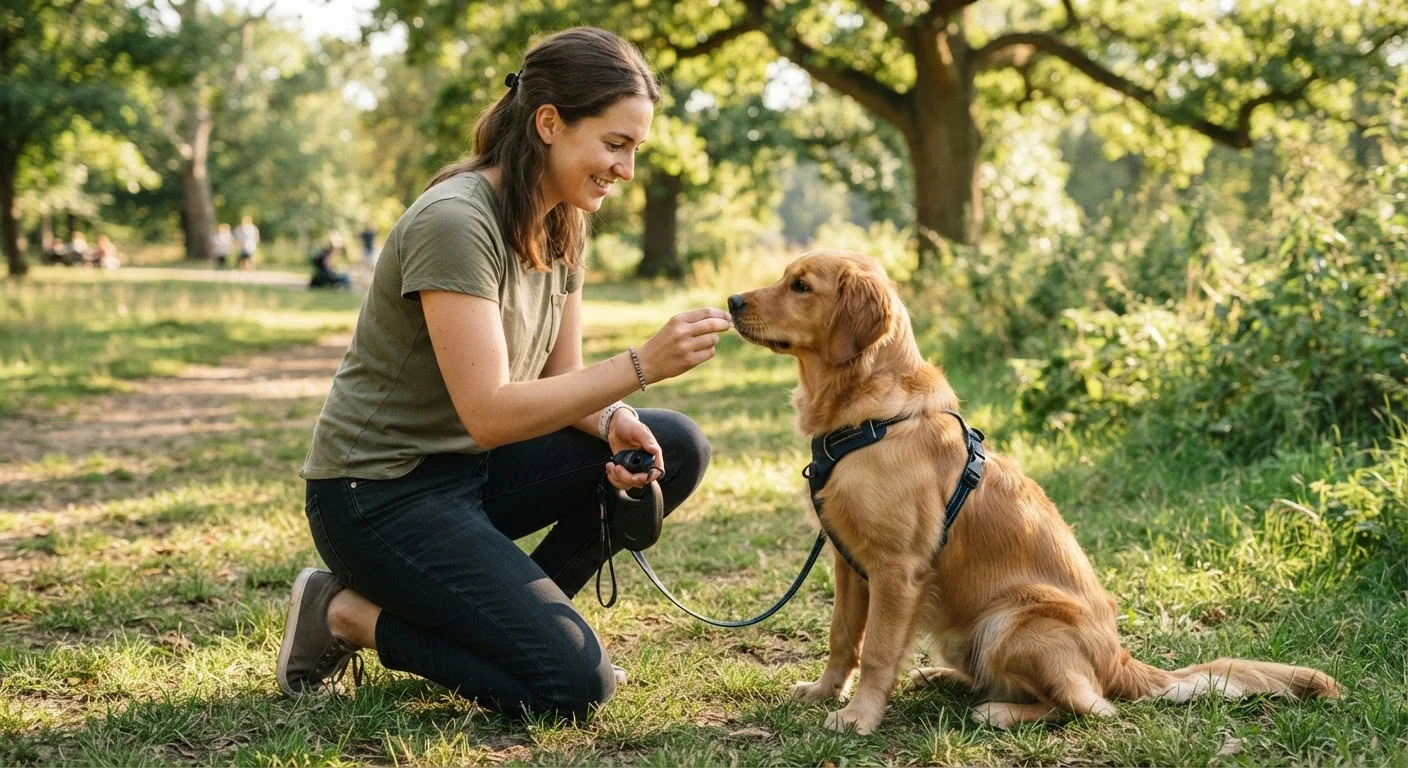
In clicker training, a small handheld device produces a short, sharp click. That click functions as a conditioned reinforcer - a neutral sound paired repeatedly with a treat until it carries its own predictive value. The click fires the instant the desired behavior occurs, then a reward follows. In verbal cue training, a spoken word - commonly "yes" or "good" - serves the same marking function, followed immediately by a reward.
To understand why precise timing matters so much in both systems, see our science behind positive reinforcement training.
| Criterion | Clicker Training | Verbal Cue Training |
|---|---|---|
| Marker consistency | Identical sound every time | Varies with tone and energy |
| Equipment needed | Clicker device required | No equipment needed |
| Ideal for complex behaviors | Strong - precise timing aids shaping | Moderate - timing harder to nail |
| Suitable for noise-sensitive pets | May startle some animals | Calm voice is less startling |
| Ease of use on the go | Requires clicker in hand | Always available |
| Learning curve | Requires timing practice | Intuitive for most owners |
| Cost | Minimal (one-time purchase) | Free |
Key Differences in Practice
The most meaningful practical difference is marker consistency. A clicker produces the identical sound every single time, regardless of your mood, energy level, or vocal tone. Human voices vary - a tired "yes" sounds different from an enthusiastic one - which can introduce subtle ambiguity for a pet learning a new behavior. Research in animal learning consistently supports the value of a clear, unambiguous marker signal.
That said, verbal markers have a significant advantage: they are always with you. Many owners find they miss training opportunities because the clicker is in another room. A verbal marker can be used the moment your pet offers a good behavior, whether you're in the kitchen, on a walk, or at the vet.
~2 sec
Reward delivery window after marker
Animal learning science generally supports delivering a reward within approximately two seconds of a marker signal to maintain its predictive value.
3-5 min
Recommended session length for cats
Short, focused sessions are widely recommended by applied animal behaviorists to maintain engagement and prevent frustration in feline training.
1 word
Marker words to use per training system
Using a single, consistent marker word - rather than several interchangeable phrases - reduces ambiguity and speeds up the animal's conditioned response.
Equipment cost is another consideration for budget-conscious owners. Clickers are inexpensive, but verbal cues require nothing beyond your voice. If you are already stretched thin on pet expenses, that zero-cost factor is genuinely meaningful.
Before any session - regardless of which method you use - running through a pre-training readiness checklist can improve consistency and results significantly.
Which Pets Respond Better to Each Approach?
Dogs are well-studied in both methods and generally adapt to either. The clicker's precision tends to shine when teaching complex behaviors or working through a shaping process - breaking a goal behavior into small, successive steps. Verbal markers work well for everyday cue maintenance once behaviors are already established.
Cats, often perceived as untrainable, respond strongly to clicker training in particular. The click's neutrality sidesteps the emotional connotations cats sometimes associate with human voices (which they may link to scolding or commands). Short, low-distraction sessions of two to five minutes are typically most effective.
Small animals - rabbits, guinea pigs, parrots - can also be clicker-trained, and many parrot owners report that verbal bridges blend naturally into vocal interaction with their birds. Noise-sensitive pets of any species may need a softer click or a muted marker; some trainers use a retractable pen click as a quieter alternative.
If your pet seems to plateau regardless of method, our article on training approaches for when progress stalls covers techniques like shaping and environmental management that complement both systems.
Common Mistakes and How to Avoid Them
With clicker training, the most frequent error is clicking at the wrong moment - either too late (after the behavior has ended) or too early (before it's complete). A late click can accidentally reinforce the behavior that followed the intended one. Practice your timing by clicking as a ball bounces, then work up to your pet.
With verbal cues, the common pitfall is inconsistency in the marker word. Switching between "yes," "good," "good girl," and "nice" in a single session dilutes the signal. Choose one word and use it exclusively as your marker - reserve other praise for after the reward is delivered.
Both methods share a universal mistake: forgetting the reward. The marker is a promise; failing to follow through quickly undermines the conditioned value of the signal. Keep treats accessible so the reward arrives within a second or two of the marker.
Inconsistent cues - not just markers - are another major reason pets appear to stop listening. Our guide to why dogs ignore commands unpacks this in detail. Both methods also sit firmly on the positive reinforcement side of the spectrum - for context on why aversive approaches carry real risks, see why punishment-based training often backfires.
Combining Both Methods Is a Valid Strategy
Many experienced trainers begin with a clicker to establish clear, precise associations and then introduce a verbal marker once behaviors are solid. Over time, the verbal marker can replace the clicker for routine cues, while the clicker is reserved for teaching new or complex behaviors. This layered approach takes advantage of the strengths of both methods without locking you into one forever.
This article provides general pet training information for educational purposes and is not a substitute for guidance from a certified professional animal trainer or veterinary behaviorist, particularly for pets showing fear, aggression, or anxiety-related behaviors.