

| Most common US electrical safety mark | UL Listed (Underwriters Laboratories) (OSHA-recognized NRTL program) |
| US energy efficiency program (appliances) | ENERGY STAR (EPA) (US Environmental Protection Agency) |
| Required appliance energy label (US) | EnergyGuide (FTC mandated) (Federal Trade Commission rule) |
| Quality management process standard | ISO 9001 (process, not product performance) (International Organization for Standardization) |
| Water efficiency certification (US) | WaterSense (EPA partnership) (US Environmental Protection Agency) |
| CE mark verification method | Often self-declared by manufacturer (EU regulatory framework) |
Why Certification Labels Matter
Walk the aisles of any store or browse a product listing online and you'll encounter a parade of logos, marks, and acronyms: CE, UL, ENERGY STAR, USDA Organic, ISO, Fair Trade. Some carry legal weight; others are voluntary. Some are verified by independent labs; others are self-declared. Knowing the difference is one of the most practical skills a shopper can develop.
This reference covers the most common certifications you'll encounter in the US market, what each one actually tests or verifies, and - critically - what it does not cover. For a broader framework on evaluating product claims, see the Shopper's Field Guide to Product Research.
| Most common US electrical safety mark | UL Listed (Underwriters Laboratories) (OSHA-recognized NRTL program) |
| US energy efficiency program (appliances) | ENERGY STAR (EPA) (US Environmental Protection Agency) |
| Required appliance energy label (US) | EnergyGuide (FTC mandated) (Federal Trade Commission rule) |
| Quality management process standard | ISO 9001 (process, not product performance) (International Organization for Standardization) |
| Water efficiency certification (US) | WaterSense (EPA partnership) (US Environmental Protection Agency) |
| CE mark verification method | Often self-declared by manufacturer (EU regulatory framework) |
Safety and Electrical Certifications
These marks indicate that a product has been tested against defined safety standards, typically for electrical, fire, or mechanical hazards.
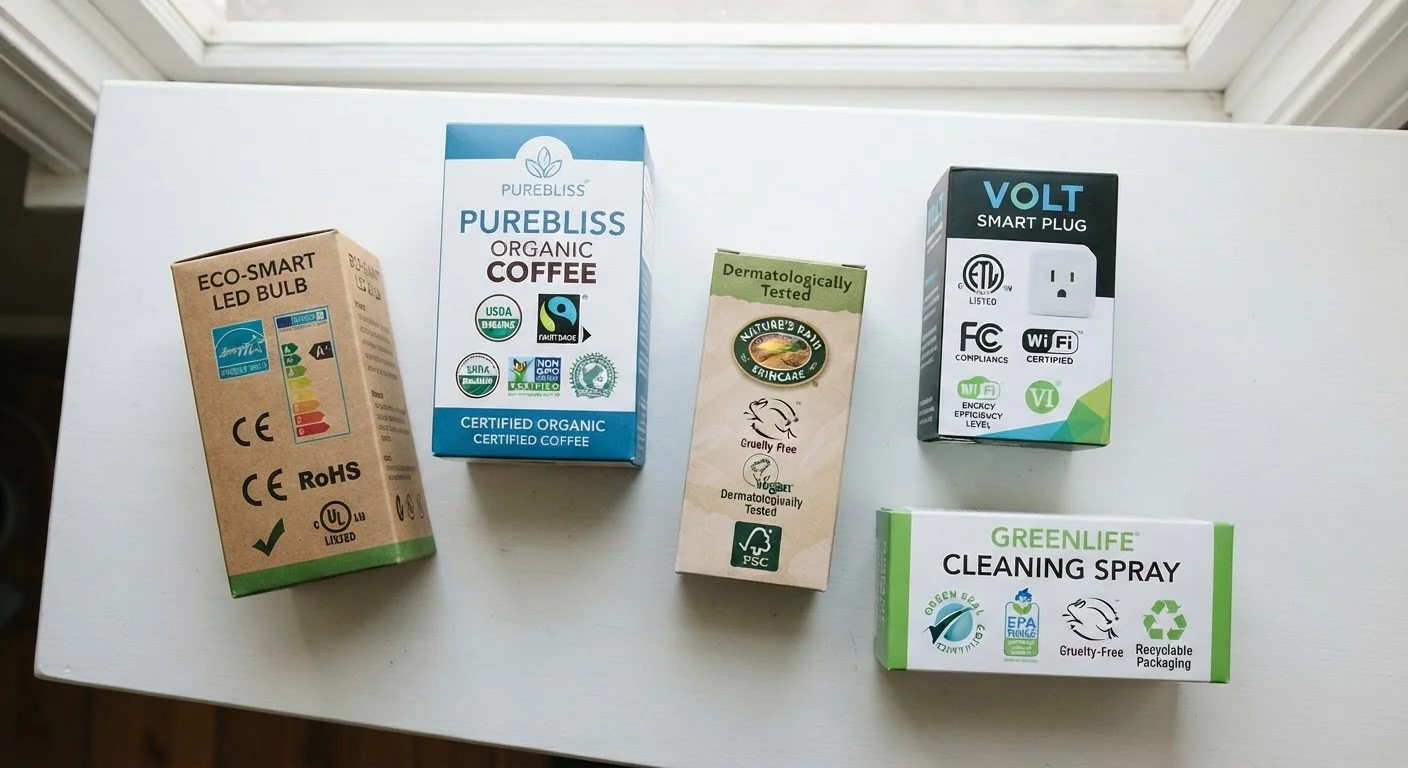
- UL Listed / UL Recognized: Underwriters Laboratories (UL) is a US-based, OSHA-accredited safety certification organization. A UL Listed mark means the complete product was tested against applicable safety standards. UL Recognized applies to components intended for use inside a larger product. Critically, UL certification covers safety - not performance or longevity.
- CE Mark: A mandatory marking for many products sold in the European Economic Area, indicating conformity with EU safety, health, and environmental directives. In the US, CE is often misread as a quality endorsement; it is a regulatory compliance marker and is self-declared by manufacturers for many product categories - not always independently verified.
- ETL Listed: Issued by Intertek, this mark carries equivalent authority to UL for electrical product safety in North America. Both are OSHA-recognized Nationally Recognized Testing Laboratories (NRTLs).
- FCC ID: Required for electronic devices sold in the US. Indicates the device complies with Federal Communications Commission regulations on radio frequency emissions - not a safety or quality rating.
When independent testing diverges from manufacturer claims, it usually shows up in safety-adjacent categories first. See how third-party testing differs from brand claims for context.
NRTL
Nationally Recognized Testing Laboratory. An organization accredited by OSHA to test products against safety standards. UL and Intertek (ETL) are examples. NRTL certification is legally recognized in the US.
Self-Declaration
A conformity claim made by the manufacturer without independent third-party verification. Some marks, including CE in certain product categories, are self-declared. Self-declaration does not automatically mean the claim is false, but it lacks external audit.
Third-Party Certification
Verification of a product's claims or compliance by an independent organization with no financial stake in the product's sale. Considered more reliable than manufacturer self-declaration.
Conformity Mark
A label indicating a product meets the requirements of a specific regulation, standard, or directive. Conformity marks may be mandatory (required by law) or voluntary (chosen by the manufacturer).
Standardized Test Conditions
A controlled environment or protocol used to measure product performance consistently across all tested units. Real-world results may differ from test results because usage patterns and environments vary.
Environmental and Energy Labels
These certifications address resource use, efficiency, and environmental impact - categories where marketing language is particularly prone to vagueness.
75+
ENERGY STAR product categories covered
The US EPA's ENERGY STAR program spans more than 75 product types, from appliances to commercial buildings, each with category-specific efficiency thresholds.
20%
Minimum water savings for WaterSense label
EPA requires WaterSense-labeled products to use at least 20% less water than comparable standard models while meeting performance criteria.
- ENERGY STAR: A US EPA program. Products bearing this label have been independently certified to meet specific energy efficiency thresholds defined by the EPA. Requirements vary by product category and are periodically updated. It covers energy consumption during use - not manufacturing impact or material sourcing.
- EnergyGuide Label: A yellow tag required by the FTC on most major appliances sold in the US. It shows estimated annual energy consumption and operating cost based on standardized test conditions - useful for apples-to-apples comparison shopping, though real-world usage will vary.
- WaterSense: An EPA partnership program for water-efficient products. Items must use at least 20% less water than standard products and meet performance criteria. Independent testing is required before the label can be used.
- USDA Organic: Governed by the National Organic Program. For food and agricultural products, it requires certified production practices limiting synthetic pesticides, GMOs, and certain additives. For non-food products (cosmetics, textiles), the standard applies only to ingredients, not the finished product's overall safety or performance. For more on reading food labels specifically, see reading a nutrition label without getting confused.
Quality Management and Industry Standards
These labels don't certify a specific product - they certify a company's processes or a product's conformance to defined technical specifications.
- ISO 9001: Issued by the International Organization for Standardization, this certifies that a manufacturer operates a documented quality management system. It does not certify product performance or durability - only that consistent processes exist. A company can hold ISO 9001 certification and still produce a product you find disappointing.
- NSF International Marks: NSF certifies products across categories including drinking water filters, food equipment, dietary supplements, and home appliances. Each NSF mark is category-specific; an NSF/ANSI 42 mark on a water filter confirms aesthetic reduction claims (taste, odor), not contaminant removal, which is covered by NSF/ANSI 53 or 58.
- Fair Trade Certified: Verifies that certain supply-chain standards were met regarding labor conditions and pricing for farmers or workers. It addresses sourcing ethics, not product safety or technical performance.
Understanding what a specification sheet actually tells you beyond the certification mark is equally important - the guide to reading product specifications walks through that process.
One Label Does Not Cover Everything
A certification verifies only what its specific standard tests - and nothing more. A product can be UL Listed for electrical safety and still have poor build quality. It can be USDA Organic certified and still contain ingredients some consumers want to avoid. Always check which specific standard a mark references before treating it as a general quality endorsement. Reading the actual certification scope, available on the certifying body's website, takes less than two minutes and removes a lot of guesswork.