
Envelope Budgeting vs. Digital Spending Caps: Which Keeps You More Accountable?

Key Takeaways
- Envelope budgeting uses physical cash to create a hard, tangible spending limit per category.
- Digital spending caps set category limits inside a budgeting app and alert you when you approach them.
- Cash envelopes reduce the psychological ease of overspending; digital caps work best when you're disciplined enough to heed alerts.
- Neither method is universally superior - your payment habits and spending triggers determine the better fit.
- Hybrid approaches, combining cash for high-risk categories with digital tracking elsewhere, are a legitimate option.
Option A
Envelope Budgeting
The tactile, cash-first accountability system.
Best for: Shoppers who overspend on discretionary categories and benefit from a physical spending limit they can see and feel.
Option B
Digital Spending Caps
The automated, always-with-you guardrail.
Best for: People who pay primarily by card or app and want real-time alerts without handling physical cash.
If you frequently overspend on groceries, dining, or entertainment
Envelope Budgeting
Running out of physical cash creates an unmistakable hard stop that a push notification simply cannot replicate for impulse-prone spenders.
If most of your spending is card-based or online
Digital Spending Caps
Cash envelopes don't translate to e-commerce or subscription billing; app-based limits track card transactions automatically across those channels.
If you want accountability without changing your payment method
Digital Spending Caps
App-based systems categorize spending passively, requiring less behavioral change while still surfacing where money is going.
If past budgets have consistently failed due to small, repeated overspending
Envelope Budgeting
The friction of physically handing over cash has been shown to make people more deliberate at the point of purchase compared to card or contactless payment.
If you manage shared household finances with a partner
Digital Spending Caps
Shared app dashboards give both partners visibility into category balances in real time, avoiding the logistics of splitting and tracking physical envelopes.
How Each Method Actually Works
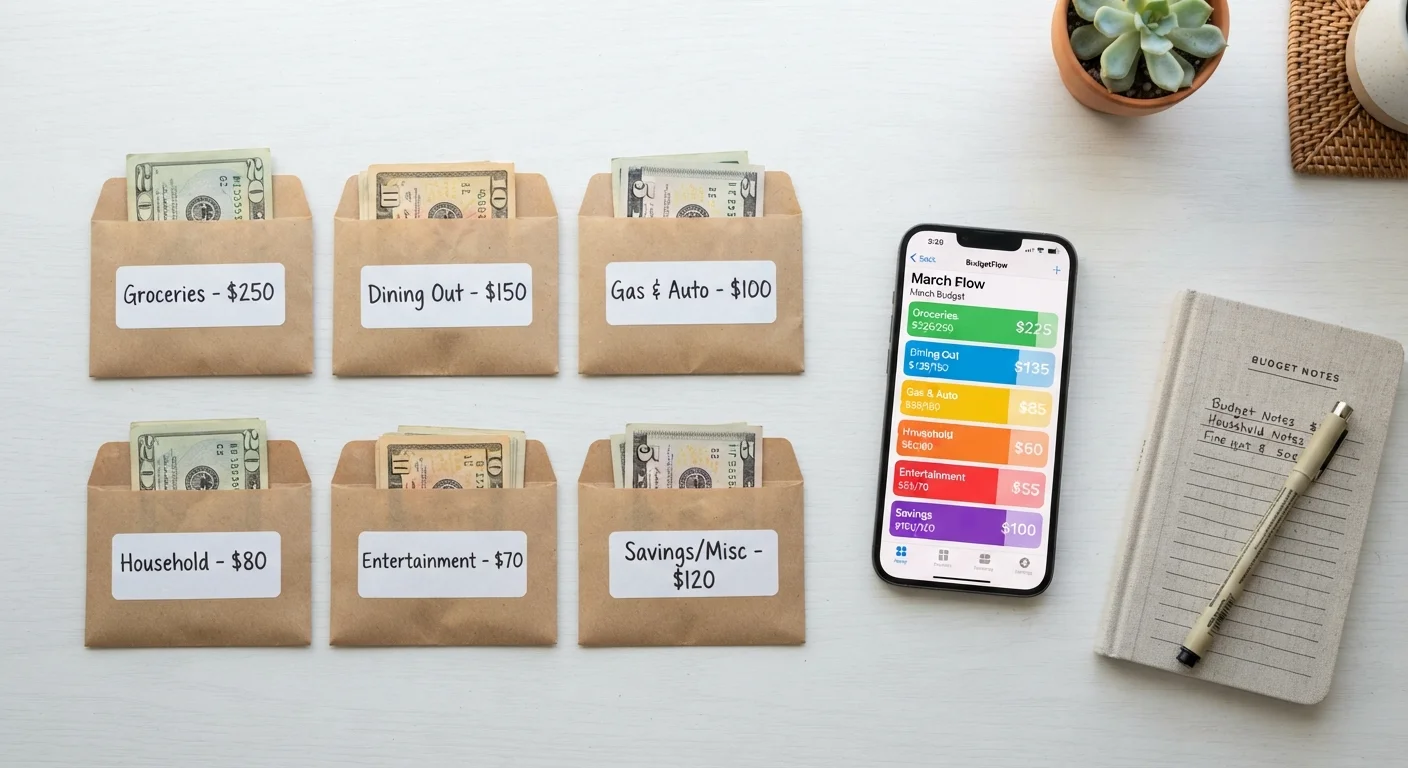
Envelope budgeting is a cash-allocation system: at the start of each pay period, you withdraw your planned spending in cash and distribute it into labeled envelopes - one per category (groceries, dining out, gas, and so on). When an envelope is empty, spending in that category stops until the next cycle. No overdraft, no workarounds.
Digital spending caps work inside a budgeting app or bank account dashboard. You set a monthly dollar limit per category, and the app tracks transactions against that limit, sending alerts when you near or hit the ceiling. The cap is a notification boundary, not a hard mechanical one - you can keep spending if you choose to ignore the alert.
That structural difference is the most important thing to understand before choosing between them. Envelope budgeting enforces limits by design; digital caps enforce them by prompting your own willpower. For a fuller comparison of budgeting system architectures, see how paper, spreadsheet, and app budgets compare.
| Criterion | Envelope Budgeting | Digital Spending Caps |
|---|---|---|
| Spending limit enforcement | Hard stop - cash runs out | Soft stop - alert-based, overridable |
| Works for online purchases | Limited; workarounds needed | Yes - tracks card transactions automatically |
| Setup effort | Requires cash withdrawal each cycle | One-time app setup; auto-syncs |
| Real-time balance visibility | Yes - count remaining cash | Yes - via app dashboard or alerts |
| Relies on willpower | Minimal - physical limit is automatic | High - must act on notifications |
| Suitable for shared finances | Logistics can be complex | Shared dashboards work well |
| Handles subscriptions/auto-pay | No | Yes |
The Psychology Behind Each Approach
Research on payment method psychology consistently finds that spending cash feels more concrete than swiping a card. The physical act of handing over bills activates a more visceral sense of loss, which tends to make people more deliberate about individual purchases. This is sometimes called the "pain of paying" - and envelopes maximize it by making your remaining balance visible at all times.
Digital caps sidestep this friction entirely. The convenience that makes card and app payments popular in the first place is the same feature that makes overspending easier to rationalize. An alert saying "You've used 90% of your dining budget" requires you to choose restraint in the moment - a different, and for many people more difficult, cognitive task.
That said, digital systems have a real psychological advantage for people who respond well to data and progress tracking. Seeing a category bar at 60% with two weeks left in the month can motivate course correction well before a crisis point. Understanding what drives your own spending is foundational here - the article on spending triggers most people don't notice covers the behavioral patterns worth examining first.
83%
People who spend more with cards vs. cash
Multiple consumer behavior studies have found the majority of people spend measurably more when using card payments compared to cash for the same purchases.
~1 in 3
US adults who exceed their monthly budget regularly
Surveys from personal finance research organizations consistently find that a significant share of Americans report spending more than planned in a given month.
Practical Trade-Offs to Consider
Envelope budgeting has real logistical limitations in a world where much spending happens online or via contactless payment. Subscriptions, ride-shares, and e-commerce purchases don't fit neatly into a cash envelope. Some people work around this by keeping a debit card designated for online spending and treating its balance like a digital envelope - but this requires additional discipline.
Digital caps are frictionless to set up and maintain, but their effectiveness depends on the app's transaction categorization accuracy. Miscategorized purchases distort your category totals, and if you're not reviewing them regularly, you may have a false sense of where you stand. They also don't work well for people who routinely dismiss notifications.
A hybrid approach is worth considering: use cash envelopes for the two or three categories where you most consistently overspend, and rely on digital tracking for fixed or predictable expenses. This concentrates the high-friction accountability exactly where you need it most. For perspective on when strict category limits can actually backfire, see the case for building in flex spending.
Envelope Budgeting Without Cash
Some budgeting apps offer a virtual envelope system that mimics the cash-allocation model using digital sub-accounts or category "pockets." These can bridge the gap for card-first spenders who want envelope-style structure. However, the psychological impact is generally considered weaker than handling physical cash, since the friction of spending is reduced. It's worth testing both formats to see which prompts more deliberate decisions for you personally.
This article is for general informational purposes only and does not constitute personalized financial advice. Consider consulting a qualified financial professional for guidance tailored to your specific situation.