

Key Takeaways
- A complete service history helps you spot recurring problems before they become costly repairs.
- Recording mileage, date, cost, and work performed is the minimum viable log entry.
- Digital logs are easier to back up and share; paper logs are simple and always accessible.
- A well-documented service record can meaningfully support your vehicle's resale value.
Why Keeping a Maintenance Log Matters
Most drivers can recall their last oil change - but how many remember the exact date, the mileage, or which shop did the work? That gap in memory is exactly where problems breed. A maintenance log turns scattered receipts and vague recollections into a clear, usable record of your vehicle's health.
Beyond personal organization, a documented service history serves two practical purposes. First, it helps you identify patterns - for example, noticing that a particular fluid needs topping up more often than it should, which can indicate a slow leak. Second, it supports your vehicle's resale value. Prospective buyers and dealers place real weight on verifiable service records. See our lifetime maintenance guide for a broader view of what keeping up with your car actually involves over the long run.
Record every service event within 48 hours of it happening.
Memory degrades quickly, and details like mileage or part specifications are easy to misremember after a few days. Logging promptly keeps entries accurate and prevents gaps from forming in your record.
Use consistent units and terminology across every entry.
Inconsistent entries - mixing kilometers and miles, or using vague terms like 'checked fluids' - make it hard to identify patterns or share your record meaningfully with a mechanic.
Keep copies of all receipts attached to or linked from your log.
A log entry without supporting documentation is difficult to verify at resale or when disputing a warranty claim. Receipts confirm exactly what work was done and by whom.
Set calendar reminders based on your log's service intervals.
Proactive reminders prevent you from exceeding manufacturer-recommended intervals, which can accelerate wear and, in some cases, affect warranty coverage.
Note any unusual symptoms alongside routine service entries.
Documenting odd noises, warning lights, or handling changes - even when no immediate repair is needed - creates a timeline that helps mechanics diagnose intermittent problems faster.
What Every Log Entry Should Include
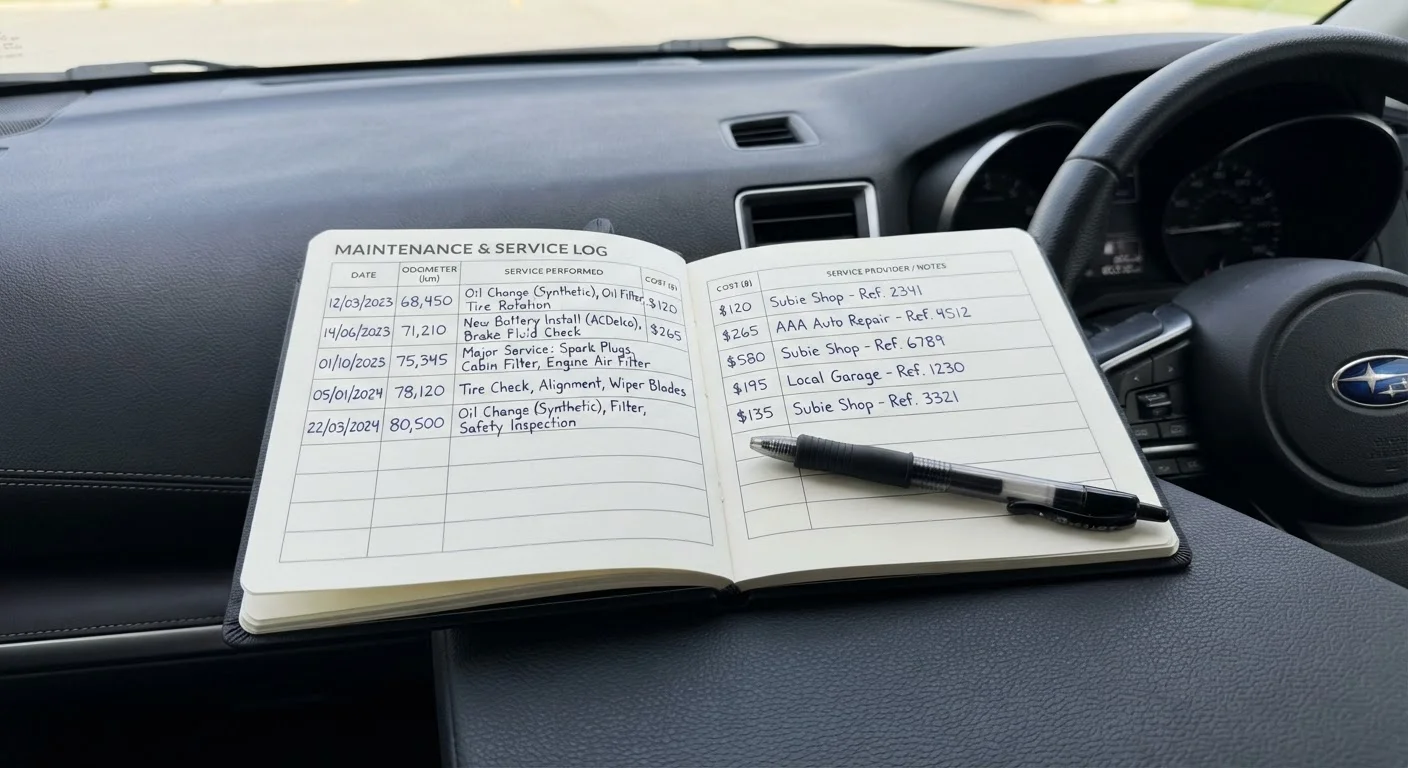
The value of a log depends entirely on what you put into it. A minimal but effective entry covers: the date of service, the odometer reading, the work performed, the name of the shop or mechanic, and the total cost. If you did the work yourself, note that too - future owners and mechanics will want to know.
For parts replacements, record the part name and, where relevant, the brand. For fluid changes - oil, coolant, brake fluid, transmission fluid - note the specification used (for example, 5W-30 full synthetic). This level of detail takes less than two minutes per entry and pays off whenever a mechanic asks, "When was this last done?"
Up to 1 in 3
Drivers who lack a complete service history
Industry surveys consistently find that a significant share of used vehicle owners cannot produce a full service record, complicating resale and diagnostic conversations.
5-15%
Potential impact on resale value from documented service history
Automotive valuation guidance generally indicates that verifiable maintenance records can positively influence a vehicle's assessed value at private sale or trade-in, though outcomes vary by vehicle age and condition.
If you want a fuller picture of what gets checked and replaced during a standard appointment, our breakdown of a standard car service explains each inspection point in plain language.
Choosing Your Format: Paper, App, or Spreadsheet
There is no single right format - the best log is the one you will actually use consistently. Here is a plain comparison:
- Paper logbook: Low-cost, requires no power or connectivity, and lives in the glovebox. Vulnerable to damage and not easily searchable.
- Spreadsheet: Easy to customize, searchable, and simple to share with a mechanic. Needs to be backed up regularly to avoid data loss.
- Maintenance apps: Many offer reminder alerts for upcoming services and can store receipts as photos. Dependent on continued app support and account access.
Whichever format you choose, attach or scan any receipts and invoices. Physical paperwork fades and gets lost; a photo stored alongside your log entries is far more durable.
Back Up Your Log in Two Places
Whether you use paper or digital, store a second copy somewhere separate. For paper logs, photograph pages periodically and save them to cloud storage. For digital logs, export a copy to a USB drive or email it to yourself every six months. A single lost logbook erases years of documentation.
Linking Your Log to Broader Ownership Costs
A maintenance log becomes even more powerful when you treat it as part of your overall vehicle budget. Reviewing entries at the end of each year reveals your true annual spend on upkeep - often higher than drivers expect. Our annual car ownership cost audit gives you a structured way to use that data to plan ahead.
If your log shows that repair and service costs are climbing, that's an evidence-based signal to revisit your maintenance budget. The guide to building a realistic maintenance budget can help you translate your log's history into a forward-looking plan. For drivers managing household spending more broadly, the budgeting basics hub offers practical strategies for setting aside money for irregular costs like car repairs.