

Key Takeaways
- Annual servicing, MOT fees, and unexpected repairs should all be factored into your car budget.
- Setting aside a monthly maintenance fund - even a modest one - prevents financial shocks.
- Older vehicles typically require more frequent and costlier repairs than newer ones.
- Keeping a maintenance log helps you predict upcoming costs and spot recurring problems early.
- Skipping routine servicing usually leads to larger bills down the road.
What you will need
Why Most Drivers Underestimate Maintenance Costs
Many drivers mentally budget for fuel and insurance, then treat every repair bill as a surprise. In practice, vehicle maintenance costs are largely foreseeable - not in their exact timing, but in the fact that they accumulate steadily over a car's life. The full picture of car running costs goes well beyond fuel, and servicing and repairs represent a significant slice of it for most owners.
The tendency to underestimate stems from a few common habits: paying only for what feels urgent, failing to account for wear-and-tear components that degrade gradually, and not reading MOT advisories carefully. As the real cost of skipping servicing shows, deferred maintenance rarely saves money - it typically shifts costs forward while making them larger.
Building a realistic budget means treating maintenance as a predictable ongoing expense rather than a series of unfortunate events. The steps below give you a method for doing exactly that.
What you will need
What You'll Need Before You Start
Before working through the steps, gather a few key inputs. Having these on hand means you can populate your budget with figures relevant to your own vehicle rather than generic estimates.
Owner's Manual
Identifies manufacturer-recommended service intervals and fluid specifications for your specific vehicle.
Spreadsheet or Budgeting App
Tracks planned maintenance costs, upcoming due dates, and actual spend over time.
Maintenance Log or Notebook
Records completed work, parts replaced, and mechanic notes to build a reliable service history.
MOT History Report
Shows past MOT results and advisory items that may signal developing issues worth budgeting for.
Don't Rely Solely on MOT Pass Status
A vehicle passing its MOT means it met the minimum legal safety standard on the day of the test - it does not mean the car is in excellent mechanical condition or that nothing will fail soon after. MOT advisories (noted faults not yet serious enough to fail) often signal parts that will need attention within months. Always read the full MOT report and factor advisory items into your forward maintenance budget.
Step-by-Step: Building Your Maintenance Budget
Follow these steps in order to build a maintenance budget that reflects your vehicle's actual needs. Revisit and update it each year - or sooner if your vehicle develops a known issue.
List Your Predictable Annual Costs
Start by identifying the maintenance expenses you can plan for with reasonable certainty. These typically include:
- Annual MOT test fee - the government-set maximum for a car MOT in the US context is an inspection fee that varies by state; check your local Department of Motor Vehicles for current rates.
- Routine service intervals - most manufacturers recommend servicing every 12 months or a set mileage threshold (often 5,000-10,000 miles), whichever comes first. Costs vary depending on vehicle age, type, and whether you use a main dealer or an independent workshop.
- Consumables - oil, air filters, cabin filters, and wiper blades are predictable items replaced on a schedule.
Write these down with estimated costs based on quotes from local garages or your previous receipts. This forms the baseline of your maintenance budget.
Account for Wear-and-Tear Components
Beyond routine servicing, several parts degrade progressively and will need replacing at predictable - if not perfectly timed - intervals. Common examples include:
- Tires - typically last 25,000-50,000 miles depending on driving style and road conditions.
- Brake pads and discs - front pads often last 30,000-70,000 miles; rear pads tend to last longer. Discs may need replacing at the same time as pads depending on wear.
- Battery - most car batteries last three to five years. Review our guide to battery health to understand warning signs.
- Timing belt or chain - a belt replacement is a significant but predictable cost with a clear mileage interval in your manual.
Use your current mileage and part age to estimate when each will likely need attention, and spread the anticipated cost across the months until then.
Set a Monthly Repair Reserve
Unexpected repairs - a failed sensor, a leaking seal, a cracked exhaust - are genuinely unpredictable in timing, but not in the fact that they will happen. The standard approach is to set aside a monthly repair reserve that accumulates until needed.
A practical starting point: divide the vehicle's estimated annual repair cost by 12. For an older vehicle (8+ years), many mechanics suggest budgeting at least $100-$150 per month for unscheduled repairs. For a newer vehicle still under warranty, a smaller buffer may suffice.
Adjust this figure based on your vehicle's age, mileage, and any known issues flagged on recent inspection reports.
[tip_callout]Review Your Vehicle's Inspection or MOT Advisories
If your vehicle has had a recent inspection or MOT, pull up the full report - not just the pass/fail result. Advisory items are faults that were not severe enough to fail the vehicle but which represent wear the inspector considered worth flagging.
Common advisories include minor corrosion, slightly worn tyres, or a suspension component beginning to degrade. Each advisory is effectively a future cost - add each one to your maintenance list and assign a rough timeframe and estimated expense. Prioritise anything safety-related.
You can access MOT history records through government-run vehicle inquiry tools in many jurisdictions. Cross-referencing this with your maintenance log gives you a clearer picture of cumulative wear.
Build Your 12-Month Maintenance Budget
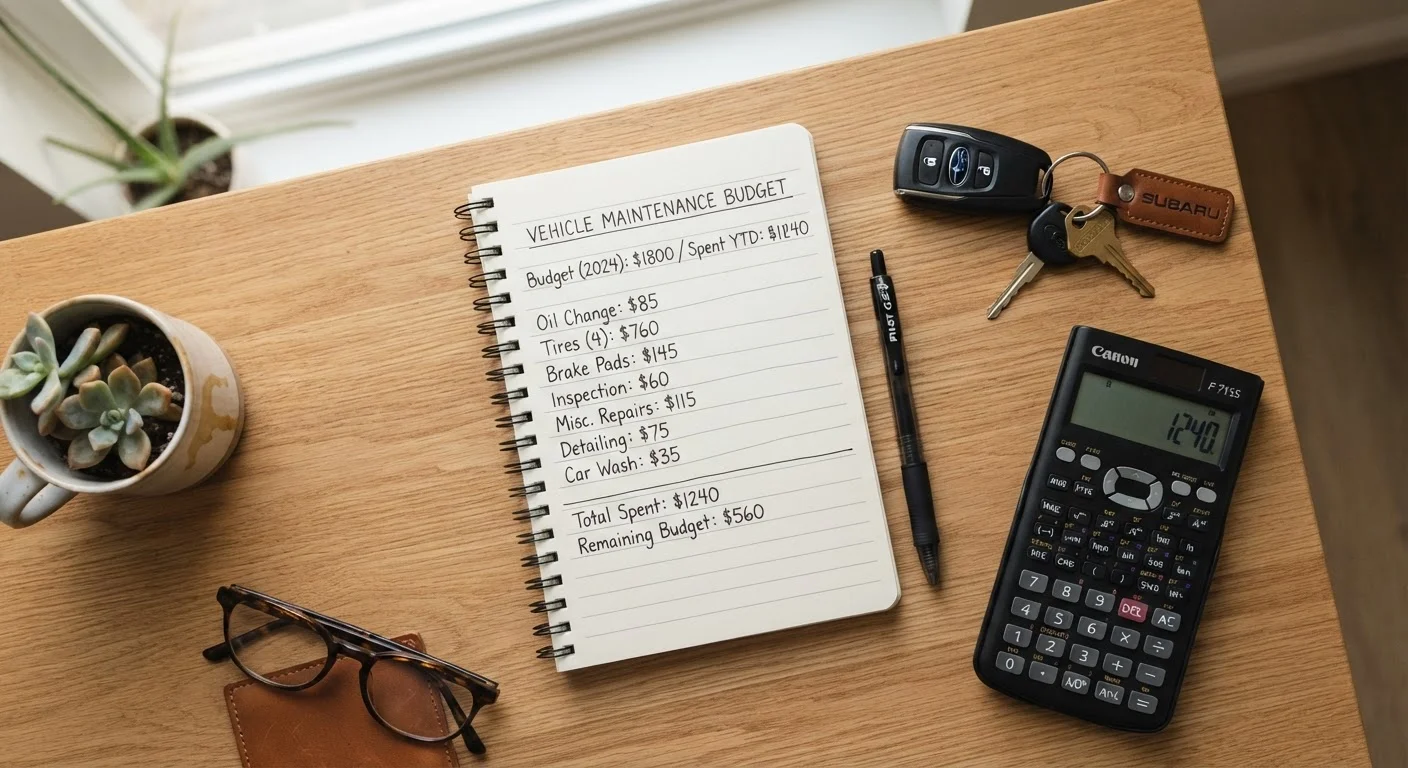
With your predictable costs listed and a repair reserve established, pull everything into a single annual view. A simple table works well:
| Cost Category | Estimated Annual Amount | Monthly Allocation |
|---|---|---|
| Routine service | $200-$400 | $17-$33 |
| MOT / inspection fee | $50-$100 | $4-$8 |
| Tires (pro-rated) | $100-$250 | $8-$21 |
| Brakes (pro-rated) | $80-$200 | $7-$17 |
| Unscheduled repair reserve | $600-$1,800 | $50-$150 |
These are illustrative ranges only - your actual figures will depend on your vehicle, location, and chosen garage. The goal is a written plan you revisit at least once a year. See our annual cost audit guide for a structured year-end review process.
Decide Which Tasks You Can Handle Yourself
Some routine maintenance items are straightforward enough for most drivers to manage at home - replacing wiper blades, checking and topping up fluids, swapping cabin air filters, and monitoring tyre pressure. Doing these yourself reduces your overall spend without compromising safety.
Other tasks - brake work, timing belt replacement, suspension repairs, anything involving the electrical system - genuinely require a qualified mechanic and the right equipment. Attempting these without the proper skills risks vehicle damage or personal injury.
Our DIY vs. mechanic guide provides a clear breakdown of what sits in each category. Factor your honest skill level into your budget - if you're comfortable with basic tasks, reduce your labour cost estimates accordingly.
Keeping Your Budget Accurate Over Time
A maintenance budget is not a one-time exercise. Costs shift as your vehicle ages, as parts wear, and as labour rates change. The most effective approach is to treat it as a living document - updating figures after each service visit and adjusting your monthly reserve whenever a new advisory appears.
A well-kept maintenance log is the foundation of this. Recording every service, repair, and parts replacement gives you the data to make your estimates sharper year on year. Pair this with habits covered in our guide to keeping car costs under control to reduce the frequency and severity of unexpected bills.
Avoid Leaving Repairs Too Long
Deferring a known repair to save money now frequently results in a more expensive problem later. A worn brake pad, for example, can damage the disc rotor if left unaddressed, turning a modest parts-and-labour job into a significantly costlier one. If a mechanic flags something as urgent, get at least one further quote but act promptly.
If you're new to car ownership and finding these costs daunting, the car maintenance guide for new drivers is a practical starting point before working through your first full budget.