

| Typical recommended pressure range | 30-36 PSI (2.1-2.5 bar) (Varies by vehicle - always check door jamb placard) |
| US legal minimum tread depth | 2/32 inch (1.6 mm) (Federal Motor Vehicle Safety Standards) |
| Recommended replacement threshold | 4/32 inch (3.2 mm) (Industry safety consensus) |
| Pressure drop per 10°F temperature fall | ~1 PSI (General physics of gas behaviour) |
| Natural monthly pressure loss | 1-2 PSI (Typical for passenger tyres in normal use) |
| Recommended rotation interval | Every 5,000-7,500 miles (Refer to your owner's manual for exact interval) |
What the Numbers on Your Tyre Actually Mean
Every tyre carries a sidewall code that looks something like 205/55 R16 91V. Breaking it down makes it immediately useful:
- 205 - tyre width in millimetres
- 55 - aspect ratio (sidewall height as a percentage of width)
- R16 - radial construction, fits a 16-inch rim
- 91 - load index (91 = 615 kg per tyre)
- V - speed rating (V = up to 149 mph / 240 km/h)
Your vehicle's recommended tyre size and pressure are found in the owner's manual or on the placard inside the driver's door jamb - not on the tyre sidewall itself. The sidewall figure is the tyre's maximum pressure, which is different and should not be used as a target.
| Typical recommended pressure range | 30-36 PSI (2.1-2.5 bar) (Varies by vehicle - always check door jamb placard) |
| US legal minimum tread depth | 2/32 inch (1.6 mm) (Federal Motor Vehicle Safety Standards) |
| Recommended replacement threshold | 4/32 inch (3.2 mm) (Industry safety consensus) |
| Pressure drop per 10°F temperature fall | ~1 PSI (General physics of gas behaviour) |
| Natural monthly pressure loss | 1-2 PSI (Typical for passenger tyres in normal use) |
| Recommended rotation interval | Every 5,000-7,500 miles (Refer to your owner's manual for exact interval) |
Tyre Pressure: How to Check, What to Target, and When to Check
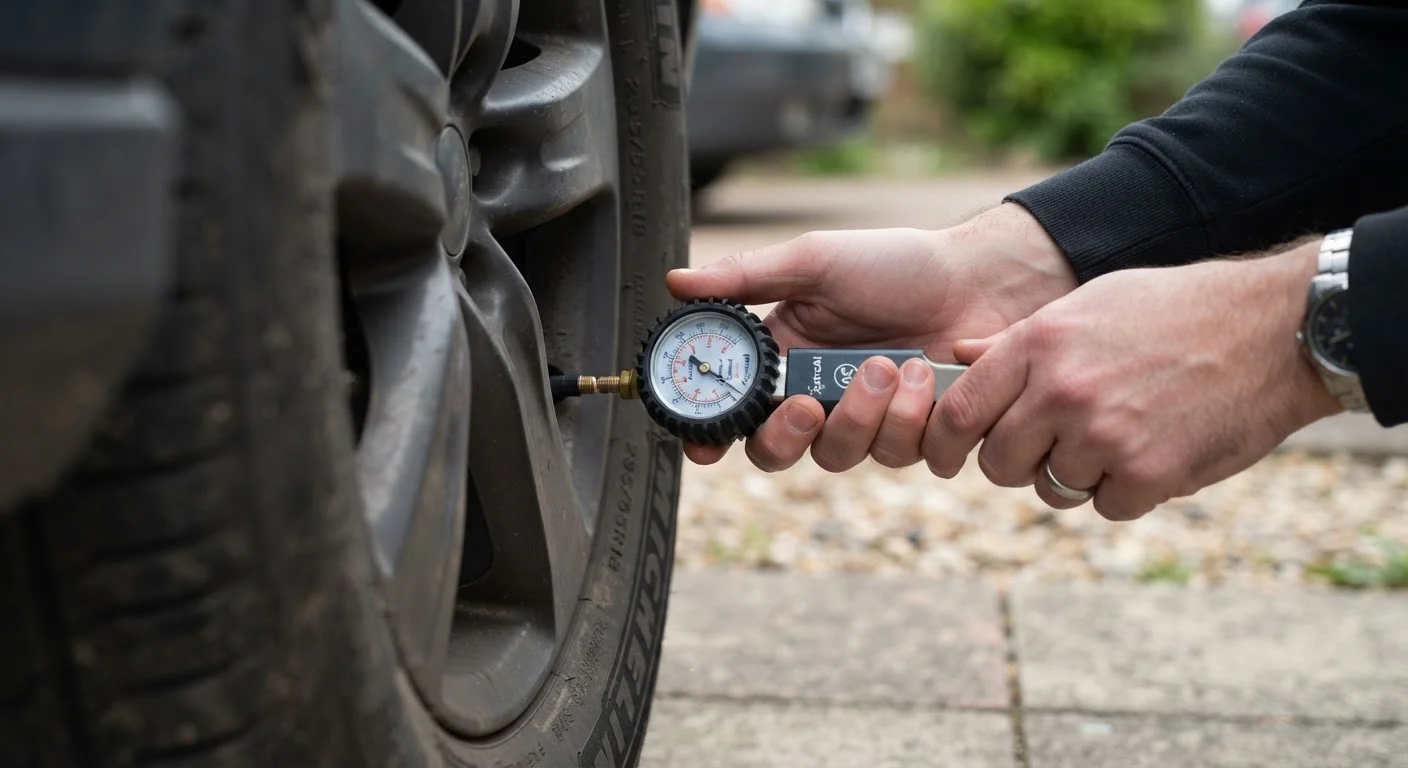
Tyre pressure is measured in PSI or bar. Most passenger vehicles call for between 30-36 PSI (roughly 2.1-2.5 bar), but always confirm against your vehicle placard rather than a general figure.
How to check pressure correctly
- Check tyres when cold - before driving or at least three hours after parking. Heat from driving raises pressure and skews readings.
- Remove the valve cap and press a calibrated gauge firmly onto the valve stem.
- Compare the reading to your vehicle's recommended pressure for front and rear axles (these often differ).
- Add or release air as needed, then replace the valve cap.
When to check
At minimum, check pressure once a month and before any long journey. Tyres naturally lose roughly 1-2 PSI per month, and pressure drops approximately 1 PSI for every 10°F (5.6°C) fall in ambient temperature - making autumn and winter checks especially important. See pre-journey vehicle checks for a broader pre-drive checklist.
Consequences of wrong pressure
- Under-inflation: increased rolling resistance, faster shoulder wear, risk of overheating and blowout
- Over-inflation: reduced contact patch, harsher ride, accelerated centre tread wear, reduced wet-weather grip
Don't Rely on TPMS Alone
Many modern vehicles include a Tyre Pressure Monitoring System (TPMS) that triggers a dashboard warning when pressure drops significantly. However, TPMS typically activates only when pressure is already 25% below the recommended level - well into unsafe territory. Use a manual gauge for monthly checks; treat a TPMS warning as an immediate prompt to stop and inspect, not a substitute for proactive maintenance.
Tread Depth: The Legal Minimum and the Safer Threshold
In the US, the federal minimum legal tread depth is 2/32 inch (1.6 mm). Most safety organisations recommend replacing tyres at 4/32 inch (3.2 mm) because wet braking distance increases significantly below this point.
Tread wear indicator
A small raised bar moulded into tyre grooves at the 2/32-inch mark. When the surrounding tread wears flush with these bars, the tyre has reached its legal minimum depth.
Aspect ratio
The tyre sidewall height expressed as a percentage of the tyre's width. A lower number means a shorter, stiffer sidewall, which affects ride comfort and handling.
Load index
A numerical code on the tyre sidewall that indicates the maximum weight each tyre can safely carry. Never fit a tyre with a lower load index than specified for your vehicle.
Speed rating
A letter code indicating the maximum sustained speed a tyre is designed to handle. It should meet or exceed the rating specified in your vehicle's documentation.
Wheel alignment
The adjustment of tyre angles so they are perpendicular to the road and parallel to each other. Poor alignment accelerates uneven tread wear and can cause steering pull.
Rolling resistance
The force a tyre must overcome to roll along a surface. Under-inflated tyres have higher rolling resistance, which reduces fuel efficiency and generates excess heat.
How to measure tread depth
- Tread wear indicators: Small raised bars moulded into the grooves at 2/32 inch. When tread is flush with these bars, the tyre is legally at its limit.
- Penny test: Insert a penny into a groove with Lincoln's head pointing down. If the top of his head is visible, tread is at or below 2/32 inch - replace immediately.
- Quarter test: Use a quarter the same way. If Washington's head is fully visible, you're at approximately 4/32 inch - plan replacement soon.
- Tread depth gauge: A simple, inexpensive tool that gives an exact reading in seconds. Worth keeping in your glovebox.
Check multiple grooves across the tyre width. Uneven wear patterns - such as more wear on the shoulders than the centre, or vice versa - can signal incorrect pressure, wheel misalignment, or suspension issues that a mechanic should assess. Ignoring these patterns is one of the habits that quietly shorten your car's lifespan.
For a broader view of how tyre upkeep fits into total ownership costs, see the vehicle running costs reference guide.
Rotation, Alignment, and When to Call a Professional
Tyre maintenance extends beyond pressure and tread. Two other routine tasks have a direct impact on how long your tyres last:
Rotation
Front tyres typically wear faster than rear tyres (especially on front-wheel-drive vehicles) due to steering and braking forces. Rotating tyres every 5,000-7,500 miles - or as specified in your owner's manual - evens out wear and extends the set's overall life. This is also covered in detail in the lifetime car maintenance guide.
Alignment and balancing
Wheel alignment refers to the angle of your tyres relative to the road and each other. Misalignment causes rapid, uneven tread wear and can affect straight-line tracking. Balancing corrects weight distribution around the wheel assembly, reducing vibration. Both should be checked after any significant pothole impact, curb strike, or if you notice steering pull or vibration.
When to see a mechanic
Bring your vehicle to a qualified technician if you notice: persistent pressure loss in one tyre (indicating a slow puncture or valve fault), visible sidewall bulges or cracking, handling that feels loose or pulls to one side, or tread wear that looks uneven across the tyre face. Do not attempt to repair a sidewall puncture yourself - this is a structural area and the tyre will generally need replacement.
This article provides general vehicle maintenance information. Always consult a qualified mechanic for concerns about your specific vehicle's condition or safety.