

Key Takeaways
- Bodyweight exercises can effectively build strength, endurance, and mobility with zero equipment cost.
- Combining pushing, pulling, hinging, and squatting patterns creates a well-rounded routine.
- Proper form matters more than volume - prioritize quality reps to reduce injury risk.
- Progressive overload is still possible without weights by adjusting tempo, range, or leverage.
- Consistency across a weekly schedule is more important than any single perfect workout.
Why Bodyweight Training Holds Up
No gym membership, no equipment, no commute - bodyweight training removes the most common barriers to consistent exercise. Yet its simplicity doesn't mean it's easy or limited. Research published in journals like the Journal of Strength and Conditioning Research consistently shows that well-structured bodyweight programs can improve muscular strength, cardiovascular fitness, and functional movement in adults across fitness levels.
The key is structure. Randomly stringing together exercises produces inconsistent results. A routine built around fundamental movement patterns - push, pull, hinge, squat, and carry - ensures you're training your body comprehensively. If you're entirely new to this approach, our complete beginner's guide to bodyweight training covers foundational principles worth reviewing before you dive in.
The exercises below are worth anchoring a routine around because they are durable, scalable, and effective for a wide range of fitness goals. Each one targets a meaningful movement pattern, can be modified for different ability levels, and requires nothing but floor space.
Check In Before Starting a New Routine
Before beginning any new exercise program, it's worth reviewing a few readiness basics - especially if you've been inactive for a while or have a health condition. Our pre-workout readiness checklist walks through what to consider before your first session. When in doubt, consult a healthcare provider.
The Exercises
Push-Up
The push-up trains the chest, anterior shoulders, and triceps while also engaging the core as a stabilizer. It's one of the most researched bodyweight exercises, and its value scales with how you position your body.
How to perform it: Start in a high plank with hands slightly wider than shoulder-width. Lower your chest toward the floor in a controlled descent, keeping elbows at roughly a 45-degree angle from your torso. Press back up without letting your hips sag or pike.
Scaling: Elevate your hands on a counter or wall to reduce load; elevate your feet on a chair to increase it. Slowing the lowering phase (a 3-4 second eccentric) adds difficulty without changing position.
Slowing the lowering phase adds significant difficulty without requiring any extra equipment.
Bodyweight Squat
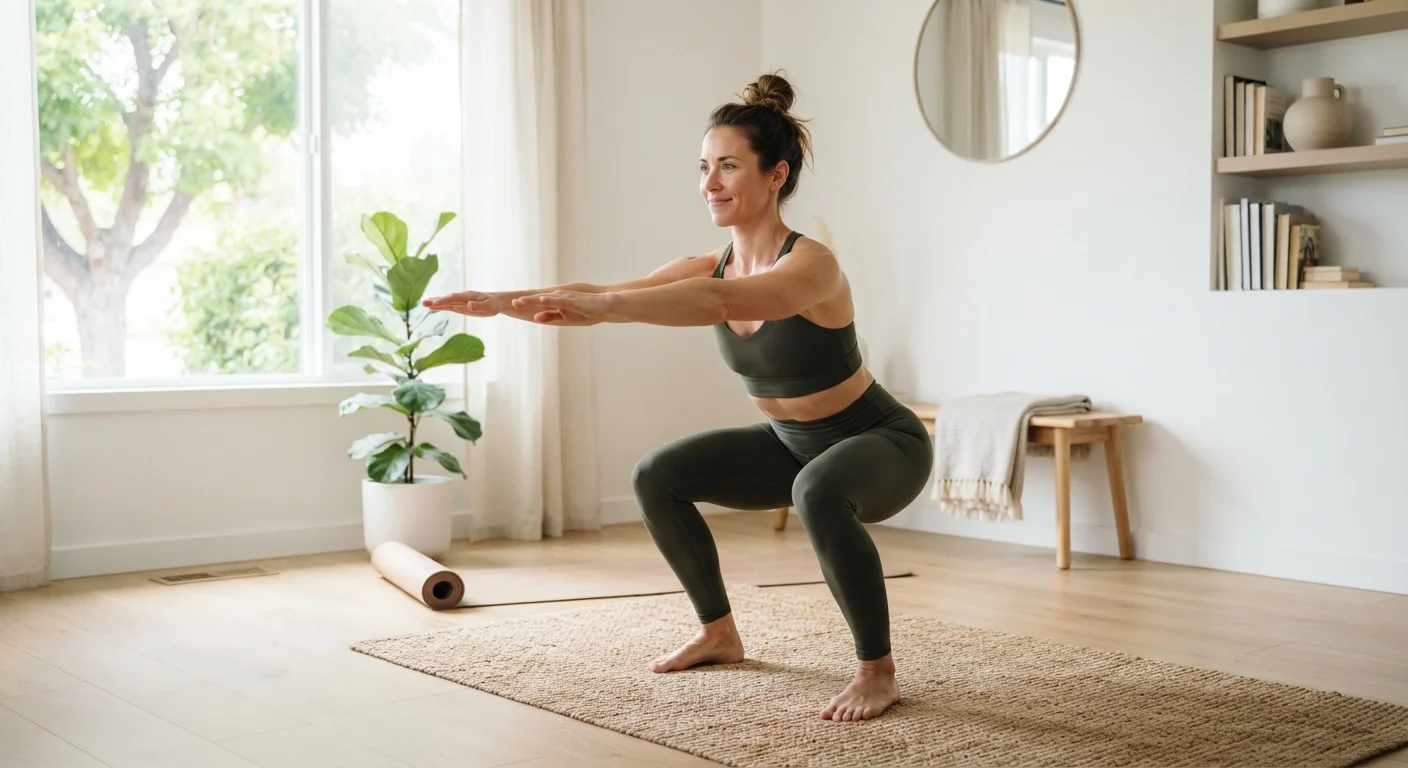
The squat is a fundamental human movement pattern that trains the quadriceps, glutes, and hamstrings while reinforcing hip and knee mechanics that matter for everyday life - sitting, standing, climbing stairs.
How to perform it: Stand with feet roughly shoulder-width apart, toes turned out slightly. Initiate by pushing hips back and bending knees simultaneously. Lower until thighs approach parallel to the floor, keeping your chest upright. Drive through the full foot to stand.
Scaling: Beginners can squat to a chair and stand back up to build confidence. More advanced progressions include the Bulgarian split squat (rear foot elevated) or the pistol squat (single leg).
The squat reinforces movement patterns used every day, making it one of the most functional exercises to practice.
Glute Bridge
The glute bridge targets the posterior chain - glutes and hamstrings - which are commonly underdeveloped in people who sit for extended periods. Strong glutes support lower back health and hip stability.
How to perform it: Lie on your back with knees bent and feet flat on the floor, hip-width apart. Press through your heels to lift your hips until your body forms a straight line from shoulders to knees. Squeeze your glutes at the top, then lower with control.
Scaling: Progress to a single-leg glute bridge by extending one leg while performing the lift. Adding a pause at the top increases time under tension effectively.
Strengthening the posterior chain supports lower back health, especially for those with sedentary daily routines.
Plank
The plank trains isometric (static) core strength - the ability to resist spinal extension under load. This transfers directly to posture, back health, and nearly every other exercise you perform.
How to perform it: Start on forearms with elbows under shoulders, or in a high plank on hands. Engage your abdomen, squeeze your glutes, and keep your spine neutral - no sagging hips, no elevated backside. Breathe steadily throughout.
Scaling: Perform from your knees to reduce difficulty. Add difficulty by lifting one foot at a time, or transitioning between a forearm plank and a high plank (plank walkups).
Isometric core work like the plank builds the stability that makes every other movement safer and more efficient.
Reverse Lunge
The reverse lunge develops single-leg strength and balance while being generally easier on the knees than a forward lunge, making it accessible for more people. It trains the quads, glutes, and hip flexors through a meaningful range of motion.
How to perform it: Stand tall, step one foot backward, and lower your back knee toward the floor - keeping it from crashing down. Your front shin should remain mostly vertical. Push through your front heel to return to standing.
Scaling: Hold a door frame lightly for balance support as a beginner modification. Add a forward lean at the torso to shift emphasis toward the glutes.
The reverse lunge builds meaningful single-leg strength with less knee stress than many other lunge variations.
Inchworm
The inchworm is a dynamic movement that combines hamstring flexibility, shoulder stability, and core engagement in a single flowing sequence. It functions equally well as a warm-up or as a low-intensity movement within a circuit.
How to perform it: Stand tall, hinge at the hips, and walk your hands out to a high plank position. Optionally perform a push-up, then walk your hands back toward your feet and stand. Move through this sequence deliberately, pausing in the plank.
Scaling: Those with limited hamstring flexibility can bend their knees slightly while walking hands out. Adding the push-up and pausing longer in the plank increases the challenge.
The inchworm trains flexibility, shoulder stability, and core control in one seamless, equipment-free movement.
Progressive Overload Without Weights
Progression in bodyweight training often comes from changing tempo, range of motion, leverage, or rest intervals rather than adding load. For example, slowing the lowering phase of a push-up to four seconds meaningfully increases muscular demand. These adjustments - rather than jumping to harder variations too quickly - are how sustainable progress is built. For a broader framework, see our guide to building a well-rounded weekly workout plan.
Building These Into a Coherent Routine
Knowing the exercises is only half the work. How you arrange them across a week determines whether you're actually progressing. A balanced approach might pair pushing and hinging movements on one day, squatting and core work on another, and reserve at least one full rest day between sessions that train the same muscle groups.
If time is your main constraint, a focused 20-minute home workout can be surprisingly effective when the movements are well-chosen and effort is consistent. And to understand how cardio and strength work fit together in a weekly plan, see our overview of cardio versus strength training.
To gauge how hard you're working without any devices, the Rate of Perceived Exertion (RPE) scale is a practical tool - our guide to using perceived exertion to monitor workout intensity explains how to apply it. If your progress plateaus over time, common reasons a fitness routine stops working offers practical troubleshooting guidance.
This article is for general informational and educational purposes only and is not a substitute for professional medical advice. Consult a qualified healthcare provider before beginning any new exercise program, especially if you have existing health conditions, injuries, or concerns.