

Key Takeaways
- Repurposing containers you already own eliminates the need to spend money on dedicated storage products.
- Everyday objects like jars, shoeboxes, and trays can handle most household organization challenges effectively.
- Labeling repurposed containers is the single step that keeps improvised systems working long-term.
- Matching the container to the category-size, depth, frequency of use-is more important than aesthetics.
- Even small repurposing wins reduce clutter and make spaces easier to maintain over time.
Why Repurposing Beats Buying New
Before you add a single storage bin to your cart, look around your home. Chances are you already own dozens of containers sitting empty or underused-glass jars from pasta sauce, shoeboxes from last winter's boots, trays from takeout, tins from holiday popcorn. Each one is a legitimate organizer waiting for a job.
This approach isn't just frugal. It's often more practical than buying purpose-built products because you can match a container to an exact need rather than adapting a fixed size that doesn't quite work. It also fits naturally into a broader decluttering mindset-see our guide to decluttering from scratch if you're still working through what to keep before you organize it.
The list below covers the most versatile everyday objects and where they work hardest, with practical notes on how to make each one pull its weight.
Glass Jars for Small-Item Corralling
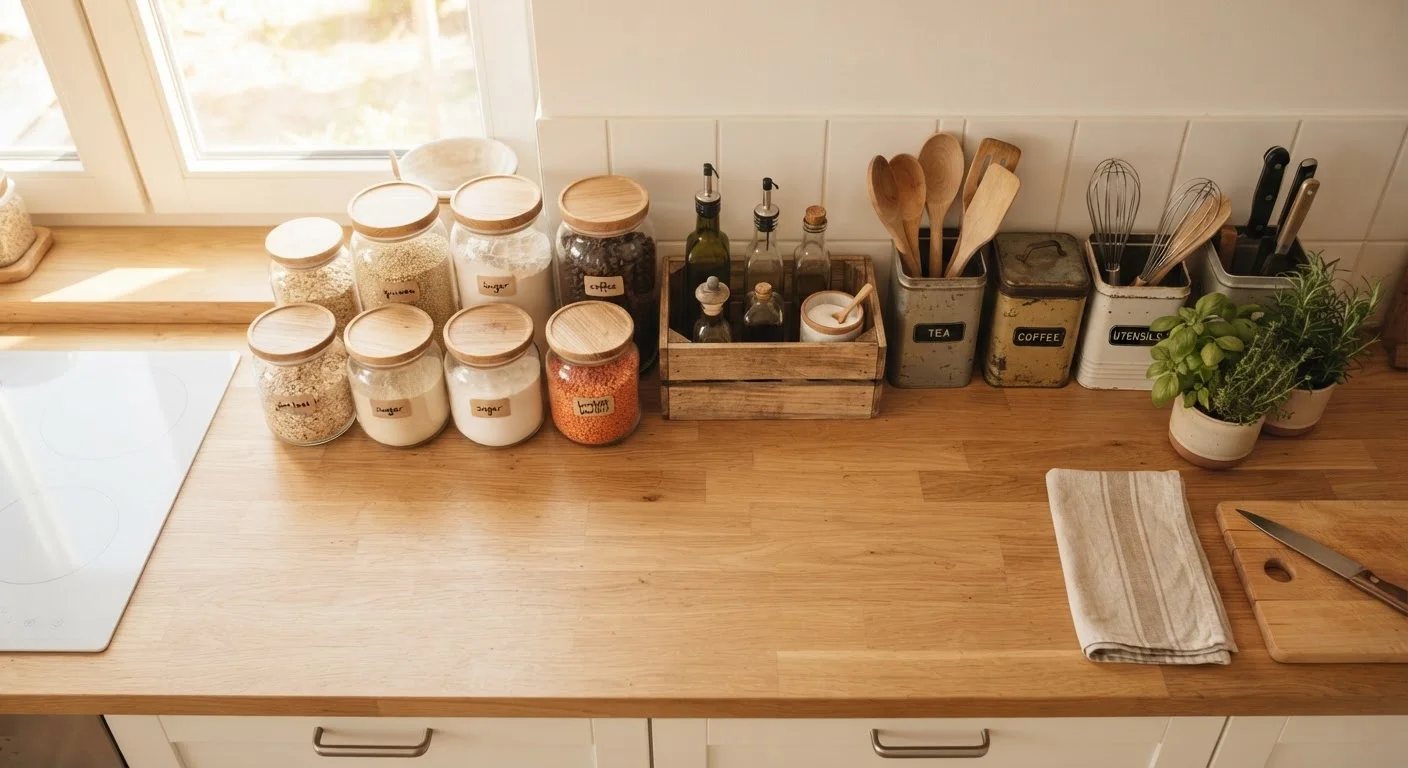
Glass jars-pasta sauce, pickle, jam, or mason jars-are among the most useful repurposed containers in any home. They're sturdy, transparent (so you can see contents at a glance), and come in a range of sizes that suit different categories of small items.
In the kitchen, use them for dry goods, rubber bands, twist ties, or spare batteries. On a desk, a wide-mouth jar holds pens, scissors, and rulers upright. In the bathroom, they corral cotton balls, Q-tips, or hair ties. Because you can see through them, you know when supplies are running low without having to dig.
Wash thoroughly, remove labels with warm soapy water and a little baking soda scrub, and group jars by size on a tray or shelf for a clean, cohesive look.
Transparent glass jars let you see exactly what's inside without opening anything.
Shoeboxes as Drawer Dividers
A full shoebox is too bulky for most drawers, but the lid alone is exactly the right depth to create compartments inside a shallow drawer. Cut lids to fit side by side, and you've made a free drawer divider system for utensils, office supplies, or makeup.
For deeper drawers, whole shoeboxes work well on closet shelves to group folded items by category-belts in one, socks in another. Cover them in wrapping paper or fabric remnants if you want a tidier appearance, though plain cardboard functions just as well.
Shoeboxes are also excellent under-bed storage for out-of-season accessories, craft supplies, or documents you need to keep but rarely access. Slide them in with a label facing out for easy retrieval.
Shoebox lids make surprisingly effective, no-cost drawer dividers for any room.
Egg Cartons for Tiny Objects
The molded compartments in a standard cardboard egg carton are nearly perfect for storing small, easily lost objects-thumbtacks, jewelry findings, buttons, screws, drill bits, or seed packets. Each cup holds one category and keeps it separated without any sliding or mixing.
In a junk drawer, an egg carton tucks flat and immediately introduces order to a chaotic category of miscellaneous small items. In a craft room or workshop, it organizes beads, nails, or paint caps. Because cartons are flimsy, keep them in a drawer or box rather than free-standing on a shelf.
Cardboard versions are biodegradable, so replace them when they wear out-which is easy since they're free every time you buy eggs.
Egg carton compartments are nearly perfectly sized for thumbtacks, buttons, and small hardware.
Takeout Containers and Food Tins as Desk Trays
Rectangular takeout containers-especially rigid plastic ones-function well as shallow trays for desk surfaces. They're flat enough to keep items visible and accessible without becoming a catch-all pile. Use them to hold incoming mail, receipts to process, or a single category of paperwork.
Decorative tins (from popcorn, cookies, or tea) serve a slightly different purpose: they're deep enough to store pens, markers, or charging cables upright, and they often look presentable on a shelf or desktop without any modification. Tins with lids are particularly useful for storing small items that need to stay dust-free.
Group two or three tins of the same height on a tray to create a unified desktop organization station at zero cost.
Decorative tins store pens and cables upright while looking presentable without any modification.
Produce Baskets and Wooden Crates for Shelf Organization
Wooden clementine crates and wire produce baskets from grocery stores are among the most structurally useful repurposed containers available. They're rigid, stackable in some configurations, and have open sides that make contents easy to grab.
On a pantry shelf, a produce basket holds onions, potatoes, or fruit in a way that keeps them off the counter and allows airflow. On a laundry shelf, it stores cleaning supplies upright. In a mudroom or entryway, a crate corrals dog leashes, reusable shopping bags, or spare gloves.
For bedroom organization, small wooden crates can be repurposed as cubby-style shelf inserts-an approach that complements the strategies in our small bedroom organization guide.
Wooden crates and wire baskets bring structure to shelves without adding cost.
Muffin Tins for Junk Drawer Rescue
An old or spare muffin tin laid flat in a wide kitchen drawer instantly creates twelve categorized compartments. The rigid structure won't shift when you open the drawer, and the standard cup size fits coins, rubber bands, chip bag clips, small batteries, or spare keys with room to spare.
This is one of the fastest wins in junk drawer management-a ten-second setup that creates immediate order without buying anything. If you have two muffin tins, overlap them or use them in adjacent drawers for different categories of small items.
Mini muffin tins work well in bathroom drawers for hair clips, bobby pins, and small accessories that tend to scatter. Standard 12-cup tins handle heavier kitchen miscellany without warping.
A muffin tin in a wide drawer creates twelve instant compartments for small, loose items.
Making Improvised Systems Stick
Repurposed organizers work best when the system is just as deliberate as anything bought from a store. That means one rule above all others: label everything. A mason jar filled with rubber bands looks identical to one filled with twist ties. A quick piece of painter's tape and a marker takes ten seconds and prevents a cascade of rummaging later.
Label Every Repurposed Container
The easiest way to make an improvised organization system last is to label every container clearly. Painter's tape and a permanent marker work perfectly and are easy to update when a container gets reassigned. Without labels, improvised storage tends to collapse back into clutter within weeks because no one can remember what goes where.
It also helps to revisit containers seasonally. A shoebox that works perfectly for gift wrap ribbon in December may be better repurposed for seed packets in spring. Flexibility is the point-these containers cost nothing to reassign. For households with multiple people, building shared agreement on where categories live is equally important; the organizing guide for shared homes covers how to get everyone on the same page. For a fuller picture of room-by-room strategies, the comprehensive home organization resource is a practical next step.