

Key Takeaways
- Decluttering before organizing prevents wasted effort and money on unnecessary storage.
- Assigning every item a fixed home is the single most effective habit for maintaining order.
- Room-by-room zoning reduces decision fatigue and makes tidying faster over time.
- Many effective organizers cost nothing - repurposed containers work as well as purchased ones.
- Small, consistent daily habits outperform periodic deep-clean sessions over the long term.
Why Most Organization Efforts Fail
Most people approach home organization by buying storage - bins, racks, drawer dividers - before addressing what they actually own. The result is organized clutter: tidily contained items that still don't serve any real purpose. Organization systems fail not because of poor products, but because of poor sequencing.
A durable system has three components working together: a decision about what stays, a logical home for everything that does stay, and a lightweight daily habit that keeps it in place. Skip any one of these, and the system collapses within weeks. This guide walks through all three in practical terms.
25%
Of home space used for items rarely needed
Research from the National Association of Professional Organizers suggests roughly a quarter of home space is occupied by seldom-used possessions.
40%
Of housework attributed to excess clutter
Studies referenced by professional organizing bodies estimate that clutter accounts for a significant portion of time spent on household maintenance tasks.
Decluttering First: The Foundation
Before a single label is printed or a single shelf installed, the volume of possessions must be reduced to what is genuinely used and valued. The reason is simple: organizing items you don't need wastes both space and effort that could serve you better.
A workable starting approach is the four-category sort - keep, donate, discard, and relocate. Work one area at a time rather than pulling everything out at once, which is a common mistake that leads to overwhelm. A single drawer, one shelf, or one countertop is enough for a session.
For households with significant accumulation, a structured starting framework can help establish realistic first steps without triggering burnout. The goal is sustained momentum, not a single exhausting weekend sprint.
Set a Timer, Not a Goal
Instead of planning to 'organize the pantry,' commit to 20 focused minutes on one shelf. Timed sessions feel manageable and often produce more output than open-ended projects, which tend to expand indefinitely and lead to abandonment.
Room-by-Room Organization Logic
Once volume is reduced, each room benefits from a distinct organizational logic based on how it is actually used - not how it looks in a magazine. The guiding principle is frequency of use: items used daily belong at arm's reach; items used rarely belong in higher or deeper storage.
- Kitchen: Group items by task (prep zone, cooking zone, storage zone). Keep counters clear of anything not used at least twice a week.
- Bathroom: Use drawer inserts or small trays to separate daily-use from occasional-use items. Store extras under the sink in clearly grouped categories.
- Bedroom: Closet organization works best when clothes are sorted by category and frequency. Small bedrooms especially benefit from vertical storage and under-bed solutions.
- Common areas: Every surface should have a defined function. Flat surfaces without assigned purpose become default dumping zones.
For a comprehensive room-by-room framework, the zone method approach offers a structured way to assign functional areas within each room, which reduces daily decision fatigue significantly.
Before assigning a home to any item, ask where you naturally set it down - then make that location the official home. Fighting instinct is exhausting; working with it is sustainable.
Systems aligned with existing behavior require less mental effort to maintain, which dramatically increases the chance they persist over time.
Label the inside of cabinet doors with what belongs on each shelf. It takes two minutes and eliminates the guesswork that causes clutter to creep back in.
Visual cues at the point of decision reduce the cognitive load of putting things away correctly, especially in shared households.
Low-Cost Storage Strategies
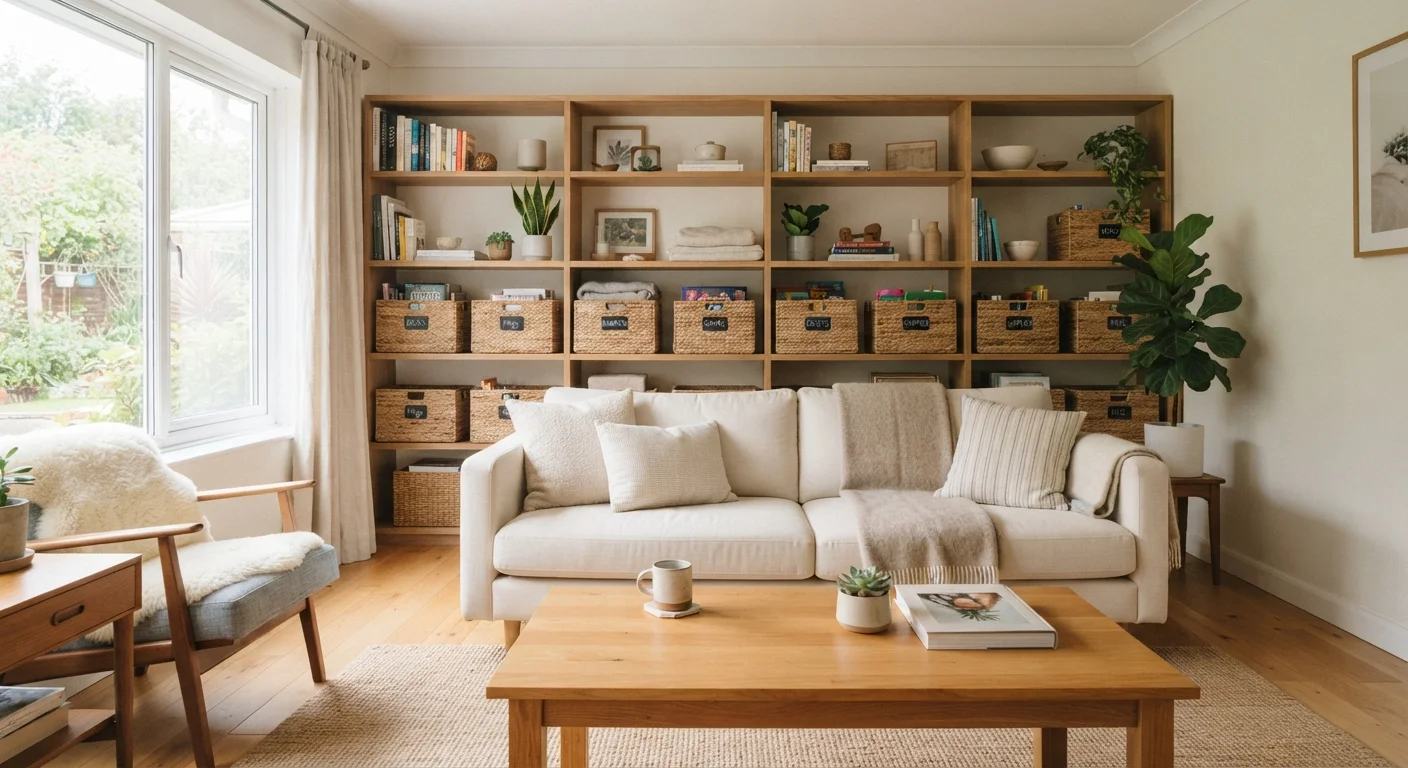
Effective storage does not require a large budget. Many of the most practical organizers are already in your home in the form of repurposed containers. Shoeboxes become drawer dividers. Glass jars store small items in workshops or pantries. Trays corral loose items on dressers or entryway tables.
Everyday objects can double as organizers with surprisingly little modification - the key is consistency in sizing so grouped containers look intentional rather than random.
When purchased storage is necessary, prioritize modularity over aesthetics. Uniform bins that stack and can be relabeled will serve you across years and across rooms. Avoid single-purpose organizers that can't adapt as your needs change.
Don't Buy Storage Before Decluttering
Purchasing bins and baskets before reducing item volume is one of the most common and costly organization mistakes. You will almost certainly buy the wrong sizes, fill them with things you don't need, and create the illusion of organization without the function. Declutter first - then measure, then purchase only what fills a confirmed gap.
Vertical space is also consistently underused. Wall-mounted shelves, over-door organizers, and stackable units can double usable storage in a room without consuming any floor area - a meaningful advantage in smaller homes.
Building Habits That Actually Stick
The gap between a clean home and an organized one is habit. Organization creates the structure; daily routines maintain it. Without a maintenance habit, even the most thoughtful system degrades within a month.
The most reliable maintenance habit is the reset routine: a short daily window - often 10 to 15 minutes - where every out-of-place item is returned to its assigned home. This only works if every item has an assigned home, which is why the earlier steps matter so much.
Behavioral research consistently shows that habit formation is easier when new behaviors are attached to existing ones. Pairing a reset routine with something already fixed in your day - a morning coffee, the end of a workday, or before a meal - removes the need to remember to do it.
Shared Households Need Shared Systems
In homes with multiple occupants, any organization system needs buy-in from everyone who uses the space. A system one person maintains while others ignore it will not hold. Brief conversations about where things live - and why - are far more effective than labels alone.
Managing a household also has a financial dimension. When items are easy to find and spaces are clearly organized, duplicate purchasing drops noticeably. That connects directly to smarter everyday spending and supports a more intentional household budget overall.
Zone Method Room-by-Room Guide
A structured framework for dividing each room into functional zones, making decluttering decisions easier and long-term maintenance more realistic.
Repurposed Container Ideas
Creative, zero-cost ways to use jars, boxes, and trays you already own as effective, attractive home organizers.
Household Budget Planner
A practical tool for tracking household spending and identifying where an organized home can reduce unnecessary duplicate purchases.