

Key Takeaways
- Fixed expenses stay the same each month; variable expenses change based on usage or behavior.
- Knowing the split helps you identify exactly where budget cuts are realistic.
- Variable expenses are where most households have room to adjust spending.
- Both types must be tracked to build a budget that holds up month to month.
- Irregular but predictable costs (like annual insurance) benefit from a sinking fund approach.
Option A
Fixed Expenses
The predictable, unchanging costs you can plan around.
Best for: Households wanting a stable baseline to anchor their monthly budget.
Option B
Variable Expenses
The fluctuating costs that require active monitoring.
Best for: Identifying where spending flexibility-and overspending risk-actually lives.
If you're building a budget for the first time
Fixed Expenses
Start by listing every fixed cost to establish your non-negotiable monthly baseline before allocating anything else.
If you're looking to cut spending this month
Variable Expenses
Variable costs are where behavioral changes-eating out less, reducing subscriptions, carpooling-actually move the needle.
If your income changes month to month
Fixed Expenses
Knowing your fixed floor helps you determine the minimum income needed to stay afloat in a low-earning month.
If you frequently blow your budget without knowing why
Variable Expenses
Untracked variable spending-small daily purchases especially-is typically the culprit behind budget shortfalls.
What Makes an Expense Fixed or Variable
A fixed expense is any recurring cost that stays the same amount every billing period-rent or mortgage payments, car loan installments, and most insurance premiums are classic examples. You know what's coming, and the number doesn't change based on how much you use the service or product.
A variable expense, by contrast, shifts from month to month depending on your choices and circumstances. Groceries, gas, utilities, dining out, and clothing are all variable. Some months you spend more, some less-and that fluctuation is exactly what makes them both flexible and risky.
The distinction isn't just semantic. It determines where you have control in your budget. For a deeper look at how categorizing these costs changes your planning approach, see our guide to categorizing fixed and variable costs.
| Criterion | Fixed Expenses | Variable Expenses |
|---|---|---|
| Amount each month | Same every period | Changes month to month |
| Examples | Rent, car payment, insurance | Groceries, gas, dining out |
| Control level | Low - hard to change quickly | High - behavior-driven |
| Budget predictability | Easy to plan in advance | Requires ongoing tracking |
| Where to cut | Possible, but takes time or major changes | Primary lever for short-term savings |
| Overspending risk | Low - amount is known | High - easy to underestimate |
Why Getting This Wrong Derails Most Budgets
Many people try to cut a budget without first separating fixed from variable costs. The result: they target reductions in areas where they have little or no control, then feel frustrated when the numbers don't move. Rent isn't negotiable on a Tuesday; groceries are.
Conversely, people who don't track variable spending tend to underestimate it significantly. Studies on consumer spending consistently show that people recall fixed costs accurately but underestimate discretionary variable spending-often by a wide margin. Those small purchases accumulate fast.
~30%
Income households typically spend on variable costs
Consumer Expenditure Survey data from the U.S. Bureau of Labor Statistics suggests a substantial share of household budgets goes toward variable spending categories like food, apparel, and entertainment.
1 in 3
Americans with no monthly budget
Surveys conducted by the National Foundation for Credit Counseling have found roughly a third of U.S. adults do not maintain a household budget of any kind.
There's also the matter of irregular costs-annual expenses like car registration, holiday gifts, or a semi-annual insurance premium. These aren't truly variable (the amount is often predictable) but they don't appear monthly. Treating them as surprises is a common budgeting mistake. A sinking fund strategy helps you set aside money in advance so these costs don't blow up your budget when they arrive.
It's also worth remembering that some purchases carry ongoing costs that aren't obvious upfront. Our piece on hidden costs in everyday purchases explains what to watch for.
How to Use This Distinction in a Real Budget
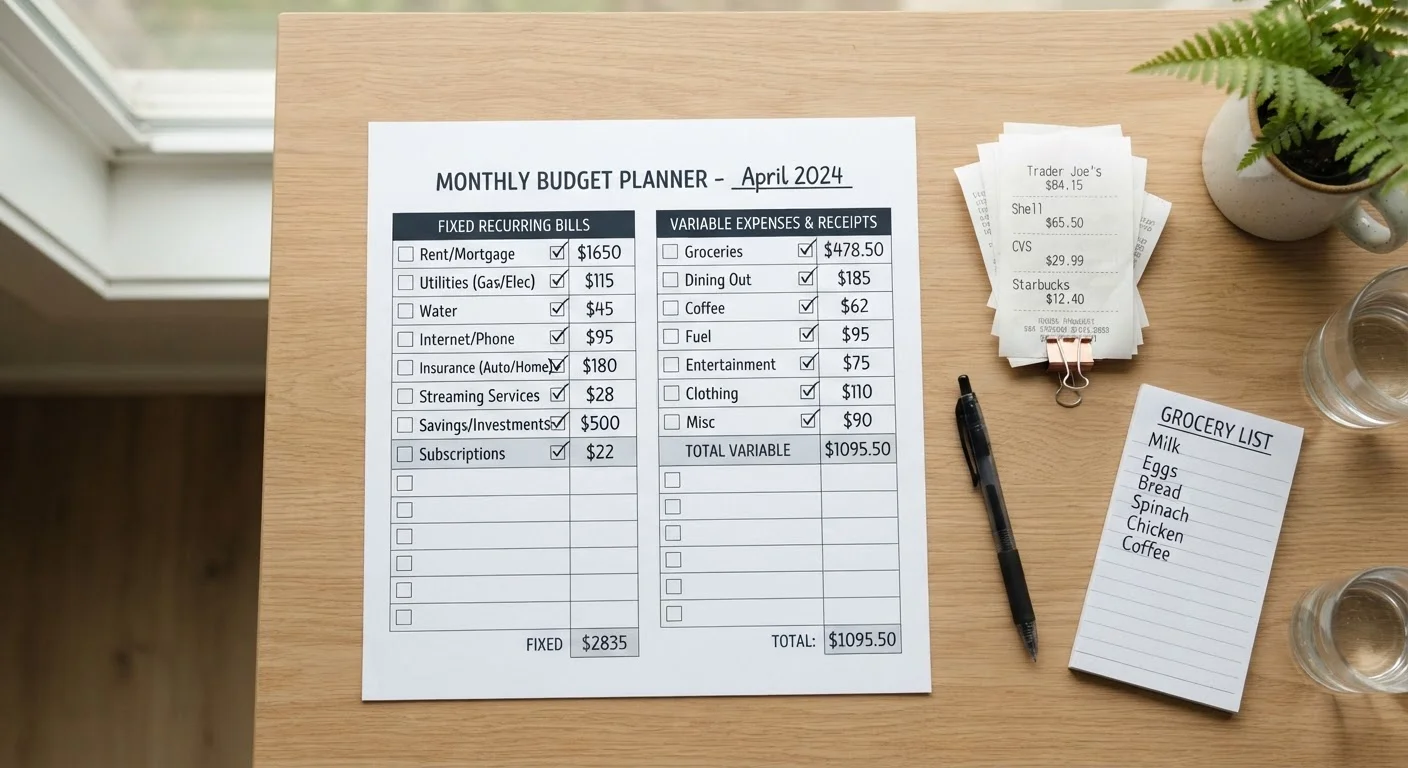
The most practical application is simple: list your fixed expenses first. Add them up. That total is the floor your income must clear every month before you can spend a dollar on anything else. If your fixed costs already exceed your take-home pay, no amount of coupon clipping will fix the budget-something structural has to change.
Next, estimate your variable expenses by category. Look at two or three months of bank and credit card statements rather than guessing-most people are surprised by what they find. Assign a realistic monthly target for each category, knowing these will fluctuate.
This two-column approach is the backbone of budgeting methods like zero-based budgeting and the 50/30/20 framework. Regardless of which method you prefer, the underlying logic is the same: know what's locked in, then make deliberate decisions about what's flexible. If your income isn't steady, this foundation becomes even more critical-see our guide to budgeting on irregular income for strategies that account for income swings.
For a full glossary of the terms you'll encounter as you build your plan, the key budgeting terms reference is a useful starting point. And for ongoing strategies to stretch every dollar, explore the Smart Budgeting hub and the Smart Spending hub.
This article is for general informational purposes only and does not constitute personalized financial advice. Consult a qualified financial professional for guidance specific to your situation.