

| Price Matching | Retailer-specific policy; requires identical item at a verified competitor price |
| Price History Tracking | Shows how a product's price has changed over time across one or more retailers |
| Price Alerts | Automated notification when a product hits your target price |
| Post-Purchase Price Match Window | Typically 14-30 days, but varies by retailer policy |
| Common Price Match Exclusions | Third-party sellers, auction prices, out-of-stock items, membership-only pricing |
What These Tools Are and Why They Matter
Price matching, price history tracking, and price alerts are three distinct tools that serve one shared purpose: helping you spend money more deliberately. They're often mentioned together but work very differently, and knowing when to use each one can save real money over time.
| Price Matching | Retailer-specific policy; requires identical item at a verified competitor price |
| Price History Tracking | Shows how a product's price has changed over time across one or more retailers |
| Price Alerts | Automated notification when a product hits your target price |
| Post-Purchase Price Match Window | Typically 14-30 days, but varies by retailer policy |
| Common Price Match Exclusions | Third-party sellers, auction prices, out-of-stock items, membership-only pricing |
None of these tools guarantee savings on their own. Their value depends on how well you understand what they do - and what they don't. As a starting point, see how price fits into broader purchase decisions in our Shopper's Field Guide to Product Research.
Price Matching: What Retailers Actually Cover
Price matching is a retailer policy - not a universal right. When a retailer offers price matching, they agree to sell you an item at a lower price that a competitor is currently charging for the same product. The key word is same: most policies require an identical item (same brand, model number, size, color, and condition).
Price Matching
A retailer policy in which the store agrees to honor a lower price offered by a qualifying competitor for the exact same product. Conditions and exclusions vary by retailer.
Post-Purchase Price Match
A form of price matching applied after a purchase is made. If the price drops within a specified window, the retailer refunds the difference. Not all retailers offer this.
Price History
A record of how a product's price has changed over time, typically displayed as a chart. Used to assess whether a current price is genuinely lower than usual.
Price Alert
An automated notification - usually via email or app - sent when a tracked product reaches a price threshold you set in advance.
Anchor Price
A reference price (often a "was" or original price) displayed alongside a sale price to make the discount appear larger. Price history tools help verify whether the anchor is accurate.
Common exclusions to watch for:
- Marketplace sellers or third-party listings (many retailers exclude these)
- Auction sites or limited-time flash sales
- Items that are out of stock at the competing retailer
- Open-box, refurbished, or clearance merchandise
- Membership-only prices (such as warehouse club pricing)
Some retailers also offer post-purchase price matching - if the price drops at that same retailer within a set window (commonly 14-30 days), you can request a refund of the difference. Always read the fine print, as these windows and conditions vary widely. For context on how retailers set and adjust prices, our explainer on retail pricing tactics is worth a read.
Price History: Reading the Track Record
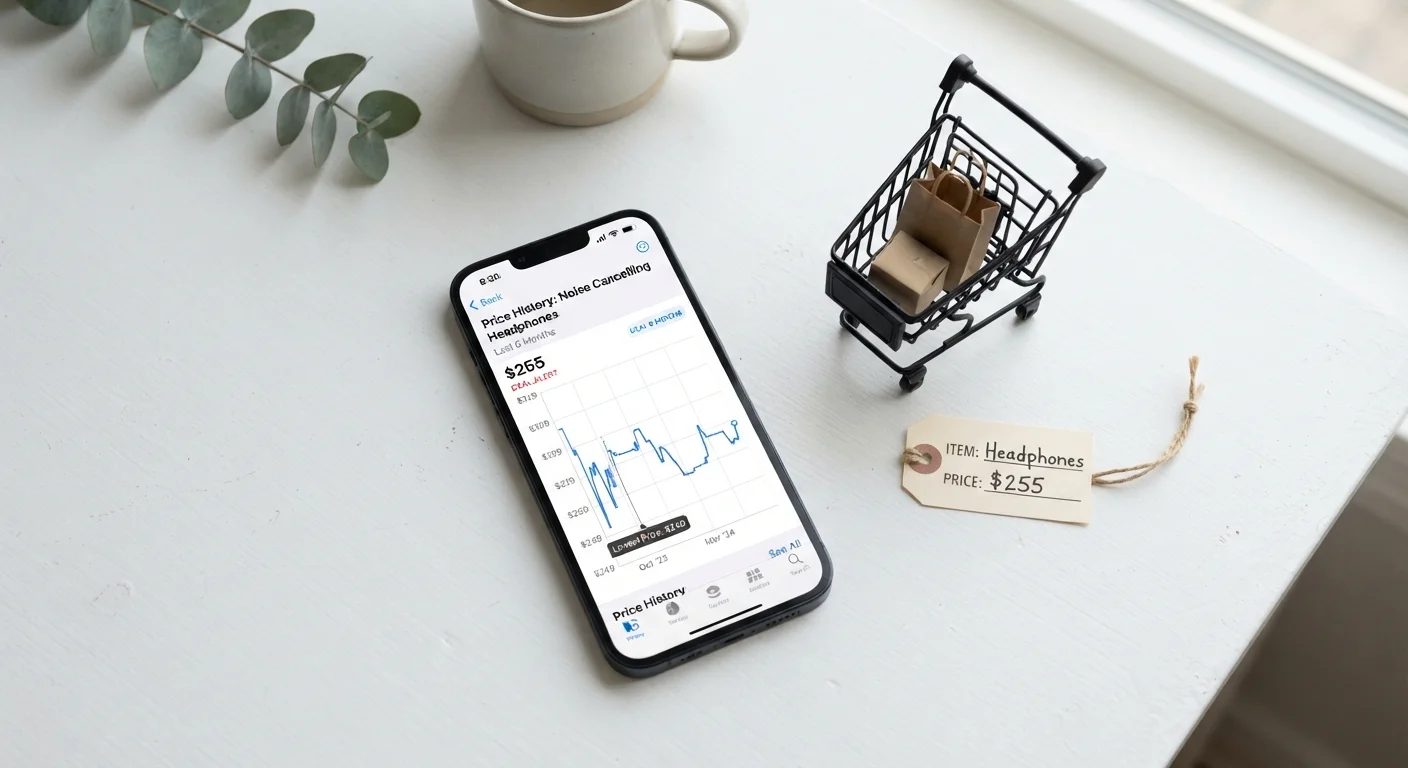
Price history tools record how much a product has cost over time at one or more retailers. Browser extensions and dedicated websites collect this data and display it as a chart, letting you see whether today's listed price is genuinely lower than usual - or simply dressed up as a deal.
Up to 3x
Price swings on popular electronics in a single year
Consumer price tracking analyses have found that prices on frequently discounted categories like electronics can fluctuate dramatically within a 12-month period.
14-30 days
Typical post-purchase price match window
Many retailers that offer post-purchase price matching set a claim window of two to four weeks from the original purchase date, though terms differ.
Price history is most useful when:
- A product is advertised as "on sale" and you want to verify the claim
- You're researching a major purchase and want to understand normal price ranges
- You suspect a price was briefly inflated before a discount was applied
One important limitation: price history data is only as complete as what the tool has recorded. If a product launched recently or the tool hasn't tracked it consistently, the history may be thin or misleading. Price history complements - but doesn't replace - the kind of value analysis covered in unit price and total value tracking.
Price Alerts: Buying on Your Timeline
A price alert is a notification you set in advance: when a product reaches a price you specify, you get an email or app notification. This shifts you from reactive shopping (responding to sales) to intentional shopping (waiting for your target price).
To set an effective alert:
- Check the price history first to understand realistic low points for the item.
- Set your target price at or near a historical low, not an arbitrary number.
- Decide your patience window - if you need the item within a month, factor that in.
Price Alerts Work Best With a Target in Mind
Setting a price alert without first checking the item's price history can lead to alerts that never trigger - or that trigger at a price that's not actually a good value. Spend two minutes reviewing the historical price range before choosing your alert threshold. If the item rarely dips below a certain point, calibrate your expectations accordingly.
Price alerts work best for non-urgent purchases where you have flexibility on timing. For time-sensitive needs, they're less practical. Understanding how discount cycles work can also inform when to set your alert - see how retailers structure discounts for background on promotional timing.
This article is for general informational purposes only and does not constitute financial advice. Individual results vary. Consult a qualified financial professional for guidance specific to your situation.