

Key Takeaways
- Short, consistent daily sessions outperform occasional long training marathons.
- Positive reinforcement is supported by behavioural science and works across species.
- Problem behaviours are easier to redirect early than to correct after they solidify.
- Training needs change as pets age - puppies, adults, and seniors each require adjustments.
- Some behaviours signal underlying health issues and warrant a veterinary check before training.
Why Home Training Works
Professional training classes can be valuable, but they are not the only path to a well-behaved pet. Research in animal behaviour consistently shows that learning happens wherever the animal lives - meaning your home is already a rich training environment. Because pets encounter their most common triggers (doorbells, guests, mealtimes) at home, practising cues in that context produces stronger, more reliable responses than drills in a neutral class setting.
Cost is another practical reality. Consistent home training, guided by sound principles, can achieve results comparable to group classes without the ongoing expense. The key is understanding how animals learn, not just what commands to teach. Our guide to positive reinforcement in pet training explains the behavioural science behind reward-based methods in depth.
5-10 min
Ideal daily training session length per block
Behavioural science literature consistently recommends short, frequent sessions over long infrequent ones to optimise retention in companion animals.
3-14 weeks
Critical socialisation window in puppies
Veterinary and behavioural guidelines identify this developmental window as the most sensitive period for positive exposure to new stimuli in dogs.
1-2 seconds
Maximum reward delay for effective conditioning
Classical and operant conditioning research shows that rewards delivered beyond two seconds after a behaviour significantly reduce learning accuracy.
Core Principles Before You Begin
Before teaching a single cue, establish these foundations:
- Timing: Deliver a reward within one to two seconds of the desired behaviour. Delayed rewards train the wrong moment.
- Consistency: Every household member should use identical cue words and hand signals. Mixed signals slow learning significantly.
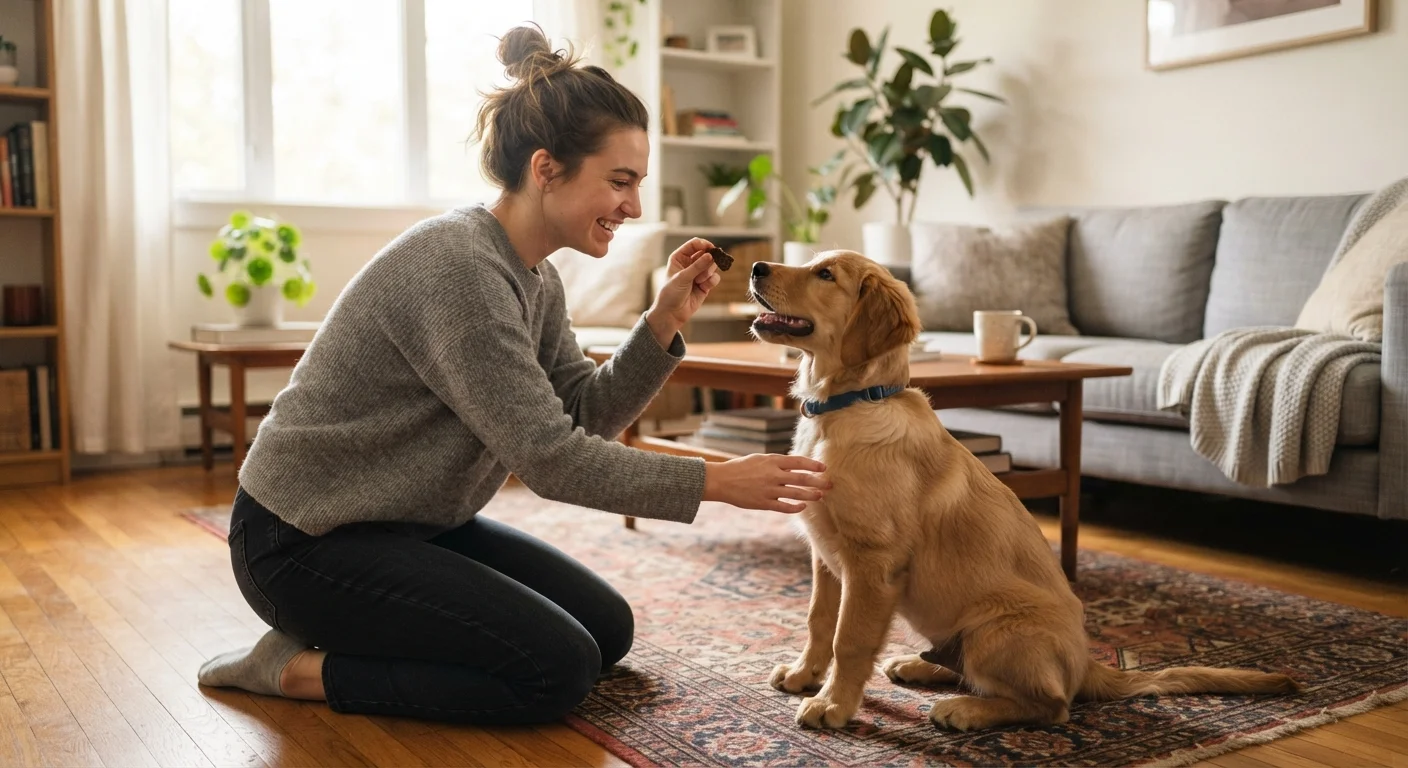
- Session length: Five to ten minutes per session, two to three times daily, is more effective than a single thirty-minute block. Pets - especially young ones - fatigue mentally faster than physically.
- Reward value: Match the reward to the difficulty of the task. High-distraction environments call for higher-value treats; quiet practice may only need praise.
Set Up Your Environment Before You Start
Prepare rewards, remove distractions, and choose a familiar, low-traffic area of your home before beginning a session. Having everything ready means you can respond to the pet's behaviour instantly - which is where effective training lives. A cluttered or busy environment will add unnecessary difficulty, especially for beginners.
Training is also one of the most direct ways to support your pet's mental health. Pairing it with the everyday habits that shape long-term wellbeing creates compounding benefits for behaviour and overall health.
Foundational Cues for Every Pet
Regardless of species, a small set of core behaviours forms the backbone of home training:
- Sit / Settle
- The most versatile cue. Lure the animal into position, mark (with a click or verbal marker like "yes"), then reward. Practice at varying times of day so it generalises across contexts.
- Stay
- Build duration before distance. A three-second stay is mastered before a thirty-second one. Add distance only after duration is reliable.
- Come / Recall
- Never punish a pet that comes to you, even if they took their time. A reliable recall is a safety cue - protect its positive association rigorously.
- Leave it
- Teaches impulse control and is foundational for preventing dangerous ingestion. Start with low-value items and progress slowly.
Use your pet's regular mealtime kibble as training treats during the learning phase. It keeps calorie intake balanced and ensures your pet is always motivated at training time.
Many owners over-supplement with high-calorie treats during training, which can contribute to weight gain. Using measured meal portions as rewards eliminates this risk while maintaining motivation.
End every session on a success - even if that means reverting to an easier cue the pet knows well. Finishing on a positive note keeps the animal engaged and willing for the next session.
Behavioural research on associative learning shows that the final experience in a session has an outsized influence on the animal's attitude toward the next training opportunity.
For new puppies, the first eight weeks of puppy training covers how to introduce these cues alongside crate habits and early socialisation.
Managing Problem Behaviours
Problem behaviours are almost always unintentionally reinforced. Jumping, barking, or counter-surfing persist because they have worked - at least sometimes. The most effective approach is to make the unwanted behaviour unrewarding while simultaneously teaching an incompatible alternative.
Rule Out Medical Causes First
Before attributing a problem behaviour to stubbornness or disobedience, consider whether a physical issue may be driving it. Pain, hormonal imbalances, neurological changes, and sensory decline can all manifest as behavioural change. If a behaviour appears suddenly or is accompanied by other changes in appetite, sleep, or mobility, schedule a veterinary evaluation before beginning any behaviour modification programme.
Common strategies include:
- Management first: Use baby gates, leashes, or environmental barriers to prevent rehearsal of the problem behaviour while you build the replacement cue.
- Differential reinforcement: Reward the behaviour you want heavily (e.g., four paws on the floor) rather than focusing on punishing what you don't want.
- Identify triggers: Track when problem behaviours occur. Patterns (time of day, specific visitors, sounds) help you set up proactive training scenarios.
Avoid Punishment-Based Methods
Aversive techniques - including yelling, leash corrections, or shock collars - are associated with increased fear, anxiety, and aggression in companion animals according to peer-reviewed veterinary behaviour research. Beyond welfare concerns, punishment often suppresses behaviour temporarily without addressing its cause, leading to rebound or displacement into other problem behaviours. Reward-based methods are both more humane and more durable.
Training Through Life Stages
A pet's learning capacity and motivations shift with age. Adjusting your approach accordingly improves outcomes at every stage.
Young Animals (Puppies and Kittens)
The socialisation window - roughly three to fourteen weeks in dogs - is critical for exposure to sounds, surfaces, and people. Prioritise positive, low-pressure introductions over formal cue drilling at this stage.
Adult Pets
Adult animals are fully capable learners; the idea that "you can't teach an old dog new tricks" has no scientific basis. Adults often have longer attention spans than puppies, making complex behaviours easier to shape. Focus on building reliable cue responses across varied environments.
Senior Pets
Older pets may have sensory or mobility limitations that require modified reward delivery or shorter sessions. Note any sudden behavioural changes in a senior pet - these can reflect pain, cognitive decline, or other health issues. A veterinary evaluation should precede any behavioural intervention in seniors. For broader wellness context, the Pet Health and Wellness hub offers guidance on keeping ageing pets thriving.
When to Seek Professional Help
Home training handles the vast majority of everyday behaviour goals, but some situations call for qualified support:
- Aggression: Any behaviour involving biting, growling with stiff body language, or resource guarding that escalates warrants evaluation by a certified applied animal behaviourist or veterinary behaviourist - not just a general trainer.
- Separation distress: Severe anxiety (destructive behaviour, self-injury, vocalisation) when alone is a welfare concern that often benefits from a combination of behaviour modification and veterinary assessment.
- Sudden behaviour changes: If a previously calm pet becomes reactive, fearful, or aggressive without a clear environmental cause, rule out a medical origin first.
Credentials Matter When Choosing a Professional
Titles like "dog trainer" are unregulated in most US states - anyone can use them. When seeking professional support, look for credentials such as Certified Applied Animal Behaviourist (CAAB), Veterinary Behaviourist (board-certified, DACVB), or Certified Professional Dog Trainer (CPDT-KA). These designations involve formal education, supervised hours, and continuing education requirements.
Seeking help is not a failure - it is sound judgement. A professional can design a behaviour modification plan specific to your pet's history, while you continue to do the daily practice that makes the difference. The Pet Care Basics hub provides additional foundational resources to support your training journey.
This article provides general educational information about pet training and is not a substitute for advice from a qualified veterinary or animal behaviour professional. If your pet shows signs of distress, injury, or aggression, consult a licensed professional promptly.