

Key Takeaways
- Puppies learn fastest through short, positive sessions repeated throughout the day.
- Crate training reduces accidents and builds a puppy's sense of security when done gradually.
- Sit, stay, and recall are the three highest-priority commands for a safe, well-behaved dog.
- Socialisation during weeks 8-16 shapes how a dog responds to the world for life.
- Consistency from every household member matters more than any single training technique.
Start here
What to Expect in the First Two Weeks
Next
Crate Training and Sleep Routines
Build on it
Teaching Sit, Stay, and Recall
Broaden it
Socialisation Without Overwhelm
Keep it going
Staying Consistent on a Budget
What to Expect in the First Two Weeks
Bringing a puppy home triggers what behaviourists call an adjustment period - a window of 10-14 days during which your puppy is simultaneously overwhelmed, curious, and forming its first impressions of your household. Don't interpret early clinginess or nighttime crying as a training failure; it's normal stress response.
Before you do anything else, read what new pet owners often overlook to set realistic expectations about daily time demands. Your first priority in week one isn't teaching commands - it's establishing a predictable daily rhythm around feeding, toilet breaks, naps, and brief play.
Puppies at 8 weeks sleep up to 18 hours per day. Structure your household routine around those natural rest cycles: active training only happens when your puppy is awake, rested, and not hungry.
Positive reinforcement
Adding something pleasant - like a treat or praise - immediately after a behaviour to make that behaviour more likely to happen again.
Cue
A signal (a word, hand gesture, or sound) that tells your pet what behaviour you're asking for.
Socialisation window
A developmental period (roughly weeks 3-16 in puppies) during which positive exposure to new experiences has the strongest long-term effect on temperament.
Flooding
Overwhelming a puppy with a scary stimulus until it stops reacting - considered counterproductive and potentially harmful in modern training practice.
Luring
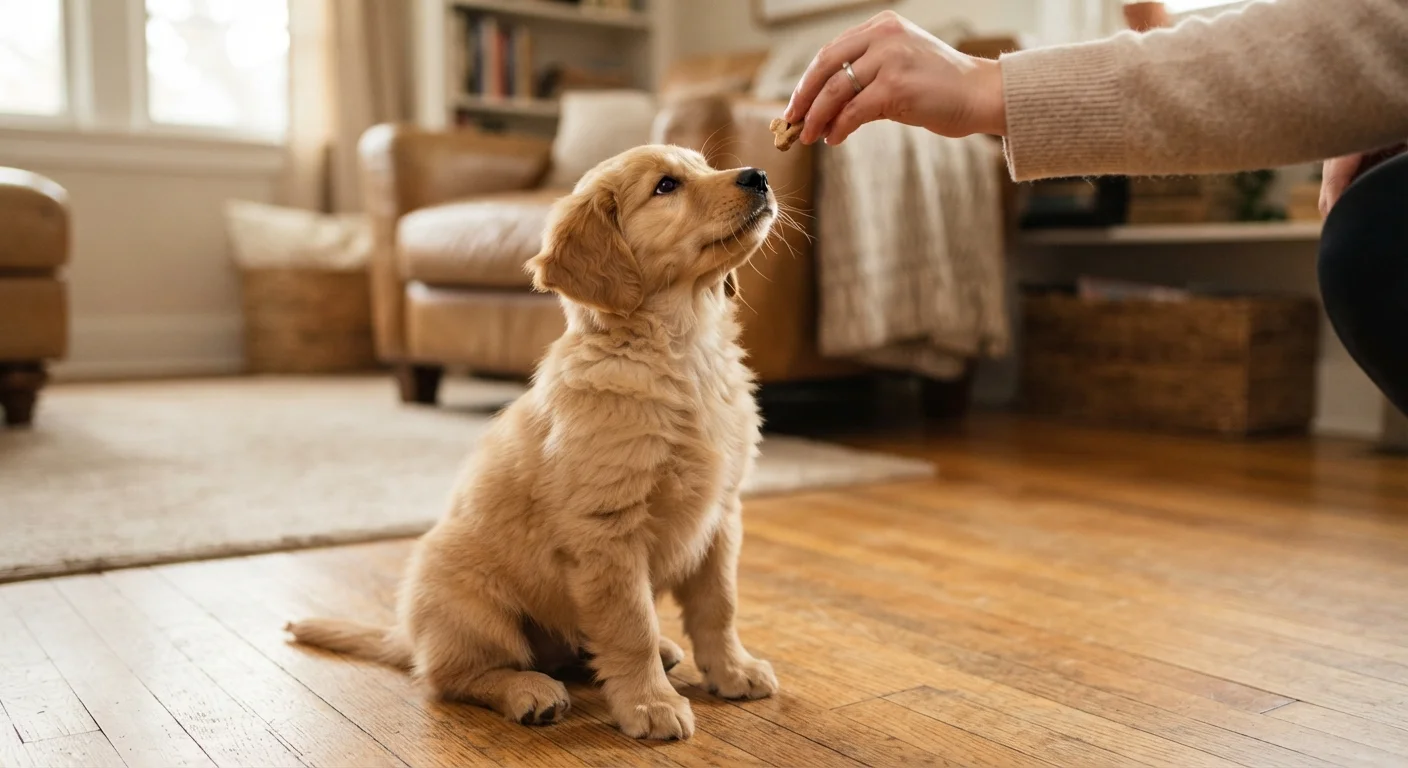
Using a treat held in your hand to guide a puppy into a desired position, such as moving a treat back over the head to prompt a sit.
Crate Training and Sleep Routines
A crate - sized so your puppy can stand, turn around, and lie down comfortably, but not much larger - becomes a den when introduced correctly. On day one, leave the door open and toss treats and meals inside so the puppy enters voluntarily. Close the door briefly only once the puppy is relaxed inside.
Gradually extend the time the door is closed over several days. Never use the crate as punishment; its value depends entirely on it feeling safe. For overnight sleeping, place the crate near your bed so your puppy can smell and hear you - this dramatically reduces nighttime crying.
Cover the Crate at Night
Draping a lightweight blanket over three sides of a wire crate mimics a den environment and can help puppies settle more quickly. Leave the front uncovered so air circulates freely. A worn item of your clothing placed inside can also provide comfort through familiar scent.
Expect 1-2 overnight toilet trips for the first 3-4 weeks. Take your puppy outside calmly and immediately return to the crate without play or fuss; you're reinforcing the idea that nighttime outings are functional, not social events.
Teaching Sit, Stay, and Recall
These three commands form the practical core of puppy training. Each is taught with positive reinforcement - a reward delivered immediately after the desired behaviour. Timing matters: a treat arriving within 1-2 seconds of the behaviour tells your puppy exactly what it's being rewarded for.
- Sit: Hold a treat at your puppy's nose, then slowly move it back over their head. As their nose follows the treat upward, their bottom naturally lowers. The moment it touches the ground, say "sit" and reward immediately.
- Stay: Ask for a sit, then take one small step back. Return, reward, and repeat - extending distance and duration only gradually over days, not within a single session.
- Recall (come): Call your puppy's name followed by "come" in a warm, upbeat tone when they're already moving toward you. Reward enthusiastically every single time. Never call your puppy to you for something unpleasant - it poisons the cue.
For detailed help structuring your practice time, see how short daily sessions build reliable behaviour. Before each session, run through the owner readiness checklist to set yourself and your puppy up for success.
Socialisation Without Overwhelm
Weeks 8-16 represent a critical socialisation window. Positive exposure to a wide variety of sights, sounds, surfaces, people, and (safely chosen) animals during this period shapes how your dog processes novelty for the rest of its life. Missing this window doesn't doom a dog, but it does require more patient work later.
Keep exposures brief and positive. Watch your puppy's body language for signs of stress - yawning, lip-licking, tucked tail, or freezing - and increase distance or reduce intensity immediately if you see them. The goal is curiosity, not flooding.
Vaccination Status Affects Safe Socialisation
Puppies are vulnerable to serious infectious diseases like parvovirus before their vaccination series is complete. Discuss a socialisation plan with your veterinarian rather than skipping exposure entirely - the risk of under-socialisation is also real. Your vet can help you find a safe middle ground.
Until your puppy's core vaccinations are complete, avoid areas with high dog traffic such as dog parks. Your veterinarian can advise on safe exposure options during this period. Carrying your puppy to observe busy environments can provide valuable sensory exposure while limiting disease risk.
Staying Consistent on a Budget
Effective training costs very little. The two most important ingredients - consistency and timing - are free. Every person in your household should use the same cues and the same rules; mixed messages are the most common reason early training stalls.
Familiar training terms like reinforcement and shaping help you understand free online resources and public library books on positive reinforcement. Many county humane societies also offer low-cost or free puppy classes if you later want structured group socialisation.
American Veterinary Society of Animal Behavior (AVSAB)
AVSAB publishes free position statements on puppy socialisation and humane training methods, grounded in current behavioural science - a reliable starting point for any new owner.
Your Local Public Library
Many libraries carry up-to-date books on positive reinforcement training at no cost. Titles focusing on reward-based methods and developmental puppy behaviour offer structured, expert guidance without a class fee.
At the end of eight weeks, your puppy will not be a finished product - but it will have a routine, a safe sleeping space, a handful of reliable behaviours, and a growing confidence in its world. That foundation is everything.
This article is for general informational and educational purposes only and does not constitute veterinary or professional animal behaviour advice. Consult a licensed veterinarian or certified animal behaviourist for guidance specific to your puppy's health or behaviour.