

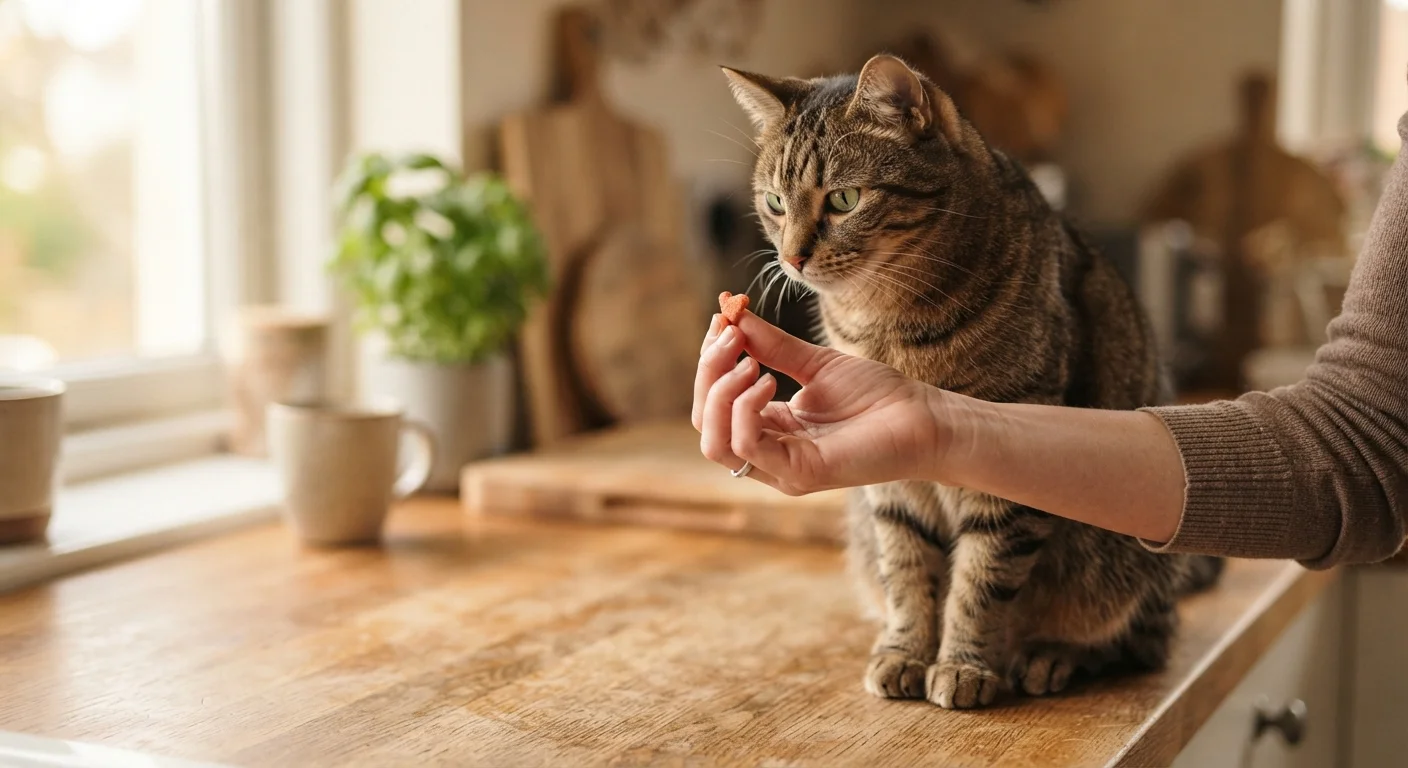
Key Takeaways
- Cats are capable of learning cues, tricks, and routines through consistent positive reinforcement.
- Punishment-based methods are ineffective with cats and can damage your relationship with them.
- Short, frequent training sessions work better for cats than long, infrequent ones.
- Age is not a barrier - adult and senior cats can still learn new behaviours.
- Food motivation varies by cat; finding the right reward is key to success.
Why Cat Training Myths Persist
Cats have a reputation for being aloof, stubborn, and beyond the reach of training. This reputation is largely cultural rather than scientific. Because cats don't display compliance as visibly as dogs, many owners assume nothing is working - or never try. In reality, mismatched expectations and inappropriate techniques account for most training failures, not any inherent limitation in cats themselves.
Understanding what the evidence actually says can save time, money, and frustration - especially for owners who want to manage behaviours at home without the cost of professional classes. Our complete at-home pet training guide covers foundational techniques applicable to cats and other pets at every life stage.
Myth
Cats are simply untrainable and too independent to learn cues.
Fact
Cats are fully capable of learning behaviours through operant conditioning - the same learning mechanism that works in dogs.
The idea that cats cannot be trained stems from comparing them to dogs, which have been selectively bred for millennia to follow human direction. Cats were domesticated under different pressures, making them more self-reliant - but not unlearnable. Studies on feline cognition confirm that cats respond well to reward-based methods. They can learn to sit, come when called, use a scratching post on cue, and more. The difference is motivation: cats work for what they value, so finding the right reward is the trainer's first job.
Myth
You can't train an older cat - it has to be done as a kitten.
Fact
Adult and senior cats retain the ability to learn new behaviours; age alone is not a meaningful barrier to training.
While kittens do have a socialization window during which exposure shapes long-term temperament, the capacity for associative learning persists throughout a cat's life. Many rescue cats are successfully taught new routines, litter habits, and even cues well into adulthood. Patience and consistency matter more than the cat's age. If an older cat seems harder to engage, it is worth ruling out sensory decline or discomfort with a veterinary check-up rather than attributing it to age alone.
Myth
Cats are only motivated by food, so if your cat isn't food-driven, training won't work.
Fact
Food is a common reward, but play, praise, and attention can be equally effective motivators for many cats.
Cats vary widely in what they find rewarding. While high-value treats - such as small pieces of cooked chicken or commercial treats - work well for many cats, others are more motivated by a favourite toy, a brief play session, or even gentle petting. The key is identifying what your individual cat finds genuinely reinforcing and using it consistently. Experimenting with different reward types during short sessions is a practical first step. See our guide to positive reinforcement in pet training for a deeper look at how reward systems work across species.
Myth
A cat that misbehaves needs to be corrected firmly so it understands what it did wrong.
Fact
Cats do not connect delayed punishment with a previous action; firm correction typically creates fear rather than understanding.
Unlike some interpretations of dog training, punishment in cats is rarely effective and carries real risks. A cat cannot link a scolding or physical correction to a behaviour that occurred even a few seconds earlier. What the cat does learn is to associate you - or the environment - with something unpleasant. This erodes trust and can worsen problem behaviours over time. Redirecting unwanted behaviour and rewarding desirable alternatives is a more durable strategy. For a fuller breakdown of why aversive methods tend to backfire, see why punishment-based training often backfires.
Myth
Long training sessions help cats learn faster by giving them more practice.
Fact
Cats learn more effectively in multiple short sessions of two to five minutes than in extended practice blocks.
Cats have relatively short attention spans for structured interaction and are quick to disengage when they are no longer interested or rewarded at a satisfying rate. Animal behaviour practitioners generally recommend keeping sessions brief - often just two to five minutes - and repeating them several times a day rather than attempting one long session. Ending each session on a successful repetition helps reinforce a positive association with the training activity itself.
Practical Takeaways for Cat Owners
Debunking myths is only useful if it translates into better daily practice. Here are the evidence-grounded principles that matter most:
- Start with observation. Watch what your cat naturally gravitates toward - a toy, a treat, a cozy lap session. That is your reward currency.
- Keep it short. Two to five minutes per session, repeated throughout the day, consistently outperforms marathon attempts.
- Be consistent. Use the same cue word or hand signal every time. Variation confuses the learning process.
- Ignore what you don't want, reward what you do. Withholding attention for unwanted behaviours and immediately rewarding alternatives is far more effective than correction.
Avoid Punishment and Spray Bottles
Spraying cats with water, yelling, or physically reprimanding them may suppress a behaviour momentarily but typically increases fear and stress. Research in animal behaviour consistently links aversive methods with higher anxiety and a breakdown of the human-animal bond. These approaches are likely to make training harder, not easier.
If you notice abrupt behavioural changes in your cat that training doesn't address, check our related article on common cat health myths vets keep correcting - sometimes what looks like a training problem is a health signal.
Training Does Not Replace Veterinary Care
Sudden changes in a cat's behaviour - such as aggression, hiding, or litter box avoidance - can signal underlying health issues. Always consult a veterinarian before assuming a problem is purely behavioural. Training is a complement to, not a substitute for, professional veterinary guidance.
For broader context on how reward-based methods work across different pets and scenarios, the Pet Care Basics hub is a good starting point for owners building confidence at home.
This article is for general informational and educational purposes only. It does not constitute veterinary or professional behaviour advice. If your cat is showing signs of distress, aggression, or sudden behavioural changes, consult a qualified veterinarian or certified animal behaviour specialist.