

Key Takeaways
- Your owner's manual contains the only maintenance schedule specifically written for your vehicle.
- Service intervals are usually triggered by mileage, time, or driving conditions - whichever threshold arrives first.
- Severe-duty driving (frequent short trips, towing, extreme climates) typically shortens recommended service intervals.
- Skipping scheduled services can void portions of a powertrain warranty and lead to costlier repairs.
- Keeping a service log creates a verifiable record that supports resale value and helps track upcoming services.
Maintenance Schedule
A maintenance schedule is a manufacturer-specified plan that outlines when particular vehicle services - such as oil changes, filter replacements, and fluid checks - should be performed. Intervals are typically expressed in miles driven, months elapsed, or both, whichever comes first. Following the schedule helps protect mechanical reliability and can preserve your vehicle's resale value.
Modern vehicles often use condition-based monitoring systems (sometimes called oil life monitors or service reminder systems) that calculate service intervals based on driving data rather than fixed mileage alone.
What a Maintenance Schedule Actually Contains
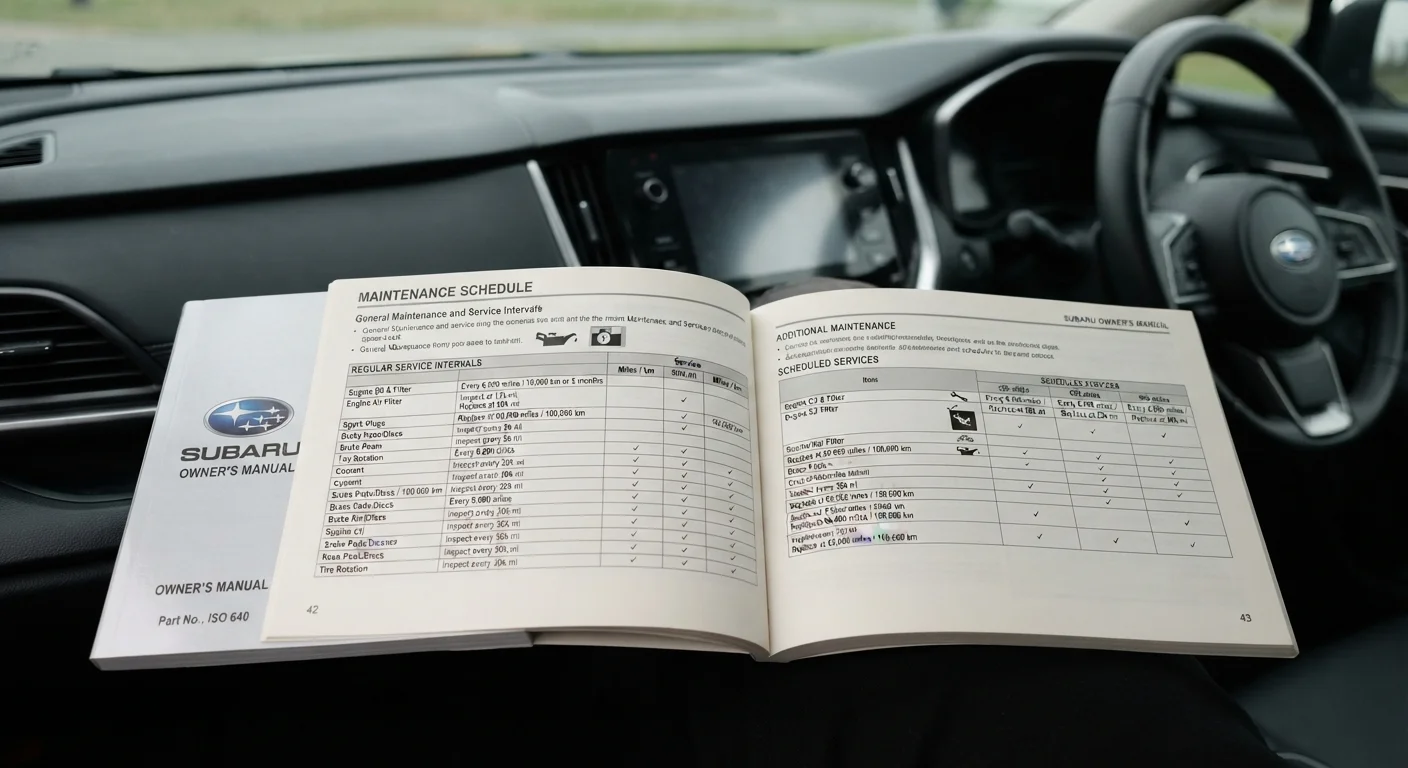
Flip past the first few pages of your owner's manual and you'll find a table - sometimes several - listing every routine service your vehicle needs and exactly when to perform it. These tables are organized by mileage milestones (such as every 5,000, 15,000, or 30,000 miles) and corresponding time intervals (every six months, annually, etc.). Each row identifies a specific component or fluid, and each column marks the interval at which it should be inspected, changed, or replaced.
Common items you'll encounter include:
- Engine oil and filter - the most frequent service on nearly every vehicle
- Tire rotation - typically aligned with oil changes to promote even tread wear
- Air filter (engine and cabin) - usually on a longer cycle, often 15,000-30,000 miles
- Brake fluid, coolant, and transmission fluid - replaced on extended intervals or when condition-based testing flags them
- Spark plugs and drive belts - major intervals, often 60,000-100,000 miles depending on the type
For a detailed breakdown of what a mechanic actually examines at each visit, see what mechanics check during a standard service.
Miles vs. Months: Which Interval Triggers First?
A common source of confusion is the dual-trigger format - for example, "change engine oil every 7,500 miles or 12 months, whichever comes first." This matters because fluids and rubber components degrade over time even if the odometer barely moves. A vehicle driven only 3,000 miles per year still needs annual attention because moisture, oxidation, and temperature cycling break down lubricants and seals.
If your driving falls below the mileage threshold before the time interval, use the calendar date as your trigger. If you commute heavily and hit the mileage limit first, schedule service promptly rather than waiting until the month arrives.
Use Both Triggers, Not Just the Odometer
Always check the time interval alongside the mileage interval in your maintenance schedule. If you drive fewer miles than average, the calendar date often becomes the controlling trigger. Setting a recurring reminder in your phone at the start of each year takes less than a minute and keeps you from letting a time-based interval slip by unnoticed.
Many newer vehicles display a service reminder on the instrument cluster based on an onboard monitoring system. This is a useful alert, but it supplements - not replaces - the owner's manual schedule. Cross-reference both to stay on track.
Normal vs. Severe Driving: Knowing Which Category Applies to You
Most owner's manuals include two parallel schedules: one for normal operating conditions and one for severe or "special" conditions. Severe driving is more common than many people realize. You likely fall into that category if you regularly:
- Make trips of five miles or fewer, especially in cold weather
- Drive in stop-and-go traffic for extended periods
- Tow trailers or haul heavy loads
- Operate in extreme heat, cold, dusty, or hilly terrain
- Leave the vehicle idling frequently
Short trips are particularly hard on engines because the motor never fully warms up, preventing moisture in the crankcase from evaporating. Over time, that moisture contaminates oil faster than long highway drives would. If several of these conditions describe your daily use, apply the severe schedule - it's not an upsell; it's what the manufacturer engineered for your driving reality.
5,000-10,000 mi
Typical modern oil change interval
Many automakers now specify extended oil change intervals for vehicles using full-synthetic oil, compared to the traditional 3,000-mile guideline.
30,000 mi
Common air filter replacement milestone
Engine air filter replacement is frequently scheduled around 15,000-30,000 miles, though dusty driving conditions can shorten that interval considerably.
2-in-1
Dual triggers: mileage and time
Most manufacturer schedules include both a mileage and a time interval - service is due when either threshold is reached first, not just the mileage.
To see how maintenance costs map to these schedules over time, the guide to building a realistic maintenance budget walks through how to estimate and plan for those expenses.
Keeping Track and Staying Ahead
Reading the schedule is only half the job - staying current with it is the other half. A simple log noting the date, odometer reading, and service performed gives you a clear picture of what's due next. This record also carries real practical value: a documented service history can support a vehicle's resale price and help a mechanic diagnose recurring issues.
Keeping an accurate car maintenance log covers how to build and sustain that record whether you use a notebook, a spreadsheet, or a phone app. Pair that habit with seasonal vehicle checks and you'll have a year-round system rather than scrambling to remember when things were last done.
For the full picture of what maintenance looks like across a vehicle's lifetime - from break-in period to high mileage - everything that goes into maintaining a car over its lifetime provides a stage-by-stage overview.
Manufacturer Schedules vs. Quick-Lube Recommendations
Service reminders at quick-lube facilities are set to a shop's default interval, which may differ from what your manufacturer specifies. The owner's manual is the authoritative reference - it was written specifically for your engine, transmission, and the fluids those components require. When in doubt, bring the manual to your service appointment and ask the technician to align service timing with those specifications.