

Key Takeaways
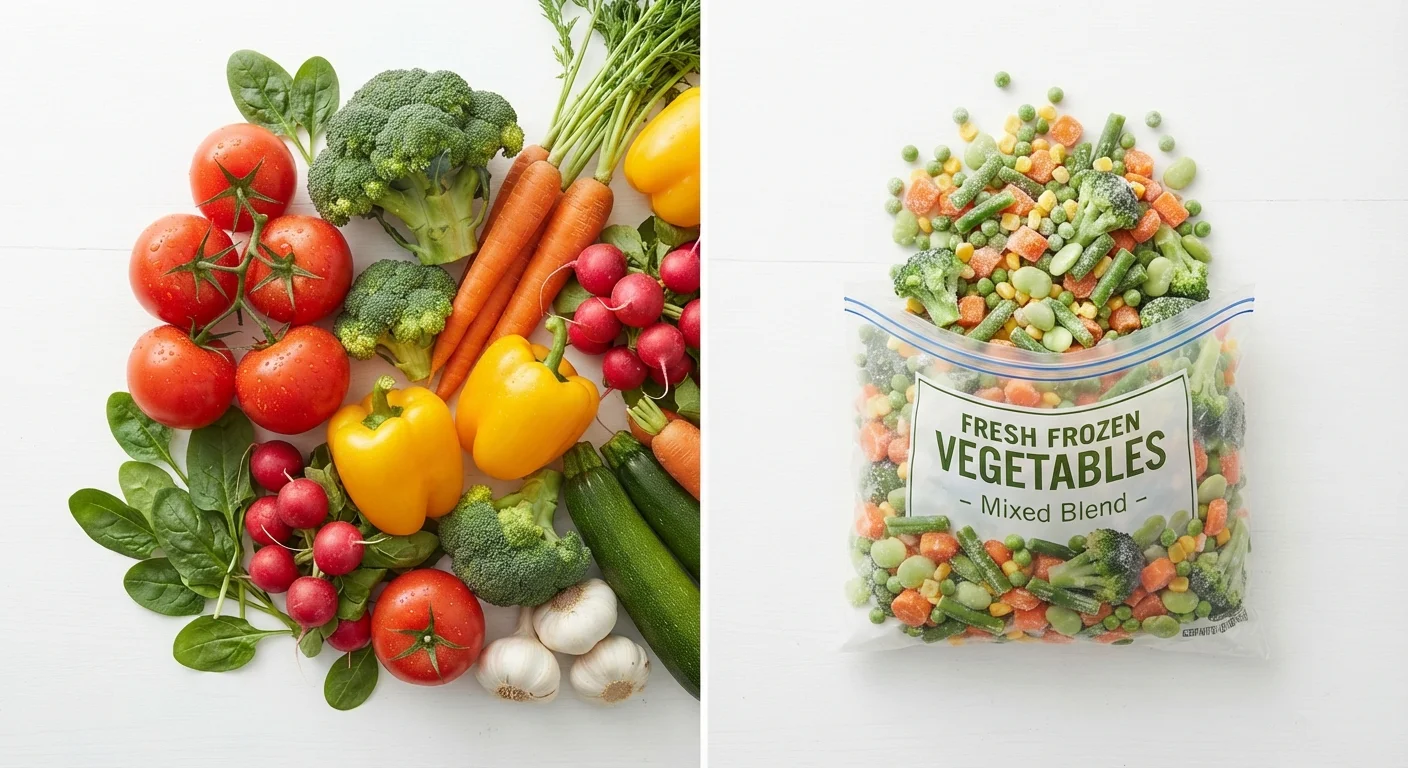
- Frozen vegetables are often harvested and flash-frozen at peak ripeness, preserving most nutrients.
- Fresh produce can lose significant nutrients during transport and storage before it reaches your plate.
- Frozen options typically cost less per serving and generate less food waste than fresh.
- Some nutrients, like vitamin C, may be better retained in frozen produce than in week-old fresh items.
- The healthiest choice is whichever form you'll actually eat consistently within your budget.
- Check frozen labels for added salt, sugar, or sauces that can undermine nutritional value.
Option A
Fresh Produce
The sensory and culinary benchmark for fruits and vegetables.
Best for: Best for eating raw, peak-season farmers market finds, and dishes where texture and flavor matter most.
Option B
Frozen Produce
The convenient, long-shelf-life option that locks in nutrients at harvest.
Best for: Best for budget-conscious shoppers, reducing food waste, and cooking cooked dishes year-round.
If you're working with a tight grocery budget
Frozen Produce
Frozen vegetables and fruits typically cost less per serving and last months in the freezer, reducing costly waste.
If you're preparing raw salads, slaws, or fresh-eating dishes
Fresh Produce
Texture and palatability matter here - fresh produce holds up far better when eaten raw or lightly dressed.
If you want consistent nutrition regardless of season
Frozen Produce
Flash-freezing locks in nutrients at peak ripeness, so frozen options can be nutritionally superior to out-of-season fresh produce shipped long distances.
If you're cooking soups, stir-fries, casseroles, or smoothies
Frozen Produce
Frozen produce performs equally well in cooked or blended applications and costs less without sacrificing nutritional benefit.
If you shop at a local farmers market during peak season
Fresh Produce
Locally grown, recently harvested produce offers peak flavor and nutrients - and supports regional food systems.
The Nutrition Case for Frozen Produce
A common assumption is that fresh always means more nutritious. The reality is more nuanced. Most frozen fruits and vegetables are harvested at peak ripeness and flash-frozen within hours, a process that halts enzymatic activity and locks in vitamins and minerals. Research published in journals such as the Journal of Food Composition and Analysis has found that frozen produce can match or outperform fresh in key nutrients like vitamin C, folate, and certain antioxidants.
Fresh produce, by contrast, begins losing nutrients as soon as it's harvested. Exposure to heat, light, and air during transport and storage all accelerate this decline. A head of broccoli that spent five days in transit and two more in your refrigerator may contain meaningfully less vitamin C than its frozen counterpart. That said, certain heat-sensitive nutrients can be reduced during the blanching step that precedes freezing - a trade-off worth knowing.
40%
Vitamin C lost in fresh spinach after storage
Research cited by the University of California, Davis found refrigerated fresh spinach can lose up to 40% of vitamin C within a few days of harvest.
30-40%
Share of fresh produce discarded by US households
USDA Economic Research Service data indicates US households waste roughly one-third of the fresh food they purchase, with produce among the highest-waste categories.
For a deeper look at how food processing affects nutritional profiles, see our guide to whole foods vs. processed foods.
Cost and Waste: Where Frozen Wins Consistently
From a budget standpoint, frozen produce has a structural advantage. It's almost always less expensive per serving than fresh, especially for items like berries, peas, spinach, and edamame. Crucially, it eliminates the spoilage problem: the USDA estimates that American households discard a significant share of the fresh produce they purchase before it's eaten.
Frozen vegetables stored properly can remain safe and nutritious for eight to twelve months. That shelf stability means you can stock up without the pressure to eat everything within days - a meaningful benefit for households managing irregular shopping schedules or limited storage. Our bulk buying guide covers how to think about storage limits before stocking your freezer.
| Criterion | Fresh Produce | Frozen Produce |
|---|---|---|
| Nutrient retention | High when just harvested; declines with time | Locked in at peak ripeness via flash-freezing |
| Cost per serving | Generally higher, especially off-season | Typically lower and more consistent year-round |
| Shelf life | Days to 1-2 weeks | 8-12 months in freezer |
| Food waste risk | Higher - spoils quickly if unused | Lower - use only what you need |
| Texture for raw eating | Superior - crisp and firm | Soft after thawing; better for cooked dishes |
| Additive risk | Minimal - just the food | Check labels for added salt, sugar, or sauces |
| Seasonal availability | Limited by season and region | Available year-round regardless of season |
One caution: always check labels on frozen products. Sauces, seasonings, and added sodium can significantly change the nutritional picture. Plain frozen vegetables with no additives are the most nutritionally straightforward option.
When Fresh Produce Is Worth the Trade-Off
Fresh produce earns its place in specific contexts. Texture is the most obvious - frozen spinach wilts into a soft mass that works in soups but not salads. If your goal is a crisp green salad, crunchy crudités, or fresh fruit for snacking, fresh is the practical choice. Freshness also matters for certain preparations, such as guacamole or bruschetta, where water content from thawing would compromise the dish.
Seasonality and sourcing also matter. Locally grown, in-season produce purchased close to harvest - at a farmers market or through a community-supported agriculture (CSA) program - can rival frozen in nutritional density and surpass it in flavor. The problem is that out-of-season fresh produce is often picked underripe, shipped long distances, and stored for extended periods before reaching a store shelf. In those cases, frozen is usually the stronger nutritional choice.
For shoppers interested in plant-forward eating, both options play a role. Our plant-based eating on a budget guide explores how to balance variety and cost across protein and produce categories.
This article is for general informational and educational purposes only and is not medical or dietary advice. Consult a registered dietitian or qualified healthcare professional for guidance tailored to your health needs.