

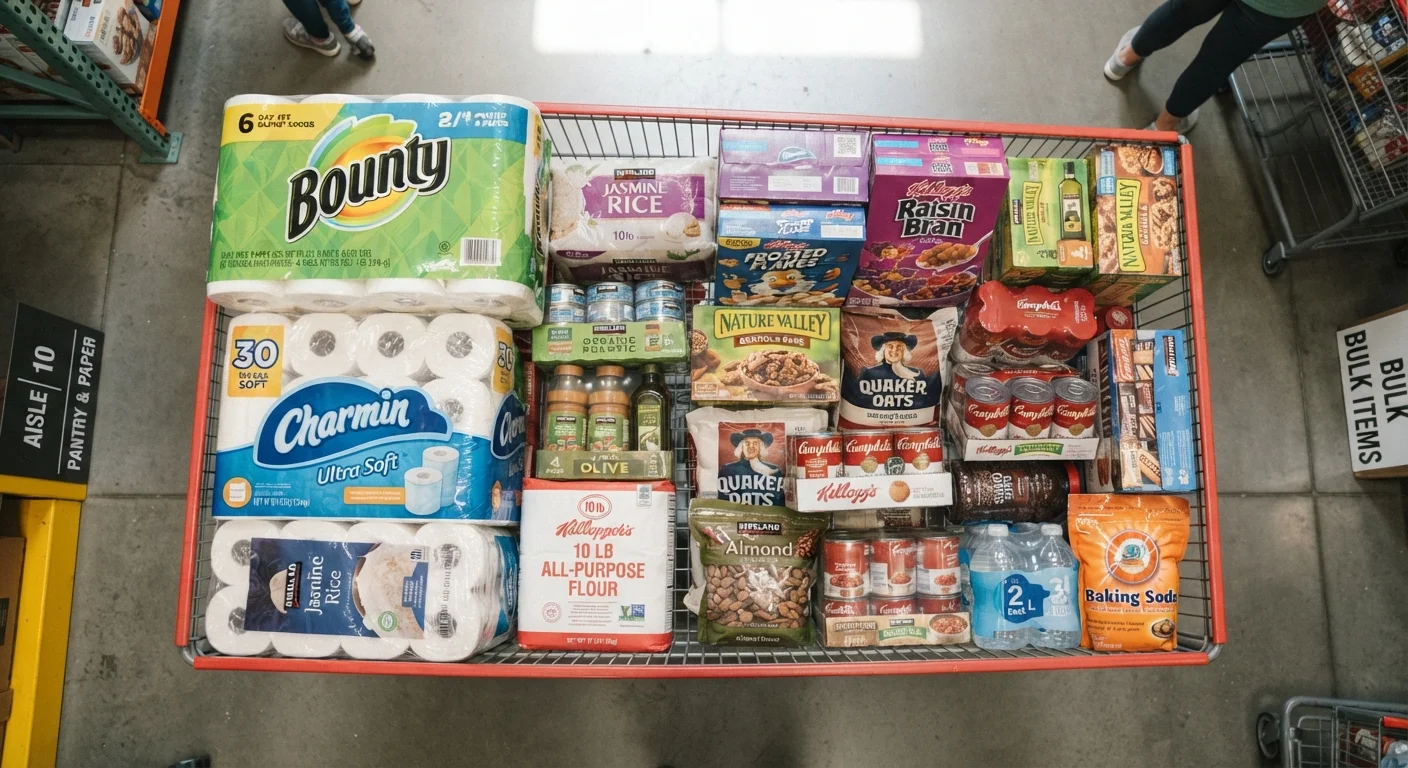
Key Takeaways
- Bulk buying saves money on non-perishables and household staples with a long shelf life.
- Spoilage, storage costs, and overconsumption can quietly cancel out the per-unit savings.
- Warehouse club memberships only pay off if your annual purchases justify the fee.
- The true cost of bulk buying includes space, time, and how quickly your household actually uses the item.
Lower per-unit cost on non-perishable staples
Buying larger quantities of items like canned goods, paper products, and cleaning supplies typically yields a meaningfully lower cost per unit, which adds up across a full year of household spending.
Fewer shopping trips and less time spent restocking
Having a deep supply of frequently used items reduces how often you need to make routine purchases, which can save both time and the incidental spending that tends to accompany extra trips to the store.
Protection against short-term price increases
Stocking up when prices are stable provides a modest buffer if costs rise later - a practical consideration for commodity goods like cooking oil, canned protein, or paper products.
Works well for predictable, high-frequency household items
Households with consistent, measurable demand for specific products - laundry detergent, pet food, toilet paper - can plan bulk purchases confidently and realise reliable savings over time.
Perishables often spoil before fully consumed
Fresh produce, bread, dairy, and deli items bought in bulk quantities frequently go to waste before a household finishes them, turning an apparent bargain into a net loss.
Larger packages encourage faster consumption
Consumer behaviour research consistently shows that people use products at a higher rate when the package is larger, which can erode the per-unit savings through unintended overconsumption.
Membership fees may not be justified by actual savings
Warehouse club memberships carry annual fees that need to be offset by genuine savings on purchases. Shoppers who buy bulk infrequently or selectively may spend more on the membership than they recover.
Storage requirements add hidden costs
Large quantities of goods require significant cabinet, pantry, or garage space - a real trade-off for households with limited square footage, particularly renters where space is at a premium.
Large upfront spend strains monthly cash flow
Even when bulk pricing offers long-run savings, the lump-sum payment can create short-term budget pressure for households managing tight monthly cash flow.
Our Verdict
Bulk buying is a genuinely effective strategy for the right categories - non-perishables, predictable household staples, and items your family reliably goes through. But the savings are conditional. When storage is limited, spoilage is likely, or a bulk purchase nudges you to use more than you otherwise would, the per-unit discount can evaporate entirely. Approached with a clear household usage baseline and honest self-assessment, bulk shopping is a practical tool - not a universal money-saver.
Best for households with adequate storage space, predictable consumption patterns, and a clear list of staples they use consistently.
Why Bulk Buying Appeals - and Where the Logic Breaks Down
The pitch is simple: pay more upfront, spend less per unit, repeat. Warehouse clubs built entire retail models around this idea, and for many shoppers it delivers. But the per-unit price is only one part of the equation.
The real question isn't whether the unit price is lower - it almost always is. The question is whether your household will use the full quantity before it expires, goes stale, or becomes inconvenient to store. When those conditions aren't met, the apparent saving is partly or entirely fictional.
Hidden costs buried in everyday purchases follow the same pattern: the price tag doesn't tell the whole story. Bulk buying has its own version of hidden costs - spoilage, storage, and the psychological pull to use more simply because you have more.
Lower per-unit cost on non-perishable staples
Buying larger quantities of items like canned goods, paper products, and cleaning supplies typically yields a meaningfully lower cost per unit, which adds up across a full year of household spending.
Fewer shopping trips and less time spent restocking
Having a deep supply of frequently used items reduces how often you need to make routine purchases, which can save both time and the incidental spending that tends to accompany extra trips to the store.
Protection against short-term price increases
Stocking up when prices are stable provides a modest buffer if costs rise later - a practical consideration for commodity goods like cooking oil, canned protein, or paper products.
Works well for predictable, high-frequency household items
Households with consistent, measurable demand for specific products - laundry detergent, pet food, toilet paper - can plan bulk purchases confidently and realise reliable savings over time.
When Bulk Buying Genuinely Works
Certain product categories are well-suited to bulk purchasing. Non-perishable pantry staples - dried pasta, rice, canned goods, cooking oil - have long shelf lives and stable demand. Household consumables like toilet paper, dish soap, laundry detergent, and cleaning products are equally predictable: you will use them, they won't expire in your cabinet, and storage is manageable.
For these categories, the arithmetic is straightforward. If a 36-roll pack of toilet paper costs meaningfully less per roll than a standard 12-pack, and you have somewhere to store it, buying in bulk is rational. The same logic applies to over-the-counter medications your household uses regularly, pet food with a long shelf life, and frozen proteins if you have adequate freezer space.
~25%
Typical per-unit savings on bulk non-perishables
Consumer spending analyses generally estimate bulk purchases of shelf-stable goods save between 20-30% per unit compared to standard retail packaging, though this varies significantly by category and retailer.
30-40%
Increase in usage rate with larger pack sizes
Academic research on package-size effects, including work published in the Journal of Marketing Research, has found consumers tend to use products noticeably faster when package sizes are larger.
Families with children, households with multiple adults, and anyone cooking at home consistently tend to benefit most. If your consumption rate is high and your usage is predictable, the bulk model rewards you directly.
The Hidden Drain: When Bulk Costs You More
Perishables are the most obvious trap. A five-pound bag of salad greens at a fraction of the per-ounce cost of a smaller bag is still a loss if half of it wilts before you get through it. The same applies to bread, fresh produce, dairy, and deli meats. If your household can't realistically consume a large quantity within the product's useful life, the discount is irrelevant.
Beyond spoilage, there's the overconsumption effect. Research in consumer behaviour consistently finds that larger package sizes lead people to use products at a faster rate - shampoo, snack foods, condiments. If buying in bulk nudges you to use 30% more than you otherwise would, the per-unit savings shrink accordingly. This is worth considering for snack foods especially: grocery shopping habits that quietly undermine a healthy diet often include buying more than a household needs.
Membership fees deserve scrutiny too. A warehouse club membership typically costs between $50 and $130 per year. If your annual bulk purchases don't yield savings that exceed that fee, you're paying for the privilege of shopping there - not actually saving. Run the numbers annually, not just when you sign up.
Perishables often spoil before fully consumed
Fresh produce, bread, dairy, and deli items bought in bulk quantities frequently go to waste before a household finishes them, turning an apparent bargain into a net loss.
Larger packages encourage faster consumption
Consumer behaviour research consistently shows that people use products at a higher rate when the package is larger, which can erode the per-unit savings through unintended overconsumption.
Membership fees may not be justified by actual savings
Warehouse club memberships carry annual fees that need to be offset by genuine savings on purchases. Shoppers who buy bulk infrequently or selectively may spend more on the membership than they recover.
Storage requirements add hidden costs
Large quantities of goods require significant cabinet, pantry, or garage space - a real trade-off for households with limited square footage, particularly renters where space is at a premium.
Large upfront spend strains monthly cash flow
Even when bulk pricing offers long-run savings, the lump-sum payment can create short-term budget pressure for households managing tight monthly cash flow.
Storage also has a real cost, particularly for renters paying for square footage. Dedicating significant cabinet or closet space to bulk goods is a trade-off that rarely appears in the savings calculation. See how convenience spending adds up for a parallel exercise in auditing ongoing costs that feel invisible.
A Practical Framework for Smarter Bulk Decisions
Before adding a bulk item to your cart, run a quick mental checklist. First, establish your actual consumption rate - not what you think you use, but what you observably go through in a month. Second, calculate whether the per-unit saving is meaningful after accounting for spoilage risk. Third, consider where the item will be stored and whether that space has genuine value to you.
For items that vary in quality or don't suit your household's taste preferences, buying in bulk is a commitment that's hard to reverse. Try a standard size first, particularly with foods. Generic vs. name-brand comparisons follow the same logic - unit price alone doesn't determine value if you end up not using the product.
Check Unit Prices Before Assuming Bulk Wins
Not every warehouse or bulk purchase is cheaper per unit than a regular grocery store. Some standard-size products - especially store-brand equivalents - match or undercut bulk pricing when you compare the price-per-ounce or price-per-unit on the shelf tag. Always verify the unit price comparison before assuming bigger automatically means better value. This is especially true during promotional periods at conventional retailers.
It's also worth checking whether bulk pricing is actually cheaper than alternatives. Store-brand options at a regular grocery store, or sale pricing on standard sizes, sometimes matches or beats warehouse club unit prices without requiring a membership or large upfront spend. Sale prices aren't always what they appear - the same skepticism applies to bulk promotions.
Bulk buying fits neatly into a broader smart budgeting strategy when it's deliberate. The goal is intentional spending based on your household's real patterns, not a reflexive reach for the largest package on the shelf.