

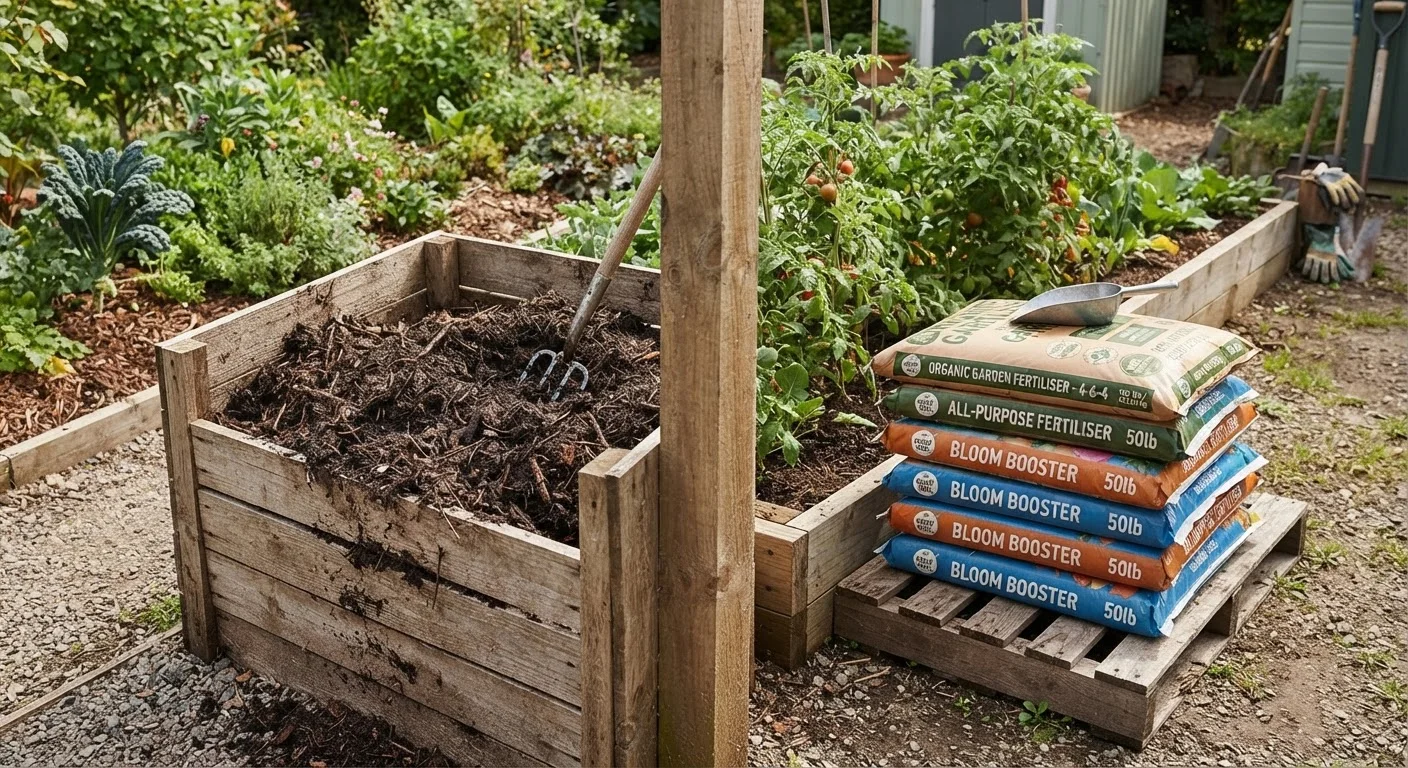
Key Takeaways
- Compost improves soil structure and microbial health over months; fertiliser delivers nutrients within days or weeks.
- Store-bought fertiliser costs money repeatedly; a compost pile costs little once established.
- Compost cannot reliably fix acute nutrient deficiencies the way a targeted fertiliser can.
- Many experienced gardeners use both - compost as a soil conditioner, fertiliser as a supplement when needed.
- Over-applying synthetic fertiliser can damage plants and leach into groundwater; compost is generally harder to over-apply.
Option A
Homemade Compost
The slow-release, soil-building classic.
Best for: Homeowners who want to improve soil structure over time and reduce waste with minimal ongoing cost.
Option B
Store-Bought Fertiliser
The fast-acting, precise nutrition solution.
Best for: Gardeners who need quick results, targeted nutrient correction, or who lack space and materials for composting.
If you want to cut ongoing garden supply costs
Homemade Compost
A compost pile primarily uses kitchen scraps and yard waste you already generate, making it nearly free to maintain after initial setup.
If your plants show signs of a specific nutrient deficiency
Store-Bought Fertiliser
Targeted fertilisers let you address nitrogen, phosphorus, or potassium shortfalls quickly and precisely - compost alone can't reliably do this.
If you're building a new garden bed or improving depleted soil
Homemade Compost
Compost adds organic matter that improves drainage, water retention, and microbial activity - foundational qualities fertiliser cannot replicate.
If you have limited outdoor space or produce little organic waste
Store-Bought Fertiliser
Without enough raw material for a productive compost pile, a quality fertiliser is a practical and time-efficient alternative.
If you want a balanced, long-term approach to garden health
Homemade Compost
Used as a base amendment with occasional fertiliser top-ups for demanding crops, compost supports sustained soil health without heavy recurring spending.
How Each One Actually Works
Compost and store-bought fertiliser both aim to feed your garden, but they work through fundamentally different mechanisms - and understanding that difference is what helps you choose wisely.
Compost is decomposed organic matter - food scraps, leaves, grass clippings, and similar materials broken down by microbes, fungi, and invertebrates. When you work it into soil, you're not just adding nutrients. You're introducing billions of microorganisms that continue breaking down organic material, improving soil aggregation, and making nutrients available to plant roots over a long period. Compost also improves drainage in clay-heavy soils and boosts moisture retention in sandy ones. Think of it as infrastructure investment for your garden.
Store-bought fertiliser delivers nutrients - typically nitrogen (N), phosphorus (P), and potassium (K) - in concentrated, rapidly available form. These are the familiar N-P-K ratios on every bag or bottle. Synthetic formulas dissolve quickly and are taken up by plants within days. Organic commercial fertilisers (blood meal, bone meal, fish emulsion) work more slowly but still provide more targeted nutrition than compost. Unlike compost, fertilisers don't meaningfully improve soil texture or biology - they feed the plant but not the soil ecosystem around it.
| Criterion | Homemade Compost | Store-Bought Fertiliser |
|---|---|---|
| Primary benefit | Improves soil structure and biology | Delivers targeted plant nutrients |
| Speed of results | Slow - months to full effect | Fast - days to weeks |
| Ongoing cost | Near-zero after setup | Recurring seasonal purchase |
| Ease of over-application | Difficult to over-apply | Can burn plants or leach if misused |
| Addresses deficiencies | Not reliably specific | Yes, with correct formula |
| Soil microbiome impact | Strongly positive | Neutral to slightly negative (synthetics) |
| Space required | Yes - bin or pile needed | Minimal storage space |
| Time investment | Regular turning and monitoring | Measure and apply; minimal upkeep |
For a broader view of how soil health connects to garden outcomes, see our guide to mulching garden beds, which covers another layer of the soil-building picture.
Cost and Convenience: The Real Trade-Off
For budget-conscious homeowners, cost is rarely simple. Compost has a low ongoing price - once you have a bin or designated pile, you're largely feeding it with material you'd otherwise discard. Initial setup (a basic bin or a designated corner of the yard) is modest. The real cost is time: compost typically takes two to six months to mature, depending on your climate, the materials you add, and how often you turn the pile.
2-6 months
Typical compost maturation time
Hot compost piles that are regularly turned can mature in as little as 8 weeks; cold passive piles may take six months or longer.
30%
Household waste that could be composted
The U.S. EPA estimates roughly 30% of what households throw away is food and yard waste that could be composted instead of landfilled.
3-5%
Target organic matter in healthy garden soil
Soil scientists generally consider 3-5% organic matter a healthy benchmark for productive garden beds; compost is a primary tool for reaching it.
Store-bought fertiliser has the opposite profile: you can buy it, apply it, and see results within a single growing season with no prep time. But it's a recurring cost - every season you need to purchase more. Over several years, that expense adds up, especially if you're maintaining a large yard. See what lawn maintenance actually costs over time for a broader look at where garden budgets quietly expand.
There's also the application factor. Fertilisers require attention to rates and timing - applying too much, too fast, or at the wrong growth stage can burn roots or cause nutrient runoff. Compost is far more forgiving: it's difficult to apply too much, and it releases slowly enough that over-application is rarely damaging.
If you're exploring other low-cost ways to improve your garden, composting fits naturally into a broader strategy of getting more from materials you already have.
When to Use One, the Other, or Both
The honest answer for most home gardeners is: both have a role, and they work well in combination.
Use compost as your default soil amendment. Incorporate it into beds each spring, use it as a top dressing for established plantings, and rely on it to maintain the organic matter percentage in your soil over time. Plants growing in compost-rich soil are generally more resilient, need less supplemental water, and show fewer signs of stress.
Reach for fertiliser when you have a specific, time-sensitive need. Heavy-feeding crops like corn, tomatoes, and leafy greens may benefit from a mid-season nitrogen boost. If a soil test reveals a specific deficiency - low phosphorus limiting root development, for instance - a targeted fertiliser addresses it faster than compost can. Soil testing kits are widely available and inexpensive; results take the guesswork out of this decision.
Soil Testing Is Worth the Small Investment
Before spending on fertiliser, consider an inexpensive soil test through your local cooperative extension service or a home testing kit. It will tell you your soil's existing nutrient levels and pH, so you can correct specific deficiencies rather than guessing. Applying fertiliser without knowing what your soil already contains can waste money and potentially harm plants. Most extension services offer low-cost or subsidised testing for home gardeners.
Your garden setup also matters. If you're growing in raised beds, you have more control over soil composition from the start. Our comparison of raised beds vs. in-ground planting covers how each setup affects your long-term soil management strategy.
The takeaway: compost builds a foundation; fertiliser handles targeted corrections. Using compost as your primary amendment and fertiliser sparingly and strategically gives you the benefits of both without overspending or overcomplicating your routine.