

Key Takeaways
- Kitchen drawer chaos typically stems from poor categorization and no defined home for miscellaneous items.
- Dividers and drawer inserts - even DIY versions - dramatically reduce clutter without major expense.
- Preventing re-clutter requires simple maintenance habits, not repeated full reorganizations.
- Overstuffing drawers with rarely used items is one of the most common and correctable mistakes.
Why Kitchen Drawers Descend Into Chaos
Kitchen drawers are high-traffic zones used dozens of times daily, yet most households treat them as catch-all spaces. The result is a predictable spiral: useful items get buried under rarely used ones, and finding a simple spatula becomes a frustrating dig. Understanding why this happens is the first step toward a lasting fix.
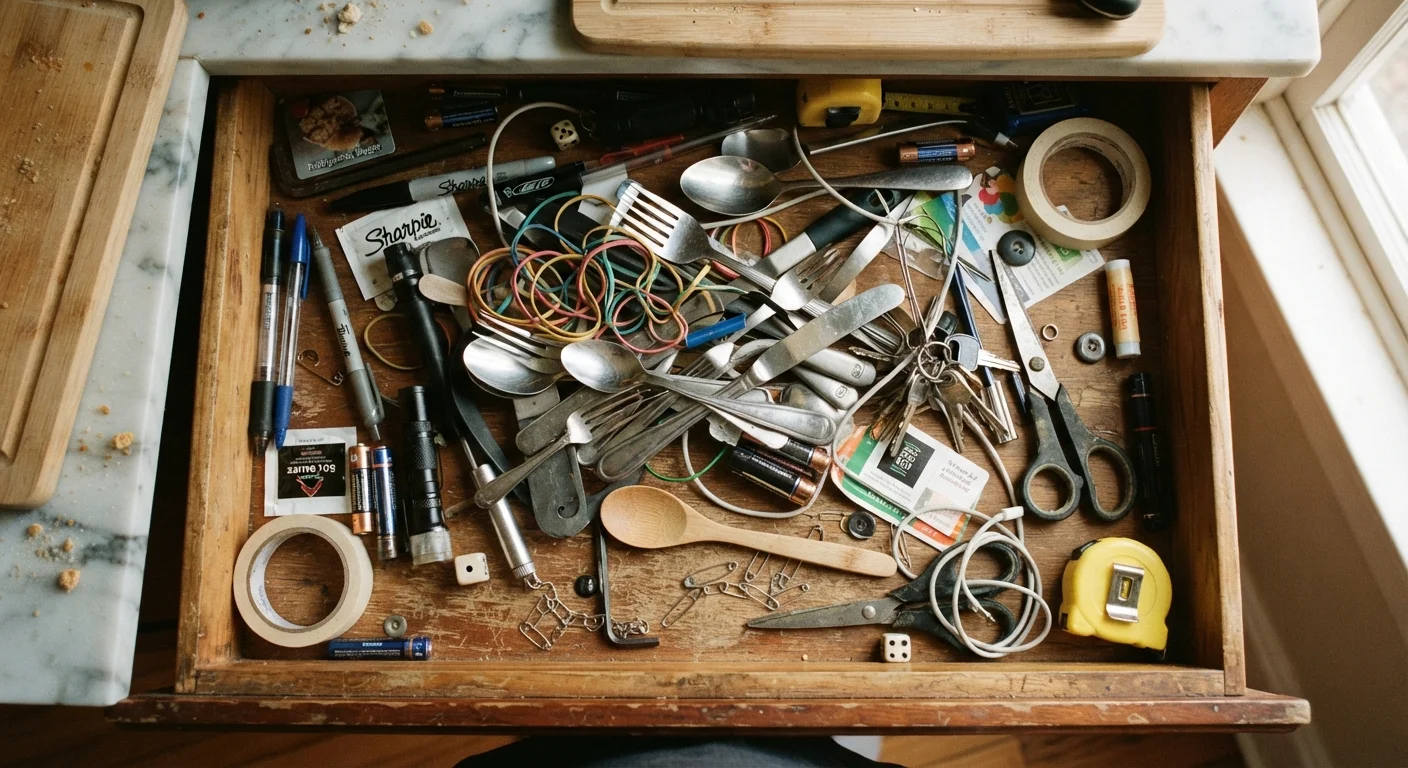
The core problem is that drawers lack natural visual boundaries. Unlike open shelves - explored in our comparison of open shelving and closed cabinets - drawers hide their contents entirely, which makes it easy to keep adding items without noticing the growing disorder. Combine that with the kitchen being a hub for tools, gadgets, batteries, takeout menus, and rubber bands, and chaos almost feels inevitable. Almost.
2.5 days
Time lost annually searching for misplaced items
Research cited by professional organizers suggests the average person spends significant time each year looking for household items that lack a defined home.
~30%
Duplicate household purchases due to lost items
Consumer behavior studies suggest a notable share of re-purchases happen simply because an item couldn't be located in time, adding unnecessary household expense.
The Most Common Mistakes - and How to Fix Them
Most drawer problems trace back to a handful of repeatable errors. Recognizing your own patterns here makes the solutions much more straightforward.
Skipping drawer dividers entirely and relying on the open space to self-organize.
Why it happens: Dividers feel like an extra purchase or step, and an empty drawer seems manageable at first - until it isn't.
Keeping every kitchen gadget ever purchased in the same drawer, regardless of how often it's used.
Why it happens: People hold onto items "just in case," and drawers conveniently hide the accumulation.
Treating one drawer as the household "junk drawer" with no organizational logic.
Why it happens: Every home has miscellaneous items - batteries, twist ties, spare keys - and one drawer inevitably absorbs them all without a plan.
Putting items back in whichever drawer is nearest rather than their assigned spot.
Why it happens: Speed wins in a busy kitchen, and the nearest drawer is always more convenient in the moment.
Reorganizing only when the drawer becomes completely unmanageable, rather than maintaining it regularly.
Why it happens: Organization feels like a big project, so people wait until the situation demands it - which takes much more effort.
Avoid Overloading Drawer Dividers
Wooden or plastic dividers can warp or crack if drawers are consistently overpacked. If a drawer won't close smoothly, that's a signal there are too many items - not that you need a bigger organizer. Reducing item count should come before upgrading storage hardware.
Building Habits That Keep Drawers Tidy
Organizing a drawer once only works if you build small routines to maintain it. The most effective habit is a 60-second reset - before closing a drawer, quickly check that everything is in its intended spot. This takes seconds and prevents the slow accumulation that leads to full-scale reorganizations.
A second useful practice is the "one in, one out" rule for tools and gadgets. When a new utensil enters the drawer, something unused leaves. This keeps volume stable over time. If you find certain items keep returning to wrong drawers, that's a signal those items need a better-defined home - or may not belong in the kitchen at all.
For households dealing with broader clutter patterns, our guide on decluttering from scratch covers the foundational habits that make room-by-room organization sustainable. It's also worth understanding the real costs of a disorganized home - from wasted time to buying duplicate items you already own but couldn't locate.
Finally, drawer organization fits into a larger system. Our whole-home organization resource connects these small habits into a coherent strategy that reduces effort across every room over time.