

Key Takeaways
- Open shelving creates visual accountability but demands consistent tidying and regular dusting.
- Closed cabinets hide clutter instantly but can become disorganized if contents aren't maintained.
- Your household habits - not aesthetics alone - should drive the decision between the two.
- A hybrid approach often delivers the best of both: display what's tidy, conceal what isn't.
- Neither system keeps a home tidy on its own - daily habits and logical placement matter most.
Option A
Open Shelving
The airy, accessible display option.
Best for: Households with curated, regularly used items and a consistent tidying routine.
Option B
Closed Cabinets
The clutter-concealing, low-maintenance choice.
Best for: Busy households that prioritize a clean visual appearance with minimal daily upkeep.
If you have a curated collection of items you use daily
Open Shelving
Frequently used items stay accessible and visible, reducing retrieval time. The display pressure also encourages you to keep things neat.
If your household generates ongoing clutter or has young children
Closed Cabinets
Closed doors instantly restore visual calm. Concealed storage tolerates imperfect organization without affecting how a room looks.
If you rent and can't install permanent cabinetry
Open Shelving
Freestanding open shelves require no drilling or landlord approval and can move with you, making them a flexible, low-commitment option.
If you live with multiple people who have different tidiness habits
Closed Cabinets
Cabinets set a lower visible-tidy threshold. Everyone can maintain a presentable space without needing to align on display standards.
If you want to minimize spending on storage solutions
Open Shelving
Basic open shelving is typically less expensive to install than full cabinetry and can be supplemented with repurposed containers at little to no cost.
What the Research Says About Visual Clutter and Tidiness
The tidiness of a space isn't just about how much stuff you own - it's about how visible that stuff is. Studies in environmental psychology consistently link visible disorder to elevated stress and reduced focus. That's the core tension in the open-shelving versus closed-cabinet debate: open storage puts everything in view, which can feel chaotic if items aren't consistently organized, while closed storage removes visual noise at the cost of what's happening behind the doors.
Neither system is inherently tidier. What changes is where disorder hides. Open shelves make mess immediately visible - which can be motivating for some and overwhelming for others. Closed cabinets transfer the problem inward; the room looks calm until you open a door and find stacked chaos. Understanding your own patterns is the first step to choosing well. For a broader look at how storage logic fits into whole-home organization, see our full home organization guide.
| Criterion | Open Shelving | Closed Cabinets |
|---|---|---|
| Visual tidiness | Requires consistent upkeep to look tidy | Hides clutter behind closed doors |
| Dust accumulation | Surfaces collect dust quickly | Enclosed; dust stays outside |
| Item accessibility | Everything visible and easy to grab | Items out of sight; searching required |
| Typical installation cost | Generally lower; freestanding options available | Higher for built-in or fitted units |
| Motivation to stay tidy | High - clutter is immediately visible | Lower - mess stays hidden |
| Works best in | Kitchens, living rooms, home offices | Bathrooms, entryways, laundry areas |
| Renter-friendly | Yes - freestanding units need no drilling | Built-ins may require landlord approval |
The Real Maintenance Demands of Each Approach
Open shelving creates what organizers sometimes call visual accountability - because you can see everything, clutter becomes harder to ignore. This works well for people who tidy habitually, but it adds a layer of ongoing maintenance that closed cabinets don't require. Dust settles on open surfaces faster than inside enclosed spaces, meaning items on open shelves need to be wiped down regularly - a task that's easy to skip and compounds over time.
Closed cabinets, by contrast, reduce ambient dust accumulation and allow you to close a door on imperfect organization. The risk is that out-of-sight items get forgotten, expire, or multiply unnoticed. Kitchen cabinets in particular are notorious for becoming disorganized over time - a pattern explored in detail in why kitchen storage becomes chaotic and how to fix it.
~1 in 3
Adults report home clutter causes daily stress
Research from the Personality and Social Psychology Bulletin found that cluttered home environments were associated with elevated cortisol levels, particularly in women.
20%
Of household items used regularly
Professional organizers commonly note that roughly 20% of stored items account for the vast majority of daily use - the rest contributes primarily to visual clutter.
The practical takeaway: open shelving rewards households that tidy frequently and own fewer decorative or dishware items. Closed cabinets suit households that prioritize a clean visual baseline and don't mind occasional deep-organization sessions inside the cabinet.
How to Make Either System Work Better
Regardless of which approach you lean toward, a few principles consistently improve outcomes:
- Limit what's stored. Both open shelves and closed cabinets become harder to manage when overfilled. Reduce volume before reorganizing.
- Group by use, not category. Items you reach for together should live together, whether on a shelf or behind a door. This reduces the chaos of searching.
- Use containers strategically. On open shelves, matching bins or baskets create visual coherence and contain smaller items. Inside cabinets, they prevent items from shifting and getting buried. Everyday objects can double as low-cost organizers - jars, trays, and boxes you already own often work just as well as purchased bins.
- Consider a hybrid layout. Many homes benefit from placing closed cabinets where clutter tends to accumulate (near entryways, in bathrooms) and open shelving where items are consistently neat and frequently used (a kitchen display shelf, a living room bookcase).
If you share your home with others, the system that works for your tidiest household member may not work for everyone. Organizing shared spaces requires different logic - closed storage typically sets a more achievable baseline across different tidiness standards.
The Hybrid Approach Is Often the Most Practical
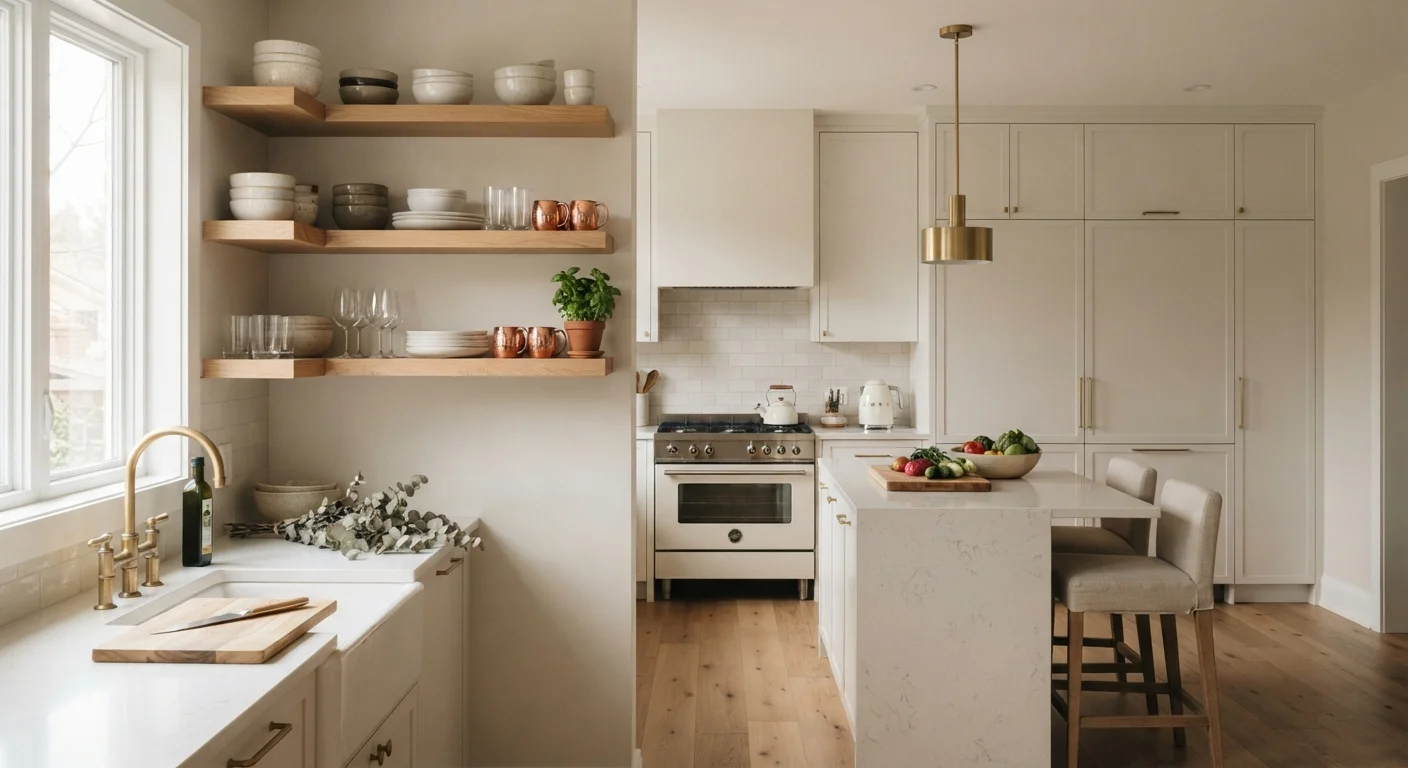
Most homes don't need to choose exclusively between open shelving and closed cabinets. Using closed storage in high-clutter zones (bathrooms, entryways, pantries) and reserving open shelving for consistently curated areas (a display shelf, a bookcase) captures the visual appeal of open storage without the upkeep burden across the entire home. This middle path tends to work especially well in smaller spaces where both flexibility and visual calm matter.
For homes with limited floor space, the choice between open and closed storage intersects with another key question. Vertical versus floor-based storage affects both types - wall-mounted open shelving, for instance, frees up floor area while still displaying contents visibly.