

| Damage pattern: ragged holes with slime trails | Slugs or snails |
| Damage pattern: stippled leaves with webbing | Spider mites |
| Damage pattern: seedlings cut at soil level | Cutworms |
| Damage pattern: vine wilting with stem entry hole | Squash vine borers |
| Damage pattern: curled leaves with sticky residue | Aphids |
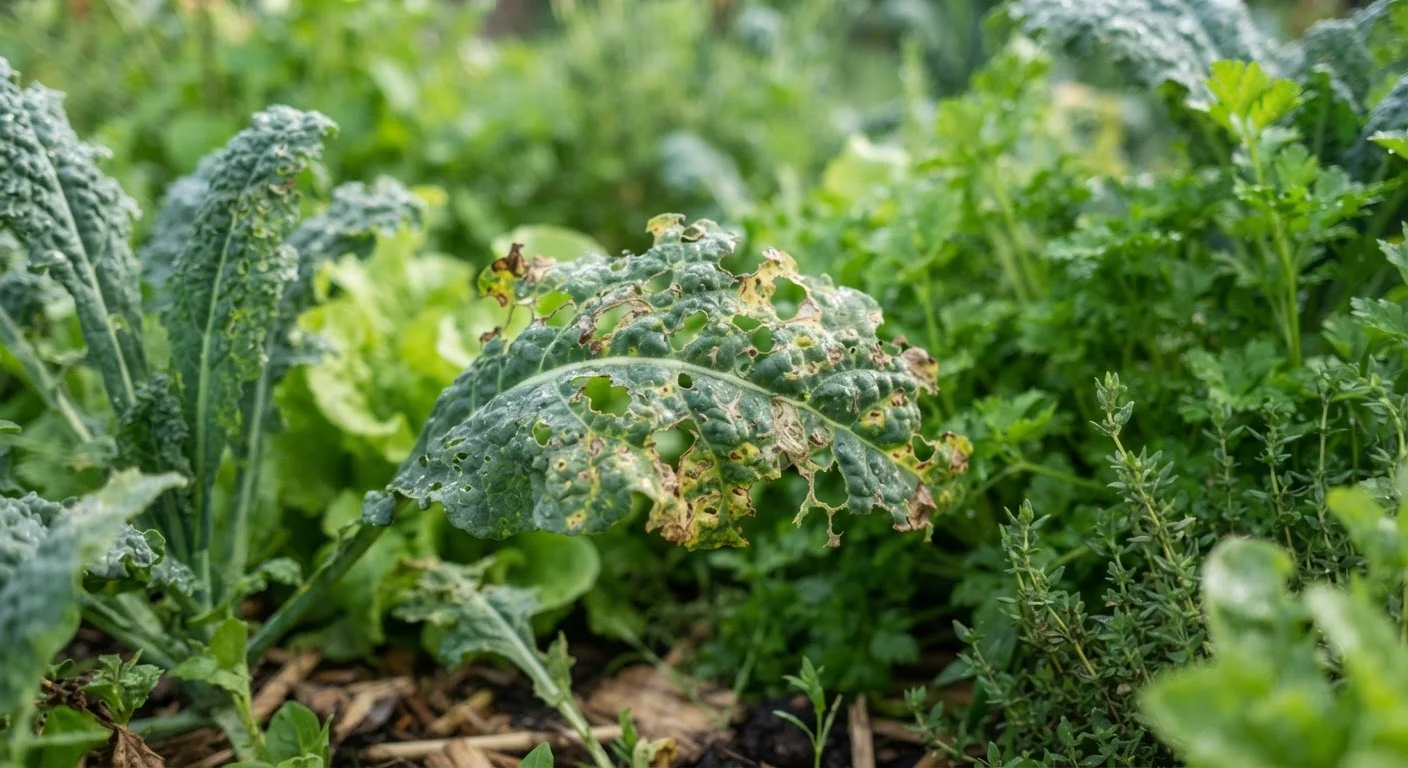
| Damage pattern: large holes with nearby frass | Caterpillars / cabbage worms |
Read the Damage First
Before reaching for any treatment, identify what you're actually dealing with. Most garden pests announce themselves through the damage they leave behind - and that evidence is often more reliable than catching the pest itself, since many feed at night or hide under soil and foliage.
| Damage pattern: ragged holes with slime trails | Slugs or snails |
| Damage pattern: stippled leaves with webbing | Spider mites |
| Damage pattern: seedlings cut at soil level | Cutworms |
| Damage pattern: vine wilting with stem entry hole | Squash vine borers |
| Damage pattern: curled leaves with sticky residue | Aphids |
| Damage pattern: large holes with nearby frass | Caterpillars / cabbage worms |
Use this lookup approach: examine the plant part affected (leaf, stem, root, fruit), note the pattern (chewed edges, stippled surfaces, wilting, tunneling), and then cross-reference with the pest profiles below. Accurate identification matters because a spray that targets caterpillars won't touch aphids, and vice versa. Misidentification wastes money and can harm beneficial insects.
For a broader picture of how seasonal timing affects pest pressure, see our year-round lawn and garden maintenance calendar.
Common Garden Pests and Their Signatures
The following profiles cover the pests most frequently encountered by home gardeners in the US. Each entry pairs the pest with its characteristic damage pattern.
Aphids
Soft, pear-shaped insects roughly 1-3 mm long, found in clusters on new growth and the undersides of leaves. Look for sticky honeydew residue, curled or distorted leaves, and a sooty black mold that develops on the honeydew. Aphids reproduce rapidly in warm weather.
Slugs and Snails
Irregular, ragged holes in leaves - often large - combined with a silvery slime trail are the telltale signs. Damage appears overnight or after rain. Hostas, lettuce, and seedlings are frequent targets.
Cabbage Worms and Caterpillars
Large, clean holes chewed from leaf edges or centers, sometimes with visible dark frass (droppings) nearby. Check the undersides of leaves for pale yellow eggs or green caterpillars camouflaged against the leaf surface.
Spider Mites
Tiny bronze or red specks on leaf surfaces, with a fine webbing under the leaf in heavy infestations. Affected leaves show stippling - hundreds of tiny pale dots - and eventually yellow and drop. Spider mites thrive in hot, dry conditions.
Cutworms
Seedlings severed at or just below soil level overnight. The larvae curl into a C-shape when disturbed and live in the top few inches of soil. Most destructive during transplanting season.
Squash Vine Borers
Wilting of a squash, zucchini, or pumpkin vine despite adequate water, with a small frass-filled entry hole near the stem base. The larva tunnels through the stem, cutting off water flow to the entire plant.
Frass
The solid waste (droppings) left by insect larvae, particularly caterpillars and borers. It often looks like dark granules or sawdust and is a reliable indicator that a pest is actively feeding nearby.
Integrated Pest Management (IPM)
A science-based approach to managing pests that combines cultural, biological, and chemical methods in sequence, prioritizing the least harmful option first. The goal is effective control with minimal impact on the broader garden ecosystem.
Honeydew
A sticky, sugary liquid excreted by sap-feeding insects such as aphids and scale insects. It coats leaf surfaces and encourages the growth of sooty black mold, which can block light from leaves.
Beneficial insects
Insects that help gardeners by preying on pest species, pollinating plants, or decomposing organic matter. Ladybugs, lacewings, ground beetles, and parasitic wasps are common examples worth protecting.
Bacillus thuringiensis (Bt)
A naturally occurring soil bacterium whose spores and proteins are toxic to specific insect larvae - most commonly caterpillars - when ingested. It is widely used in organic gardening as a targeted biological control.
Diatomaceous earth
A powdery substance made from the fossilized remains of tiny aquatic organisms. Its microscopic sharp edges damage the exoskeletons of soft-bodied insects, causing dehydration. It is non-toxic to humans and most wildlife when used as directed.
Control Options: A Tiered Approach
Effective pest management follows a hierarchy: start with the least disruptive method and escalate only when needed. This protects beneficial insects - including pollinators and natural predators - and keeps costs low.
Cultural Controls (First Line)
- Hand-picking: Practical for slugs, caterpillars, and squash vine borers caught early. Check plants in the morning or evening.
- Row covers: Lightweight fabric barriers exclude flying insects (cabbage moths, squash vine borer moths) before they can lay eggs.
- Water management: Drip irrigation keeps leaf surfaces dry, reducing conditions that favor spider mites and fungal issues.
- Garden hygiene: Remove plant debris at season's end to eliminate overwintering sites. See also our guide on autumn garden tasks that reduce spring pest pressure.
Biological Controls (Second Line)
- Beneficial insects: Ladybugs, lacewings, and parasitic wasps naturally suppress aphids and caterpillars. Avoid broad-spectrum sprays that kill them.
- Bacillus thuringiensis (Bt): A naturally occurring soil bacterium sold as a spray. Effective against caterpillars when applied at the right larval stage; harmless to mammals, birds, and most beneficial insects.
- Companion planting: Certain plant combinations may deter or confuse pests. Our article on companion planting strategies explores the evidence and practical applications.
Physical and Low-Impact Interventions
- Diatomaceous earth: A fine powder made from fossilized algae that damages soft-bodied insects. Apply around plant bases for slugs and cutworms. Reapply after rain.
- Insecticidal soap: Disrupts the cell membranes of soft-bodied pests like aphids and spider mites on contact. Does not leave persistent residue.
- Copper tape or barriers: Slugs and snails avoid crossing copper surfaces due to a mild electrical reaction.
When to Consider Chemical Controls
Conventional insecticides should be a last resort, not a first response. Many broad-spectrum products kill beneficial insects alongside pests, disrupting the natural balance that keeps your garden healthier over time. If cultural and biological options haven't worked after several weeks, consult your local cooperative extension service for region-specific guidance on appropriate, targeted treatments.
Choosing plants well-suited to your region - including natives - can also reduce pest vulnerability from the start. Our guide on native plants versus ornamental exotics weighs those trade-offs.