

Key Takeaways
- Sticker price tells you what you'll pay today; unit price tells you what you're actually getting for your money.
- A lower sticker price can mean worse value if the package contains significantly less product.
- Unit pricing is often displayed on US retail shelf labels, but the format and placement vary by store.
- Calculating unit price yourself requires only basic division and takes seconds.
- Bulk packages don't always have a lower unit price - always verify rather than assume.
Option A
Sticker Price
The visible, familiar number that drives most purchase decisions.
Best for: Quick budget checks - confirming whether you can afford the item at the register right now.
Option B
Price Per Unit
The standardized cost metric that makes fair comparisons possible.
Best for: Comparing products across different sizes, pack counts, or packaging types to find the most efficient spend.
If you're checking whether an item fits your immediate budget
Sticker Price
Sticker price tells you the exact out-of-pocket amount at checkout, which is all that matters when you're managing cash flow at the register.
If you're comparing two different-sized packages of the same product
Price Per Unit
Unit pricing creates a level playing field regardless of package size, making the true cost-efficiency instantly visible.
If you're deciding whether a bulk or club-store purchase is worthwhile
Price Per Unit
The unit price reveals whether the larger package genuinely saves money or simply moves more volume at similar or higher per-unit cost.
If you're shopping on a strict weekly grocery budget
Both together
Check the sticker price to stay within your total spending limit, then cross-reference unit price to maximize what you get within that ceiling.
Why One Number Isn't Enough
Walk down any grocery aisle and you'll be surrounded by prices - bold numbers, promotional tags, multi-buy offers. But most of those numbers answer only one question: What does this cost? They don't answer the more useful question: What am I actually paying for what I get?
Sticker price is the total amount printed on the tag or shelf label - what you hand over at the register. It's necessary information, but it's incomplete. A 12-ounce jar of peanut butter priced at $3.49 and a 16-ounce jar priced at $4.29 can't be honestly compared using sticker price alone. The second jar costs more, but costs less per ounce. Without that context, a shopper optimizing for the lower total easily walks away with the worse deal.
This is precisely the gap that price per unit fills. Unit pricing expresses cost as a rate - typically per ounce, per pound, per count, or per fluid ounce - so products with different pack sizes can be compared on equal terms. It's the same principle behind comparing miles per gallon instead of tank prices, or cost per square foot instead of listing prices. As explored in unit price, total price, and value, tracking all three numbers together gives shoppers the clearest picture of what they're actually spending.
| Criterion | Sticker Price | Price Per Unit |
|---|---|---|
| What it measures | Total cost of one package | Cost per ounce, count, or standard unit |
| Best use | Budget check at point of purchase | Comparing value across different sizes |
| Displayed on shelf labels? | Always | Usually, but varies by retailer and state |
| Can mislead shoppers? | Yes - ignores quantity differences | Rarely, if waste or spoilage is factored in |
| Calculation required? | None | Simple division if not displayed |
| Affected by sale promotions? | Yes - sticker changes with promotions | Yes - but rate comparison stays honest |
How Unit Pricing Works in Practice
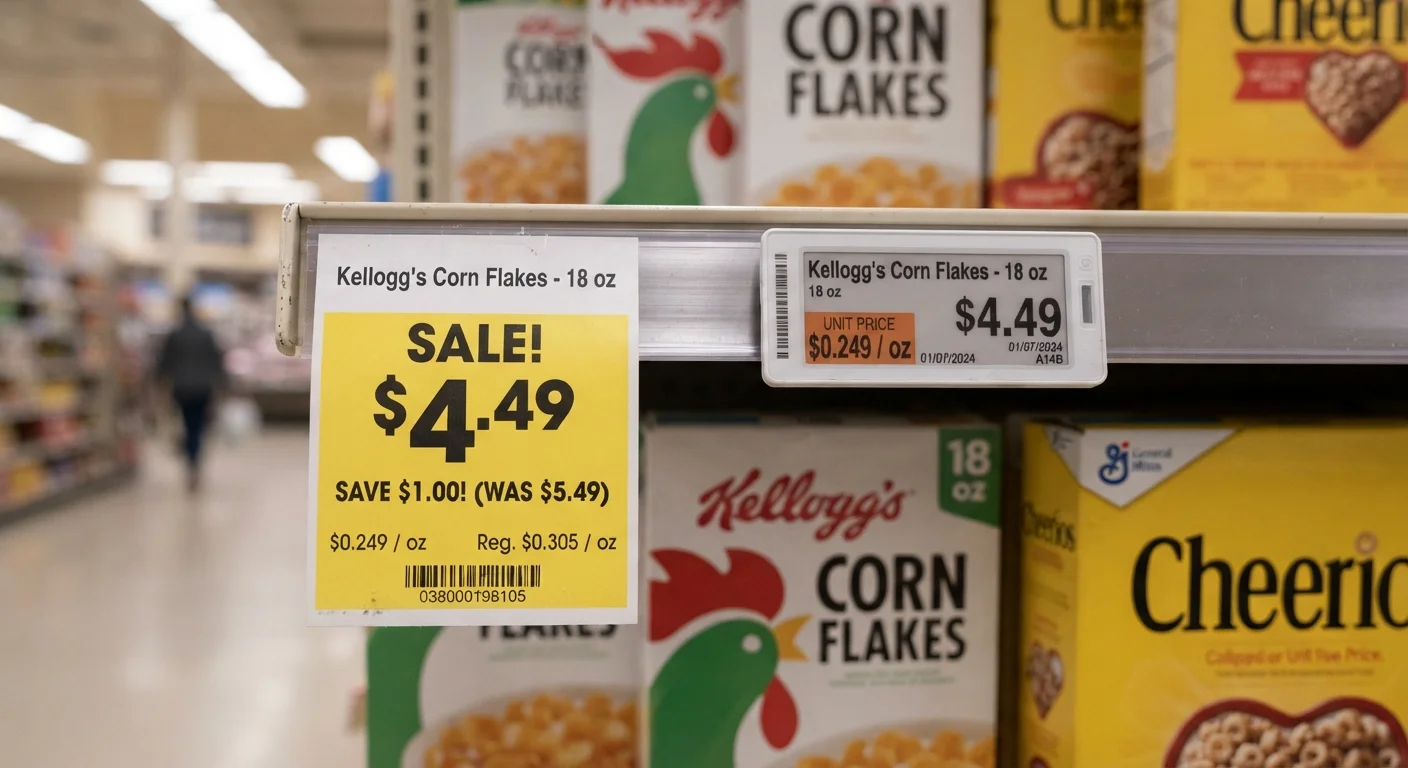
In the US, most large grocery retailers are required by state or local regulation to display unit pricing on shelf labels, though the requirement and format vary by jurisdiction. Look for the smaller print on the tag - often a figure like $0.22/oz or $1.14/ct. If it's absent, the math is simple: divide the sticker price by the quantity listed on the package.
For example: a 32-count box at $7.99 works out to roughly $0.25 per unit. A 50-count box at $11.49 comes to about $0.23 per unit. The sticker price is higher on the larger box, but the unit cost is lower - meaning you're paying less for each individual item.
~30%
Price difference unit pricing can reveal
Consumer research has found unit price differences of 20-30% or more between size variants of the same product that appear similarly priced at first glance.
Most US states
Jurisdictions with unit pricing laws for grocery stores
Unit pricing disclosure requirements for large grocery retailers exist in the majority of US states, though enforcement and display formats vary.
One important caveat: unit pricing comparisons only hold when you'll actually use the product before it expires or deteriorates. A larger container with a lower unit price isn't a saving if half of it goes to waste. This tension is covered in depth in the guide to buying in bulk, which examines when volume purchasing genuinely helps and when it quietly works against you.
It's also worth noting that promotional sticker prices can distort the picture. A "sale" tag may inflate the apparent savings while the unit price remains uncompetitive. Retail pricing tactics like anchor pricing often rely on shoppers fixating on the sticker rather than the rate.
Unit Comparisons Require the Same Measure
When comparing unit prices across products, make sure both labels use the same unit. One product might display cost per ounce while another shows cost per pound - these can't be compared directly without converting. Divide the price-per-pound figure by 16 to get the per-ounce equivalent, or multiply the per-ounce figure by 16 to match the per-pound display. Mismatched units are one of the most common sources of confusion when reading shelf tags.
When Each Metric Should Lead Your Decision
Neither sticker price nor unit price is universally superior - they answer different questions, and smart shoppers use both deliberately.
Lead with sticker price when: you're working within a hard spending limit per trip, checking if an item fits your weekly budget before anything else, or buying a one-time-use item where volume is irrelevant.
Lead with unit price when: you're buying any regularly consumed staple (cleaning products, pantry staples, personal care items), comparing products across size tiers or store formats, or evaluating whether a warehouse club membership is paying off.
The same logic applies well beyond the grocery store. Consider how the sticker price of a vehicle tells you very little about true ownership cost - a concept detailed in the breakdown of the true annual cost of owning a car. The principle is identical: the visible price is only the starting point.
For households tracking spending carefully, combining unit price checks with tools like price history and price alerts creates a more complete picture - confirming not just whether a unit price is competitive within a store, but whether it's competitive over time.
The habit of checking both numbers requires no special tools and adds seconds to a shopping decision. Over hundreds of routine purchases, that small shift in awareness tends to compound into meaningful, consistent savings.