

Key Takeaways
- Improving soil structure is the highest-leverage step for retaining moisture and reducing watering frequency.
- Native and regionally adapted plants typically require little to no supplemental irrigation once established.
- A 3-inch layer of organic mulch can cut soil moisture loss by up to 50 percent.
- Watering deeply and infrequently encourages deeper roots, making plants more resilient during dry spells.
- Grouping plants by water needs (hydrozoning) eliminates waste and simplifies maintenance.
- Drought-tolerant gardening reduces both water bills and the labor of regular watering schedules.
Why Water Efficiency Matters for Your Wallet
Outdoor watering accounts for roughly 30 percent of average household water use in the United States, according to the Environmental Protection Agency - and in drier climates that share can climb significantly higher. For budget-conscious homeowners, reducing that figure isn't just an environmental gesture; it translates directly to lower utility bills month after month.
Drought-tolerant gardening isn't about accepting a barren or neglected yard. Done well, it produces lush, layered landscapes that demand less time, less money, and far less water than a conventional lawn-and-annual setup. The core shift is moving from a high-input garden that depends on constant watering to one designed from the ground up to retain moisture and support resilient plants.
If you maintain a traditional lawn alongside these principles, the year-round lawn care calendar can help you balance water-wise habits with turf health across all four seasons.
~30%
Share of household water used outdoors
According to the U.S. Environmental Protection Agency, roughly 30 percent of average household water consumption is used for outdoor irrigation.
50%
Reduction in soil moisture loss from mulching
University extension research indicates that a proper mulch layer can cut evaporative soil moisture loss by up to 50 percent compared to bare soil.
9 billion
Gallons of water used daily for landscape irrigation in the US
The EPA estimates Americans use approximately 9 billion gallons of water per day for landscape irrigation, much of it applied inefficiently.
Start with the Soil
No amount of drought-tolerant plant selection will compensate for poor soil. Compacted, nutrient-depleted, or sandy soil drains too fast; heavy clay holds water but restricts root growth. Both conditions force plants to work harder - and push you to water more often.
The practical fix is organic matter. Compost worked 6-8 inches into planting beds improves drainage in clay soils and water retention in sandy ones, essentially moving both extremes toward a balanced loam. Aim to add 2-4 inches of compost when establishing new beds, and top-dress existing plantings annually.
A basic soil test (available inexpensively through many county cooperative extension offices) tells you your soil's pH and nutrient levels, so you can amend precisely rather than guessing. Getting your soil right upfront is the single most cost-effective investment in a low-water garden. See low-cost ways to improve your garden for DIY soil-building approaches that don't require a large budget.
Before purchasing any amendment, squeeze a handful of moist soil from your garden: if it crumbles easily when poked, you're close to ideal structure; if it smears like clay or falls apart instantly, prioritize compost additions before planting anything.
A simple manual soil test like this gives you instant, practical feedback and helps you avoid wasting money on plants that will struggle in unamended beds.
When selecting drought-tolerant plants, contact your local cooperative extension office or native plant society for a region-specific list - what thrives in the Pacific Southwest will fail in the humid Southeast.
Drought tolerance is always relative to your local climate; regionally adapted species outperform generic 'drought-tolerant' labels sold nationally.
Choosing Plants That Thrive with Less
Plant selection is where long-term water savings are won or lost. Native plants - species indigenous to your region - evolved alongside local rainfall patterns and are inherently adapted to periods of drought. Once established (typically after one to two growing seasons), many require little to no supplemental watering beyond natural rainfall.
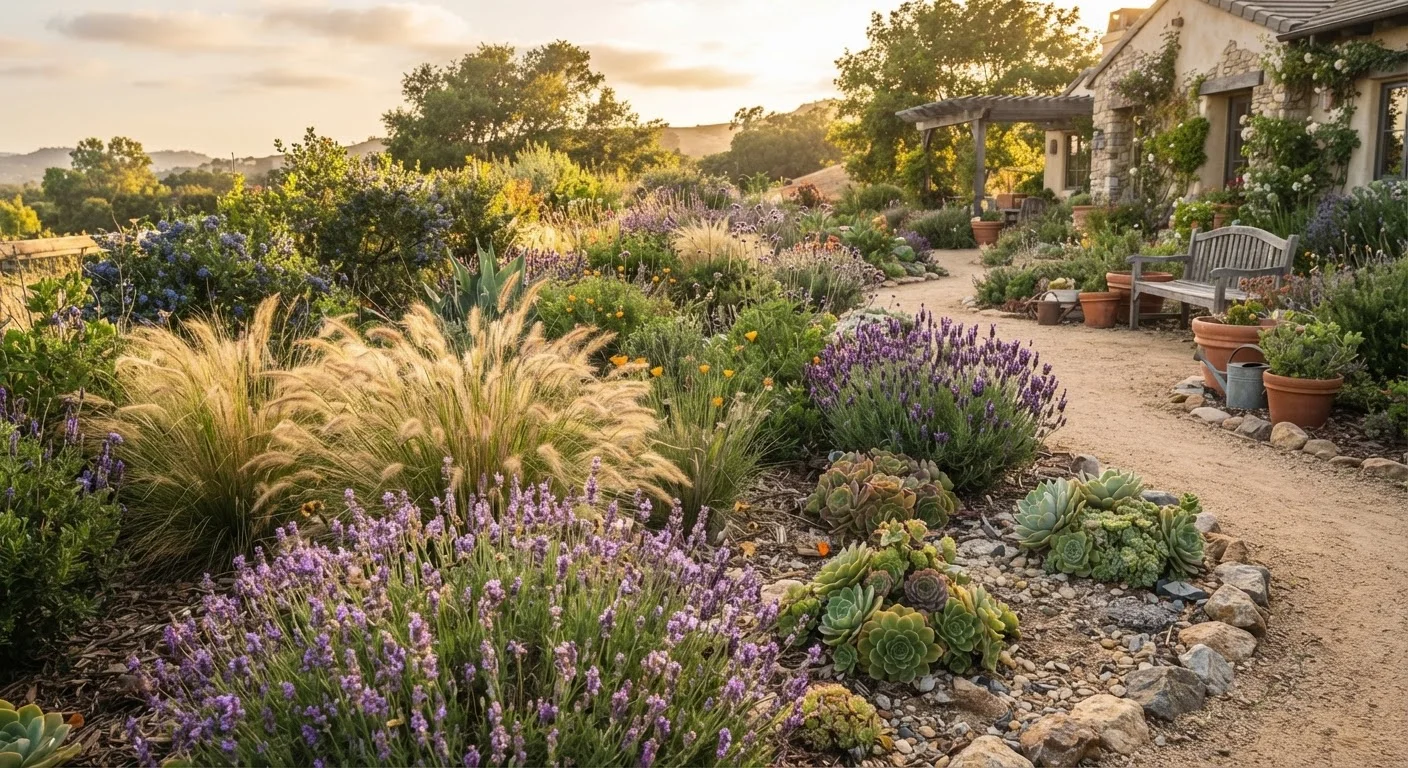
Beyond natives, look for plants labeled xeriscape-friendly or drought-tolerant by your local extension service. Common examples across US regions include lavender, black-eyed Susan, yarrow, ornamental grasses, coneflower (echinacea), and sedums. Mediterranean herbs such as rosemary, thyme, and oregano are also highly drought-resilient and practically useful.
Don't Skip the Establishment Phase
Drought-tolerant plants still need consistent watering during their first growing season to develop root systems deep enough to access soil moisture independently. Planting and then immediately withholding water is the most common reason drought-adapted plants fail in home gardens. Plan to water new plantings regularly for the first 8-12 weeks, then gradually reduce frequency.
Avoid the assumption that drought tolerance means zero water. Most drought-tolerant plants need regular watering during their first season while roots establish. After that, their water needs drop substantially. If you're also growing edibles, the beginner's guide to starting a vegetable garden covers water-intensive crops to plan around.
Mulching: The Simplest Water-Saving Move
If there is one action with an outsized return in drought-tolerant gardening, it is mulching. A 2-3 inch layer of organic mulch - shredded wood, straw, or composted bark - applied around plants creates a physical barrier that dramatically slows evaporation from the soil surface.
Research from university extension programs consistently shows that mulching can reduce soil moisture loss by 25-50 percent compared to bare soil, depending on conditions. It also suppresses weeds (which compete for water), regulates soil temperature, and breaks down over time to feed soil biology.
Keep mulch a few inches away from plant stems and tree trunks to prevent rot, and refresh the layer each spring as it decompresses. The material cost is often minimal - many municipalities offer free wood chip mulch from tree-trimming operations.
Free Mulch Is Often Available Nearby
Many municipal tree-trimming crews and utility companies offer free wood chip mulch to homeowners willing to pick it up or accept a drop-off. Check with your local parks department or search community listings. This can eliminate material costs entirely while diverting green waste from landfill.
Smarter Irrigation Habits
Even in a drought-tolerant garden, you'll water - especially during establishment or heat waves. How you water matters as much as how much you water. The most common mistake is frequent, shallow watering, which keeps roots near the surface and makes plants dependent on your intervention. Deep, infrequent watering - soaking the root zone and then letting soil partially dry before watering again - trains roots to grow deeper where soil stays cooler and moister longer.
Water in the early morning when possible. Evaporation rates are lowest, and foliage dries before nightfall, reducing disease risk. Drip irrigation or soaker hoses deliver water directly to the root zone, bypassing the inefficiency of overhead sprinklers. Many drip systems can be paired with simple timer controllers at modest cost.
For a deeper look at what common watering practices actually do to your plants, see watering myths that harm your garden.
Check Local Water Restriction Rules
Many US municipalities impose seasonal watering schedules or restrictions, particularly during drought declarations. Before installing an automated irrigation system or establishing a new garden, verify your local rules with your water utility. Violating restrictions can result in fines, and compliance often qualifies homeowners for rebates on water-efficient equipment.
Layout and Design Principles That Reduce Water Demand
Thoughtful garden layout amplifies every other strategy. Hydrozoning - grouping plants by their water requirements - is the foundational principle. When drought-tolerant plants share a zone and thirstier plants share another, you can calibrate irrigation precisely rather than over-watering the whole bed to satisfy the neediest plant.
Shade is a natural water conservator. Placing low-growing, moisture-sensitive plants in the shadow cast by larger shrubs or structures reduces their exposure to drying sun and wind. Similarly, swales (shallow channels graded into the landscape) can slow rainwater runoff and direct it toward planted areas, stretching every inch of natural rainfall.
Reducing lawn area is one of the highest-impact design changes available. Turf grass is among the most water-intensive garden elements. Replacing even a portion of lawn with groundcovers, gravel, or drought-adapted plantings can yield meaningful reductions in both water use and mowing time. The low-maintenance garden design guide covers practical groundcover and layout strategies that still look polished year-round.
“The single biggest water savings in the landscape comes not from choosing different plants, but from changing how and when you water the ones you already have.”
— Irrigation and water management researchers, University cooperative extension, landscape water use programs
EPA WaterSense Program
The EPA's WaterSense program offers free resources on outdoor water efficiency, including irrigation guidance, plant tips, and a landscape water budget calculator tailored to US climate zones.
Your State's Cooperative Extension Service
Land-grant university extension offices provide free, regionally specific plant lists, soil testing services, and irrigation advice - one of the most underused free resources available to home gardeners.
Local Native Plant Society
Native plant societies operate in most US states and offer plant sales, regional seed libraries, and expert advice on locally adapted, low-water species suited to your specific area.